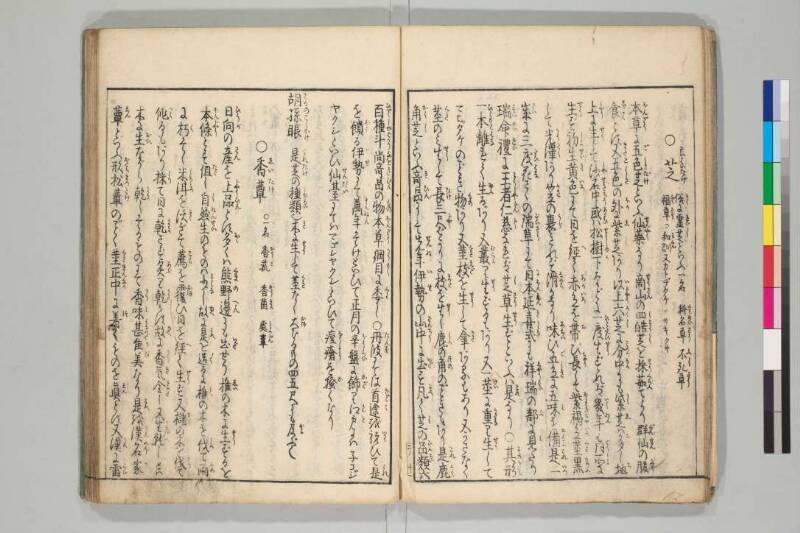
翻刻
【右丁】
○芝(さいはいたけ)《割書:俗(そく)に霊芝(れいし)といふ一名 科名草(くわめいさう) 不死草(ふしさう)|福草(ふくさう)◦和訓(わくん)ヌカトデタケ◦サキクサ》
本草(ほんざう)に五色芝(ごしきだけ)といふ仙薬(せんやく)なり商山(せうさん)の四皓(しこう)芝(し)を採(とり)茹(くらふ)てより群仙(ぐんせん)の服(ふく)
食(しよく)とす又(また)五色(こしき)の外(ほか)に紫芝(しし)あり以上(いじやう)六芝(ろくし)に分(わかつ)中(なか)にも紫芝(しし)は多(おゝ)し地(ち)
上(しやう)に生(せう)じて沙石中(しやせきちう)或(あるひ)は松樹下(せうしゆか)などに一度(ひとたび)生(せう)ずれば幾年(いくねん)も同所(どうしよ)に
生(せう)ず初生(しよせい)黄色(きいろ)にて日を経(へ)て赤色(あかいろ)を帯(お)び長(ちやう)して紫(むらさき)褐(ちや)色(いろ)茎(くき)黒(くろふ)
して光沢(かうたく)あり笠(かさ)の裏(うら)きれず滑(なめら)かなり味(あちは)ひ五色(ごしき)に五/味(み)を備(そなふ)是(これ)一(いつ)
歳(さい)に三/度(たひ)花(はな)さくの瑞草(ずいさう)にて日本(にほん)延喜式(ゑんきしき)にも祥瑞(しやうすい)の部(ぶ)に見(み)たり
瑞命礼(すいめいれい)に王者(わうしや)仁慈(じんじ)なれば芝草(しさう)生(せう)ずといふは是(これ)なり○其形(そのかたち)
一本(ひともと)離(はな)れて生(おふ)るあり又/叢(むらか)り生(せう)ずるもあり又一/茎(けい)に重(かさな)り生(せう)して
マヒタケのごとき物(もの)あり又/茎(くき)枝(えだ)を生(せう)して傘(かさ)あるもあり又かさなく
茎(くき)のみ生(せう)して長(たけ)三/尺(じやく)ばかりに枝(えた)を生(せう)し鹿(しか)の角(つの)のごときもあり是(これ)鹿(ろく)
角芝(かくし)といふ奇品(きひん)にして先年(せんねん)伊勢(いせ)の山中(さんちう)に出(いだ)す凡(すへ)て芝(し)の品類(ひんるい)六
【左丁】
百種(ひやくしゆ)斗(ばかり)尚(なを)奇品(きひん)の物(もの)本草綱目(ほんざうかうもく)に委(くわ)し○丹波(たんば)にては首途(かどて)を祝(いわ)ひて是(これ)
を饋(おく)る伊勢(いせ)にて万年(まんねん)たけといひて正月の辛盤(ほうらい)に飾(かざ)り江戸(ゑと)にはネコジ
ヤクシといひ仙台(せんだい)にてはマゴシヤクシといひて痘瘡(ほうそう)を掻(か)くなり
胡孫眼(さるのこしかけ) 是(これ)芝(たけ)の種類(しゆるい)也/木(き)に生(せう)じて茎(くき)なし大(おほ)なるもの四五尺にも及(およ)ぶ也
○香蕈(しいたけ) 《割書:○一名 香菰(かうこ) 香菌(かうきん) 処蕈(しよじん)|》
日向(ひうが)の産(さん)を上品(じやうひん)とす多(おゝ)くは熊野(くまの)辺(へん)にも出(いだ)せり椎(しい)の木に生(せう)ずるを
本條(ほんじやう)とす但(たゞ)し自然生(しねんせい)のものは少(すくな)し故(ゆへ)に是(これ)を造([つ]く)るに椎(しい)の木を伐(きつ)て雨(あめ)
に朽(く)たし米泔(しろみつ)を沃(そゝ)ぎて薦(こも)を覆(おほ)ひ日を経(へ)て生(せう)ず又/櫧(かし)の木を伐(きり)て
作(つく)るもあり採(とり)て日に乾(かわか)さず炙(あぶ)り乾(かわ)かす故(ゆへ)に香気(かうき)全(まつた)し又/生乾(きほ)しとは
木に生(おひ)ながら乾(かわか)したるものにて香味(かうみ)甚(はなはだ)佳美(かび)なり是(これ)を漢名(かんめう)家(か)
蕈(しん)といふ形(かたち)松蕈(まつたけ)のごとく茎(くき)正中(まんなか)に着(つ)くものを真(しん)とす又/漢(かん)に雷(らい)
現代語訳
【右丁】
○霊芝(さいはいたけ)《俗に霊芝という。一名、科名草・不死草・福草。和訓:ヌカトデタケ・サキクサ》
本草に五色芝という仙薬である。商山の四皓が芝を採って食べてより、多くの仙人たちの常食となった。また五色の外に紫芝があり、以上六芝に分かれる。中でも紫芝は多い。地上に生じて、砂石の中あるいは松の木の下などに、一度生じると何年も同じ場所に生える。初生のころは黄色で、日を経て赤色を帯び、成長すると紫褐色となる。茎は黒くて光沢があり、笠の裏はきめ細かく滑らかである。味わいは五色それぞれに五味を備える。これは一年に三度花を咲かせる瑞草であって、日本の延喜式にも祥瑞の部に見える。瑞命礼に「王者が仁慈であれば芝草が生ずる」というのはこれのことである。○その形については、一本独立して生えるものあり、また群れ生えるものもあり、また一茎に重なり生えてマイタケのようなものもあり、また茎に枝を生じて傘があるものもあり、またかさなく茎のみ生じて丈が三尺ばかりに枝を生じ、鹿の角のようなものもある。これを鹿角芝といい、奇品にして先年伊勢の山中に産出した。総じて芝の品類は六
【左丁】
百種ほどあり、さらに奇品のものは本草綱目に詳しい。○丹波では旅立ちを祝って、これを贈る。伊勢では万年たけといって正月の蓬莱飾りに飾り、江戸ではネコジャクシといい、仙台ではマゴジャクシといって痘瘡を掻くのに用いる。
胡孫眼(さるのこしかけ) これは芝の種類である。木に生じて茎はない。大きなものは四、五尺にも及ぶ。
○香蕈(しいたけ) 《一名:香菰・香菌・処蕈》
日向の産を上品とする。多くは熊野辺りにも産出する。椎の木に生えるのを本条とする。ただし自然生のものは少ない。故にこれを栽培するには、椎の木を伐って雨に朽たし、米のとぎ汁を注いで筵を覆い、日を経て生じさせる。また樫の木を伐って作るものもある。採って日に乾かさず、炙って乾かすので香気が全く保たれる。また「生干し」とは、木に生えたまま乾かしたものであり、香味が甚だ佳美である。これを漢名で家蕈という。形は松茸のようで、茎が正中に着くものを真(本物)とする。また漢に雷
英語訳
【Right Page】
○Reishi mushroom (saihaitake) 《Commonly called reishi (靈芝). Also known as: kameisō, fushisō, fukusō. Japanese readings: nukatodetake, sakikusa》
In the Honzō (Chinese materia medica), it is called the five-colored zhi, a divine herb. Since the Four Elders of Mount Shang gathered and ate zhi, it has become the regular food of immortals. In addition to the five colors, there is also purple zhi (shishi), making six varieties in total. Among these, purple zhi is most common. It grows from the ground, appearing in sandy or stony soil or beneath pine trees; once it grows in a spot, it returns to the same location for many years. When first sprouting it is yellow, then as days pass it takes on a reddish color, and when fully grown it becomes purplish-brown. The stem is black and lustrous, and the underside of the cap is finely textured and smooth. In terms of flavor, each of the five colors possesses one of the five tastes. This is an auspicious plant (zuisō) that blooms three times a year; it also appears in Japan's Engishiki under the section on auspicious omens. The Zuimeirei states that "when a ruler governs with benevolence and compassion, zhi grass grows"—this is precisely what is meant. ○As for its form: some grow as single, isolated specimens; others grow in clusters; others grow layered on a single stem, resembling maitake mushrooms; others produce branched stems with caps; and yet others produce only stems, growing to about three shaku in height with antler-like branches resembling a deer's horns. These are called rokkakushi (deer-antler zhi), a rare variety that was reportedly found in the mountains of Ise in recent years. In total, the varieties of zhi number around six
【Left Page】
hundred types; further details on rare varieties can be found in the Honzō Kōmoku (Bencao Gangmu). ○In Tanba province, these are given as a gift to celebrate someone's departure on a journey. In Ise they are called "man'nen-take" (ten-thousand-year mushroom) and are used as decoration on New Year's hōrai arrangements. In Edo they are called nekojakushi, and in Sendai they are called magojakushi, used for scratching smallpox sores.
Saruno-koshikake (Ganoderma/bracket fungus) This is a variety of zhi. It grows on trees and has no stem. Large specimens can reach four or five shaku in diameter.
○Shiitake 《Also known as: kōko, kōkin, shojin》
The product of Hyūga province is considered the finest quality. Large quantities are also produced in the Kumano region. Those that grow on chinquapin (shii) trees are considered the authentic variety. However, naturally occurring ones are rare. To cultivate them, chinquapin trees are cut down and left to rot in the rain; rice-washing water is poured over them, they are covered with rush matting, and after some days the mushrooms emerge. Some are also made by cutting oak trees. After harvesting, they are not dried in the sun but rather dried by roasting over fire, which fully preserves their fragrance. "Ki-boshi" (tree-dried) refers to those dried while still on the tree, which have an exceptionally fine flavor and aroma. These are called kashinjin in Chinese. In shape they resemble matsutake mushrooms; those whose stem attaches at the center of the cap are considered the genuine variety. Also, in China, thunder [the page continues...]