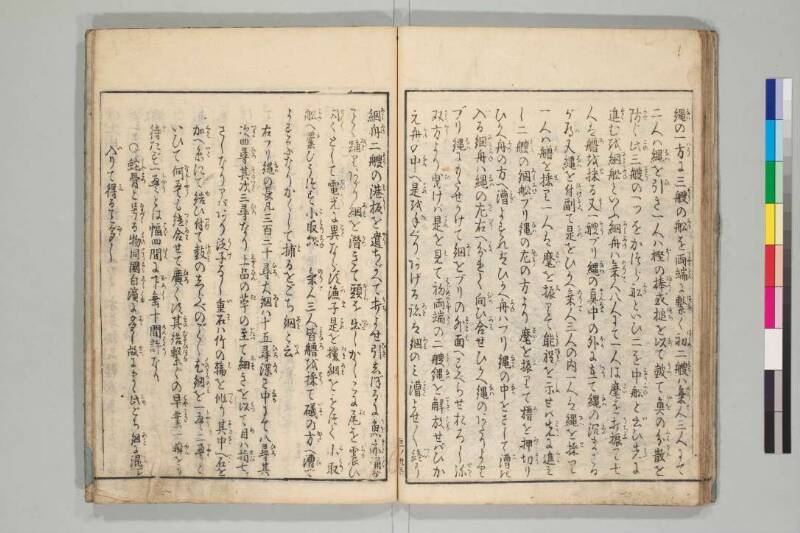
翻刻
【右丁】
縄(なは)の一方( はう)に三艘( ぞう)の船(ふね)を両端(りやうたん)に繋(つな)く初(はしめ)二艘( そう)は乗人(のりて)三人にて
二人は縄(なは)を引(ひ)き一人は樫(かし)の棒(ほう)或 槌(つち)を以(もつ)て鼓(うつ)て魚(うを)の分散(ふんさん)を
防(ふせ)ぐ此(この)三艘( そう)の一ッを《振り仮名:かつら船| ふね》といひ二を中船(なかふね)と云(い)ひ先(さき)に
進(すゝ)むを網船(あみふね)といふ網舟(あみふね)は乗人(のりて)八人にて一人は麾(さい)を打振(うちふ)り七
人は艪(ろ)を採(と)る又(また)一艘( そう)《振り仮名:ブリ縄| なは》の真中(まんなか)の外(ほか)に在(あり)て縄(なは)の沈(しづ)まざる
が為(ため)又 縄(なは)を付副(つけそへ)て是(これ)をひかへ乗人(のりて)三人の内一人は縄(なは)を採(と)り
一人は艪(ろ)を採(と)り一人は麾(さい)を振(ふ)りて能程(よきほど)を示(しめ)せば先(さき)に進(すゝ)み
し二艘( そう)の網船(あみふね)《振り仮名:ブリ縄| なは》の左(ひだり)の方より麾(さい)を振(ふ)りて櫓(ろ)を押切(おしきり)り
《振り仮名:ひかへ舟| ふね》の方へ漕(こぎ)よすれば《振り仮名:ひかへ舟| ふね》は《振り仮名:ブリ縄| なは》の中(なか)をさして漕(こ)ぎ
入(い)る網舟(あみふね)は縄(なは)の左右(さいう)へ分(わか)れて向(むか)ひ合(あわ)せ《振り仮名:ひかへ縄| なは》のあたりより
《振り仮名:ブリ縄| なは》にもたせかけて網(あみ)をブリの外面(そとも)へすべらせおろし弥(いよ〳〵)
双方(さうはう)より曳(ひ)けば是(これ)を見(み)て初(はじめ)両端(りやうたん)の二艘( そう)縄(なは)を解放(ときはな)せばひか
《振り仮名:え舟| ふね》の中(なか)へ是(これ)を手(た)ぐりあげる跡(あと)は網(あみ)のみ漕(こぎ)よせ〳〵終(つい)に
【左丁】
網舟(あみふね)二艘( そう)の港板(みよし)を遺(やり)#1ちがへて打(うち)よせ引(ひき)しぼるに魚(うを)亦(また)涌(わく)が
ごとく踊(おど)りあがり網(あみ)を潜(かつ)きて頭(かしら)を出(いだ)しかしこに尾(お)を震(ふる)ひ
《振り仮名:閃〳〵|せん 〳〵 》として電光(てんかう)に異(こと)ならず漁子(あま)是(これ)を攩網(たまあみ)をもつて小取(ことり)
船(ふね)へ■(す)#2ひうつす小取船(ことりふね)□乗人(のりて)三人 皆(みな)艪(ろ)を採(とり)て礒(いそ)の方(かた)へ漕(こひ)で
よするなりかくして捕(と)るを《振り仮名:ごち網| あみ》と云(いふ)
右《振り仮名:フリ縄| なは》の長凡三百二十尋( ひろ)大網( あみ)は十五尋( ひろ)深(ふか)さ中(なか)にて八尋( ひろ)其
次(つき)四尋( ひろ)其次(そのつぎ)三尋( ひろ)なり上品(じやうひん)の■(お)#3の至(いたつ)て細(ほそ)きを以(もつ)て目(め)は指(ゆび)七ッ
さしなりアバあり泛子(うけ)なし重石(いわ)は竹の輪(わ)を作(つく)り其中(そのなか)へ石(いし)を
加(くわ)へ糸(いと)にて結(ゆ)ひ付(つけ)て鼓(つゞみ)のしらべのごとく尤(もつとも)網(あみ)を一畳( じやう)二畳( じやう)と
いひて何畳(なんしやう)も継合(つきあわ)せて広(ひろ)くす其(その)結繋(むすひつな)ぐの早業(はやわさ)《振り仮名:一瞬| □ゆん#4》をも
待(ま)たず一畳( じやう)とは幅(はゞ)四間( けん)に下垂(おろし)十間( けん)許(ばかり)なり
○蛇骨(しやこつ)と号(なづく)る物(もの)同国(とうこく)白浜(しらはま)に多(おゝ)し故(ゆへ)にまゝ此(この)《振り仮名:ごち網| あみ》に混(こん)じ
入(い)りて得(え)ること多(おゝ)し
現代語訳
【右丁】
縄の一方に三艘の船を両端に繋ぐ。初めの二艘は乗組員三人にて、二人は縄を引き、一人は樫の棒あるいは槌を持って鼓を打ち、魚の分散を防ぐ。この三艘の一つを「かつら船」といい、二つ目を中船といい、先に進むものを網船という。網船は乗組員八人にて、一人は采配を打ち振り、七人は櫓を取る。また一艘が「ブリ縄」の真中の外にあって、縄が沈まないため、また縄を付け添えてこれを控え、乗組員三人のうち一人は縄を取り、一人は櫓を取り、一人は采配を振って良い頃合いを示せば、先に進んだ二艘の網船が「ブリ縄」の左の方より采配を振って櫓を押し切り、「ひかえ舟」の方へ漕ぎ寄せれば、「ひかえ舟」は「ブリ縄」の中を指して漕ぎ入る。網船は縄の左右へ分かれて向かい合わせ、「ひかえ縄」のあたりより「ブリ縄」にもたせかけて網をブリの外面へ滑らせ下ろし、いよいよ双方より曳けば、これを見て初めの両端の二艘が縄を解き放せば、「ひかえ舟」の中へこれを手繰り上げる。後は網のみ漕ぎ寄せ寄せ、ついに
【左丁】
網船二艘の舳先を違い違いにして打ち寄せ、引き絞るに、魚もまた湧くがごとく踊り上がり、網を潜って頭を出し、あちこちに尾を震わせ、閃々として電光に異ならず。漁師はこれを玉網をもって小取船へすくい移す。小取船は乗組員三人、皆櫓を取って磯の方へ漕いで寄せるなり。かくして捕るものを「ごち網」という。
右の「フリ縄」の長さおよそ三百二十尋、大網は十五尋、深さ中にて八尋、その次四尋、その次三尋なり。上品の麻の至って細きを以って目は指七つ差しなり。浮きあり、浮子なし。重石は竹の輪を作り、その中へ石を加え、糸にて結び付けて鼓の調べのごとく、もっとも網を一畳二畳といって何畳も継ぎ合わせて広くす。その結び繋ぐ早業は一瞬をも待たず。一畳とは幅四間に下垂十間ばかりなり。
○蛇骨と号する物、同国白浜に多し。故にしばしばこの「ごち網」に混じ入りて得ること多し。
英語訳
【Right page】
Three boats are tied to both ends of one side of the rope. The first two boats have a crew of three people each: two people pull the rope, and one person uses a oak stick or mallet to beat drums to prevent the fish from scattering. One of these three boats is called "katsura-bune," the second is called "naka-bune" (middle boat), and the one that advances first is called "ami-bune" (net boat). The net boat has a crew of eight people: one person waves a command baton, and seven people handle the oars. Another boat stays outside the center of the "buri-nawa" (yellowtail rope) to prevent the rope from sinking, and also has an additional rope attached as a control line. Of its three crew members, one handles the rope, one handles the oars, and one waves a baton to signal the right timing. When the two net boats that advanced first wave their batons from the left side of the "buri-nawa" and push their oars to row toward the "hikae-bune" (control boat), the control boat rows into the center of the "buri-nawa." The net boats separate to the left and right of the rope to face each other, lean against the "buri-nawa" from around the "hikae-nawa" (control rope), slide the net down to the outer side of the yellowtail school, and pull from both sides. Seeing this, the initial two boats at both ends release the rope, which is then hauled up into the control boat. After that, only the nets are rowed closer and closer until finally
【Left page】
The two net boats position their bows in alternating fashion, close in, and tighten the net. The fish also leap up as if boiling, diving under the net and sticking their heads out, shaking their tails here and there, flashing like lightning. The fishermen scoop them up with hand nets and transfer them to small collection boats. The collection boats have three crew members, all handling oars to row toward the shore. This method of catching is called "gochi-ami" (five-wisdom net).
The length of the aforementioned "furi-nawa" is approximately 320 fathoms, the large net is 15 fathoms, with a depth of 8 fathoms in the center, then 4 fathoms, then 3 fathoms. Made with the finest hemp, the mesh size is seven finger-widths. There are floats but no buoys. The sinkers are made by creating bamboo rings, adding stones inside them, and tying them with thread like the tuning of a drum. The nets are made by joining multiple sections called "one mat," "two mats," and so on to make them wider. The quick technique of tying and connecting takes less than an instant. One "mat" is about 4 ken wide and hangs down about 10 ken.
○ A thing called "snake bone" is abundant in Shirahama in the same province. Therefore, it is often caught mixed in with this "gochi-ami."