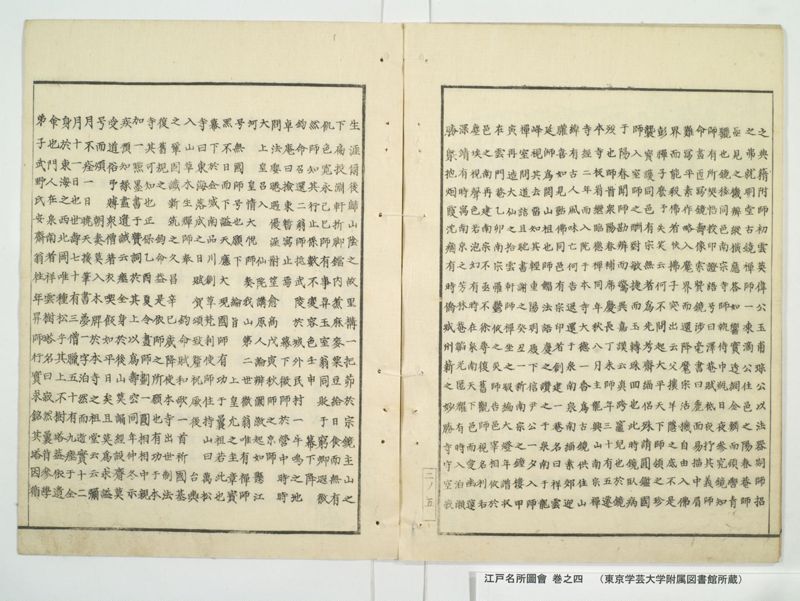
翻刻
【右丁】
之典籍附師初雲英偉公玉甫琮公以法器期師招
之弗就明堂古鏡禪師一凍滴公住邑之陽春菴師
亟見之機辨縱横應答如響實透網金鱗而頓轡青
驪也鏡移同邑南宗寺師執侍巾瓶日夜參究鏡知
師有所契悟授印證語号曰澤菴賦祗夜抒其義師
命𦘕匠冩鏡壽像索贊鏡渉毫書曰麁面易描中眉
難冩平素作略入魔界而還降魔宗活機自由入佛
界而能殺佛者快拂子突出云父攘羊隱之底不是
彭禪子麼《割書:予》失笑云何不問起大平天下師領之珍
襲寳護同邑有宗無者爲先考齋緇侶殊請圓鑑國
師入室師之酬對敏捷而玉轉珠囬也此時鏡臥病
于陽春聞師勘辨而驚異嘉謨云眞跨竈兒也於鏡
殁也師𩠐衆陽春補席慶長丁未師年三十有五遷
本寺板𩠐#1繼臨德禪同年秋八月主龍興山南宗禪
寺經二年而入院于本寺大德一香爲古鏡供住山
綽有古人風味亡何告退#2還于泉南泉南緇素郊迎
驩喜如見𰈫#8佛同邑有宗印者創建一菴名曰祥雲
延師爲開山祖也師𪛋法語慶之讚之于泉南于龍
峰視其去畱知其輕重陽𠯲#3殿下信尹公一夕入師
禪室問道詰且馳書謝之癸丒一新南宗之鐘樓甲
寅再造大仙之拾雲軒師禪坐之暇編大燈年譜収
在雲門菴乙卯南宗罹#4鬱攸之災師告邑宰相攸於
邑之南再建南宗不亟不徐尋復𦾔觀師視名利若#5
塵埃視聲色若泡幻有時在泉南天下邑而愛幽䆳
深靖有時寓南京之芳林菴韜光匿耀有時入泊瀬
勝槩抱𤇆霞沈痼有時僑城州薪之妙勝寺守空寂
【左丁】
生涯爾後歸山陰之故里構一把茆於宗鏡主山之
下扁投淵軒折脚鐺内煮麻麥粟豆給日食而無有
飢色寛永己巳師有事𢌱#6玉室翁同貶于窮卿遐徼
然師知其行止係數不變容色壬申 幕下降
鈞命召還二翁師抵武陵於城外民村一牛鳴之地
卓庵曰撿束暫寓止焉 幕下徵師於營中時時
問法𡢗睠遇優渥𡬹望愈高戊寅秋師之京師
大上皇召入 仙院講原人論辨瀾激起如懸江
河 皇情大悅師奏我山第二世徹翁唯有禪師
号無國師号也願下 綸旨 上皇允之圭章寳
黑不日而下謚天應大現國師有功于曩祖若此也
幕下於金城南品川創草梵刹使師住持山曰萬松
寺曰東海落成之日賦賀頌𦤺𨤲祝厥後 台輿
入山草木生輝師奉 鈞命賦和歌一首祈國基
之鞏固䜟新筑之久昌辛巳歲降使本寺出世制法
復𦾔規之 鈞命葢是依師之所願也有功于本
寺其可知也正保乙酉夏令𦘕師劃一圓相相中親
加一點墨書于贊詞於其上以爲壽㝐同年仲冬示
疾預知縁盡遺誡云瘞全身於後山莫誦經設齋莫
受道俗弔賻衆僧著衣喫飯如平日矣且莫爲求謚
号而煩 朝奏莫入木牌於本寺之祖堂云云彌
月不痊一日暁天授筆書夢一字泊然而逝實十二
月十一日也世壽七十有三僧臘五十有九瘞于全
身於東海之西北岡唯種松乎其上不樹塔葢依遺
𫝇也門人在泉南者祥雲樹塔名曰寂然曩昔參學
弟子武野氏安齋翁往年昇師行實求銘其塔因循
現代語訳
【右丁】
その典籍を師に附した。初め雲英偉公・玉甫琮公が師を法器として期待し招いたが、就かなかった。明堂古鏡禅師(一凍滴公)が邑の陽春庵に住していたので、師はすぐに謁見した。機辨縦横、応答は響くが如く、まさに網を透る金鱗、青驪の轡を突然引き止めるほどの人物であった。古鏡が同邑の南宗寺に移ると、師は侍者として巾瓶を執り、日夜参究した。古鏡は師が契悟するところあることを知り、印証の語を授けて「沢菴」と号させ、祗夜(偈頌)を賦してその義を述べた。師は画匠に命じて古鏡の寿像を写させ、賛を求めた。古鏡は筆を執って書した、「麁面は描き易く、中眉は写し難し。平素の作略は魔界に入りて還り、魔宗を降す。活機自由に仏界に入りて、よく仏を殺す者、快い拂子が突出する。云う、父の羊を攘みてこれを隠すの底、彭禅子にあらずや。予(古鏡)は失笑し、云う、何ぞ天下太平を起こすことを問わざると」と。師はこれを大切に領有し、珍しき宝として護持した。同邑に宗無という者があり、先考の斎のために緇侶を殊に請じ、円鑑国師を入室させた。師の酬対は敏捷にして、玉が転じ珠が廻るが如しであった。この時、古鏡は陽春に病臥しており、師の勘辨を聞いて驚き異として嘉謨に云った、「まことに竈を跨ぐ児(逸材)じゃ」と。古鏡が没すると、師は衆に頂かれて陽春の席を補い、慶長丁未(十二年、1607年)、師年三十五にして本寺の板頭に遷り、臨徳禅を継いだ。同年秋八月、龍興山南宗禅寺の住持となった。二年を経て大徳本寺に入院し、古鏡の一香として供し、住山するに古人の風味が綽然としてあった。いくばくもなく退去を告げ、泉南に還った。泉南の緇素(僧俗)は郊外に出迎え、まるで活仏を見るが如く歓喜した。同邑に宗印という者が一庵を創建し、祥雲と名付け、師を延いて開山祖とした。師は法語を賦し、これを慶賀し、泉南・龍峰においてその去留を視てその軽重を知った。陽(春)殿下信尹公がある夕べ師の禅室に入り道を問い詰め、かつ書を馳せてこれに謝した。癸丑(1613年)に南宗の鐘楼を一新し、甲寅(1614年)に大仙の拾雲軒を再造した。師は禅坐の暇に大燈年譜を編み、雲門庵に収めた。乙卯(1615年)に南宗が火災に罹り、師は邑宰に告げて邑の南に再建を相謀り、急がず徐ろに、ついに旧観を復した。師は名利を塵埃のごとく視、声色を泡幻のごとく視た。時に泉南天下邑にあって幽邃深静を愛し、時に南京の芳林庵に寓して韜光匿耀し、時に泊瀬の勝景に入って霞を抱き沈痼を癒し、時に城州薪の妙勝寺に寄寓して空寂を守った。
【左丁】
生涯、その後、山陰の故里に帰り、宗鏡主山の下に一把の茅を構えて「投淵軒」と扁額し、折れた脚の鐺(釜)の内で麻・麦・粟・豆を煮て日々の食に充てたが、飢えた色はなかった。寛永己巳(六年、1629年)、師は玉室翁と共に事があって、ともに窮郷遠境に貶せられた。しかし師はその行止が数に係ることを知り、顔色を変えなかった。壬申(寛永九年、1632年)、幕府より鈞命を降して二翁を召還した。師は武陵(江戸)に至り、城外の民村、牛の一鳴する程の地に庵を卓てて「撿束」と曰い、しばらく寓止した。幕府は師を営中に徴して、時々法を問い、眷遇は優渥で、声望はますます高まった。戊寅(寛永十五年、1638年)秋、師は京師に上り、大上皇(後水尾上皇)が仙院に召し入れ、原人論を講じると弁論が激して懸かる江河の如しであった。皇情は大いに悦び、師は「我が山(大徳寺)の第二世徹翁唯有禅師には禅師号があるが国師号がない、どうか綸旨をお下しいただきたい」と奏した。上皇はこれを允可し、圭章宝黒は日を待たずして下り、「天応大現国師」と謚された。曩祖(大燈国師)への功はかくの如くである。幕府は金城(江戸城)南の品川に草の梵刹を創って師に住持させ、山を萬松寺・東海と称した。落成の日、賀頌を賦し祝った。その後、台輿(将軍の輿)が入山して草木も輝きを生じた。師は鈞命を奉じて和歌一首を賦し、国基の鞏固を祈り、新築の久昌を諟(祈)った。辛巳(寛永十八年、1641年)、使を本寺(大徳寺)に降して出世の制法を復し旧規を定めた。鈞命はけだし師の所願によるものである。本寺への功はこれで知られよう。正保乙酉(二年、1645年)夏、画師に命じて師の一円相を劃かせ、その中に親ら一点を加え、墨書してその上に賛詞を書き、これを寿贈とした。同年仲冬、病を示し、縁の尽きるを預め知り、遺誡して云った、「全身を後山に瘞めよ。経を誦し斎を設けるな。道俗の弔賻を受けるな。衆僧は衣を著け飯を喫するよう平日の如くにせよ。かつ諡号を求めて朝奏を煩わすな。本寺の祖堂に木牌を入れるな」云々と。弥月経ても癒えず、ある日の暁天に筆を授かり「夢」の一字を書して、泊然として逝った。まことに十二月十一日である。世寿七十三、僧臘五十九。全身を東海の西北の岡に瘞め、ただ松をその上に種えて塔を樹てなかった。けだし遺言によるものである。門人で泉南にいる者たちは、祥雲(庵)に塔を樹て「寂然」と名付けた。かつての参学弟子、武野氏安斎翁は往年に師の行実を昇(まとめ)めて、その塔の銘を求めた。因循して
英語訳
【Right Page】
...he bequeathed his collection of texts to the master. At first, Masters Un'ei Ikō and Gyokuho Sō invited the master, expecting him to be a vessel of the dharma, but he did not accept. When the Meido Kokyō Zen Master (known as Ittōteki) resided at the Yōshun-an hermitage in the same district, the master immediately sought an audience with him. His doctrinal discourse was free-ranging and wide-ranging, his responses rang out like echoes—truly he was a golden carp slipping through the net, a green stallion brought to a sudden halt. When Kokyō moved to Nansō-ji in the same district, the master served as his attendant, carrying towel and water-vessel, pursuing his studies day and night. Kokyō, knowing that the master had achieved a certain enlightenment, bestowed upon him a certificate of dharma transmission and gave him the name "Takuan," composing a verse (gāthā) to expound its meaning. The master commissioned a painter to copy Kokyō's portrait from life and asked for an inscription. Kokyō took up his brush and wrote: "The coarse face is easy to paint, but the inner brow is difficult to capture. In ordinary stratagems, one enters the realm of demons and returns, subduing the demonic school. With the living mechanism freely entering the realm of Buddha, able even to slay the Buddha—with a swift flick of the whisk, it suddenly bursts forth. One says: is not the one who steals his father's sheep and conceals it none other than the Zen monk Hō? I (Kokyō) burst out laughing and say: why do you not ask about bringing great peace to the realm?" The master received this as a precious treasure and guarded it dearly. In the same district there was a man named Sōmu who specially invited members of the clergy for a memorial rite for his late father and requested that National Master Enkan preside over the dharma interview. The master's responses were quick and agile, like jade rolling and pearls turning. At this time, Kokyō was bedridden at Yōshun and, hearing of the master's keen exchanges, was amazed and delighted, saying in admiration: "Truly, this is a child who has leapt over the stove (a rare prodigy)!" When Kokyō passed away, the master was elevated by the congregation to fill the seat at Yōshun. In the year Keichō Hinoto-Hitsuji (1607), when the master was thirty-five, he was appointed head of the board at the home temple, succeeding Rintoku Zen. In the eighth month of the same autumn, he became abbot of Ryūkōzan Nansō Zen temple. After two years, he entered the ranks at Daitoku (Daitokuji), serving as a memorial incense offering for Kokyō. His manner of residing on the mountain had the relaxed flavor of the ancients. Before long, he announced his retirement and returned to Sennan. The clergy and laity of Sennan went out to the suburbs to welcome him, rejoicing as if they were seeing a living Buddha. A man named Sōin in the same district founded a hermitage, named it Shōun, and invited the master to be its founding abbot. The master composed a dharma verse to celebrate and praise it. In Sennan and Ryūhō, watching whether people came or stayed, one could gauge their priorities. Lord Nobukimi of the Yō (Haru) household one evening entered the master's Zen chamber and questioned him about the Way, also sending a letter of thanks. In the year Mizunoto-Ushi (1613), the bell tower of Nansōji was entirely rebuilt; in the year Kinoe-Tora (1614), the Jūunken of Daisen was reconstructed. In the spare moments between Zen sittings, the master compiled the Daitō Chronology, which was preserved at Unmon-an. In the year Kinoto-U (1615), Nansōji suffered a devastating fire; the master consulted with the district magistrate and together they arranged for its reconstruction to the south of the district—neither hastily nor slowly—and in due course the temple's former appearance was restored. The master regarded fame and profit as dust and ashes, and sound and color as bubbles and illusions. At times he stayed in Sennan's tranquil district, loving its secluded and deep quietude; at times he lodged at Hōrin-an in Nankyo (Kyoto), concealing his brilliance; at times he entered the scenic area of Hase, embracing the mist and nurturing his spirit; at times he resided at Myōshōji in Shinanoki of Jōshū, preserving the void and stillness.
【Left Page】
Throughout his life, he eventually returned to his native place in San'in and built a small thatched hut at the foot of the main mountain of Sōkyōji, naming it "Tōen-ken" (Pavilion of Casting Into the Deep). In a pot with a broken leg, he cooked hemp, wheat, millet, and beans for his daily meals, yet showed no sign of hunger. In the year Kanei Tsuchinoto-Mi (1629), the master had occasion to share banishment with Master Gyokushitsu to a remote and desolate place. Yet knowing that his comings and goings were determined by fate, he did not change his expression. In the year Mizunoe-Saru (Kanei 9, 1632), the shogunate issued an order recalling both masters. The master arrived at Buryō (Edo) and erected a small hermitage on the outskirts of the city in a village, within earshot of a single cow's lowing, calling it "Kensoku" (Restraint), where he temporarily resided. The shogunate summoned the master to the castle compound, frequently asking about the dharma, and treated him with generous favor; his reputation grew ever higher. In the autumn of the year Tsuchinoe-Tora (Kanei 15, 1638), the master went up to the capital, where the Retired Emperor (ex-Emperor Go-Mizunoo) summoned him into the imperial retreat and he lectured on the *Yuanren Lun* (Treatise on the Origin of Man); his eloquence surged like a great river pouring down. The imperial heart was greatly pleased. The master memorialized: "The Second Abbot of our temple (Daitokuji), Tettō Yuiyū Zen Master, has the title of Zen Master but lacks the title of National Master; we humbly request that an imperial decree be issued." The Retired Emperor approved, and the imperial document with its precious black seal was issued without delay; the posthumous title "Tennō Daigen Kokushi" (National Master of Heavenly Response and Great Manifestation) was granted. His contribution to the ancestral founder was thus accomplished. The shogunate built a modest temple to the south of Kinshiro (Edo Castle) at Shinagawa and had the master serve as its abbot; the mountain was called Banshōji and the temple Tōkai. On the day of its completion, a celebratory verse was composed and offered in praise. Thereafter, when the shogunal palanquin entered the mountain, even the trees and grasses seemed to shine with radiance. Receiving the shogunal command, the master composed a waka poem praying for the firm foundation of the nation and for the enduring prosperity of the newly built temple. In the year Kanei Tsuchinoto-Mi (1641), an envoy was dispatched to the home temple (Daitokuji) to restore the regulations governing the temple's institutional ceremonies, reinstating the former rules. That this command was issued was due to the master's wishes. His contributions to the home temple may be understood from this. In the summer of the second year of Shōhō (1645), a painter was commissioned to paint a single enso (Zen circle) by the master; the master personally added a single dot to the center, wrote an inscription above it in ink, and presented it as a birthday gift. In the middle of winter of that same year, he fell ill, foreknowing that his karmic bonds were exhausted, and left these final instructions: "Bury my whole body in the mountain behind the temple. Do not chant sutras or hold memorial feasts. Do not accept condolences or funeral offerings from monastics or laypeople. The monks should put on their robes and eat their meals as on any ordinary day. Furthermore, do not trouble the court with memorials seeking a posthumous title. Do not place a memorial tablet in the founder's hall of the home temple," and so forth. A full month passed without recovery. One morning at dawn, he took up a brush, wrote the single character 夢 (Dream), and passed away peacefully. It was truly the eleventh day of the twelfth month. His worldly age was seventy-three; his monastic seniority was fifty-nine years. His whole body was buried on the hill to the northwest of Tōkai, with only pine trees planted above—no pagoda was erected, following his dying wishes. His disciples in Sennan erected a pagoda at Shōun-an and named it "Jakunen" (Serene Stillness). A former disciple, Master Ansai of the Takeno clan, had in previous years compiled an account of the master's deeds and sought an inscription for the pagoda, but the matter was repeatedly delayed...