翻刻
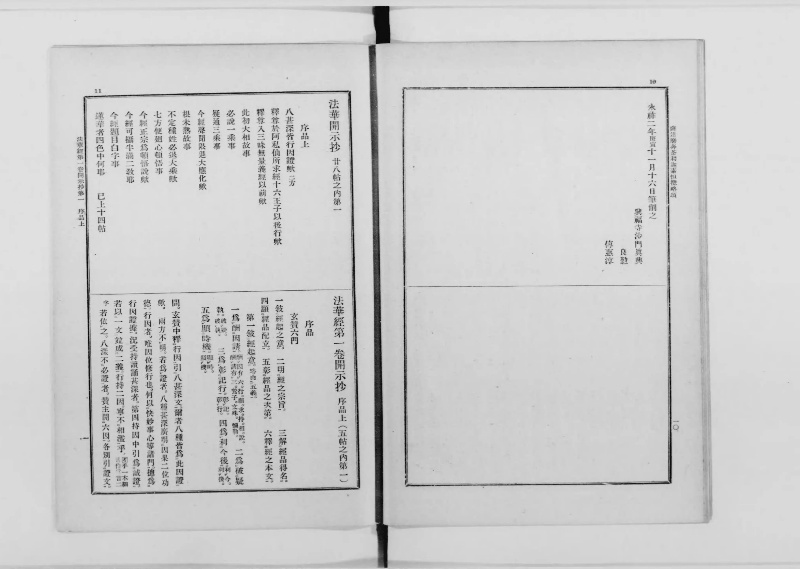
【右頁 薩達磨奔荼利迦素怛攬略頌一巻の最終頁】
永祚二年《割書:庚寅》十一月十六日筆削之
興福寺沙門眞興
良懃
傳惠淳
【左頁】
【一頁上段】
法華開示抄 廿八帖之内第一
序品上
八甚深皆行因證歟《割書:二方》
釈尊於阿私仙所求經十六王子以後行歟
釈尊入三昧無量義經以前歟
此初大相故事
必說一乘事
疑通三乘事
今經聲聞限退大應化歟
根未熟故事
不定種姓必退大乘歟
七方便廻心頓悟事
今經正宗爲頓悟說歟
今經可攝半滿二敎耶
今經題目白字事
蓮華者四色中何耶 已上十四帖
【一頁下段】
法華經第一卷開示抄《割書:序品上(五帖之内第一)》
序品
玄贊六門
一敍_二經起之意_一。 二明_二經之宗旨_一。 三解_二經品得名_一。
四顯_二經品配立_一。 五彰_二經品之次第_一。 六釋_二經之本文_一。
第一敍_二經起意。《割書:略由《返り点:二》五義_一。》
一爲_レ酬_二因請_一。《割書:酬_レ因有《返り点:レ》六。行。願。求。持。相。說。|酬_レ請有《返り点:レ》三。鶖子。文殊。弥勒。》 二爲_レ破_二疑
執_一。《割書:破_レ疑。|破_レ執。》 三爲_レ彰_二記行_一。《割書:彰_レ記。|彰_レ行。》 四爲_レ利_二今後。《割書:利_レ今。|利_レ後。》
五爲_レ顯_二時機_一。《割書:顯_レ時。|顯_レ機。》
問。玄贊中釋_二行因_一引《返り点:二》八甚深文_一。爾者八種皆爲_二此因證_一
歟。 兩方不_レ明。若爲_レ證者。八種甚深廣明_二因果二位功
德_一。行因者。唯因位修行也。何以_二快妙事心等諸門_一。摠爲_二。
行因證據_一。況受持讀誦甚深者。第四持因中引爲_二誠證_一。
若以《返り点:二》一文_一竝成《返り点:二》二義_一。行持二因。寧不_二相濫_一乎。《割書:《振り仮名:■|#3》乎一本細|書作爲言二》
《割書:字》若依_レ之。八深不_二必證_一者。贊主開《返り点:二》六因_一。各別引_二證文_一。
現代語訳
【右頁 薩達磨奔荼利迦素怛攬略頌一巻の最終頁】
永祚2年(庚寅)11月16日に筆削した
興福寺沙門真興
良懃
伝恵淳
【左頁】
【一頁上段】
法華開示抄 全28帖のうち第1帖
序品上
八甚深は皆行因の証拠であろうか(二つの見方がある)
釈尊が阿私仙のもとで経を求めた十六王子以後の修行であろうか
釈尊が三昧に入ったのは無量義経以前であろうか
この最初の大相の出来事
必ず一乗を説く出来事
三乗への疑いが通じる出来事
今の経では声聞に限って大乗から退転するのは応化身であろうか
根機がまだ熟していない出来事
不定種姓は必ず大乗から退転するであろうか
七方便の回心頓悟の出来事
今の経の正宗は頓悟のための説法であろうか
今の経は半教満教の二教に摂められるべきであろうか
今の経の題目の白字の出来事
蓮華は四色のうちどれであろうか 以上十四帖
【一頁下段】
法華経第1巻開示抄(序品上・五帖のうち第一)
序品
玄贊の六門
一、経の起こりの意を述べる。二、経の宗旨を明らかにする。三、経品の得名を解釈する。
四、経品の配立を顕わす。五、経品の次第を明らかにする。六、経の本文を釈する。
第一 経の起こりの意を述べる。(略して五つの意義による)
一、因請に酬いるため。(因に酬いるには六つある:行・願・求・持・相・説|請に酬いるには三つある:舎利弗・文殊・弥勒)二、疑執を破るため。(疑を破る|執を破る)三、記行を彰すため。(記を彰す|行を彰す)四、今後を利するため。(今を利する|後を利する)
五、時機を顕すため。(時を顕す|機を顕す)
問い。玄贊中で行因を釈する際に八甚深の文を引用している。それでは八種すべてがこの因の証拠となるのであろうか。両方ともに明らかでない。もし証拠とするならば、八種甚深は広く因果二位の功徳を明らかにしている。行因とは、ただ因位の修行である。なぜ快妙事心等の諸門をもって、総じて行因の証拠とするのか。況んや受持読誦甚深は、第四持因中に引いて誠の証拠とする。
もし一文をもって並べて二義を成すならば、行持二因がどうして相い混同しないであろうか。(一本には細書で「言」の字を作る)
もしこれに依れば、八深は必ずしも証拠とならないとするなら、贊主は六因を開いて、各別に証文を引いている。
英語訳
【Right Page - Final page of the Saddharma-puṇḍarīka Sūtra Summary in One Volume】
Revised on the 16th day of the 11th month of Eiso 2 (Kanoe-tora year)
Monk Shinkō of Kōfukuji Temple
Ryōkin
Den Ejun
【Left Page】
【Upper section of page one】
Lotus Sutra Commentary - Volume 1 of 28 volumes total
Introductory Chapter, Part 1
Are all eight profound aspects evidence of practicing causes? (Two perspectives exist)
Are the practices after the sixteen princes when Shakyamuni sought the sutra from the hermit Āḷāra?
Did Shakyamuni enter samādhi before the Immeasurable Meanings Sutra?
This matter of the first great sign
The matter of necessarily expounding the One Vehicle
The matter of doubts penetrating the Three Vehicles
In this sutra, is it only for śrāvakas that retreating from the Great Vehicle represents a transformation body?
The matter of roots not yet being mature
Do those of indeterminate lineage necessarily retreat from the Mahāyāna?
The matter of the seven expedient means and sudden awakening through turning the mind
Is the main doctrine of this sutra expounded for sudden awakening?
Should this sutra be included in the two teachings of partial and complete?
The matter of white letters in this sutra's title
Which of the four colors is the lotus? Above fourteen fascicles
【Lower section of page one】
Commentary on Lotus Sutra Volume 1 (Introductory Chapter, Part 1 - First of Five Fascicles)
Introductory Chapter
Six Gates of Xuanzan Commentary
1. Explain the intention behind the sutra's origin. 2. Clarify the sutra's fundamental doctrine. 3. Interpret how the sutra chapters got their names.
4. Show the arrangement of the sutra chapters. 5. Clarify the sequence of the sutra chapters. 6. Explain the main text of the sutra.
First Gate: Explaining the intention behind the sutra's origin (briefly through five meanings)
1. To respond to causal requests. (Responding to causes has six: practice, vows, seeking, upholding, characteristics, expounding | Responding to requests has three: Śāriputra, Mañjuśrī, Maitreya) 2. To destroy doubts and attachments. (Destroying doubts | Destroying attachments) 3. To manifest predictions and practices. (Manifesting predictions | Manifesting practices) 4. To benefit present and future. (Benefiting the present | Benefiting the future)
5. To reveal time and capacity. (Revealing time | Revealing capacity)
Question: In the Xuanzan commentary, when explaining "practicing causes," the text of the eight profound aspects is cited. Do all eight types serve as evidence for these causes? Neither perspective is clear. If they serve as evidence, the eight profound aspects broadly clarify the merits of both causal and resultant stages. "Practicing causes" refers only to cultivation in the causal stage. Why use the various gates such as the marvelous mind-events as comprehensive evidence for practicing causes? Moreover, the profundity of upholding and reciting is cited as genuine evidence in the fourth "upholding cause."
If one text is used to establish two meanings simultaneously, how would the two causes of practice and upholding not become confused? (One version has "yan" written in small script)
If we follow this interpretation that the eight profundities do not necessarily serve as evidence, then the commentary master opens six causes and cites evidence texts for each separately.