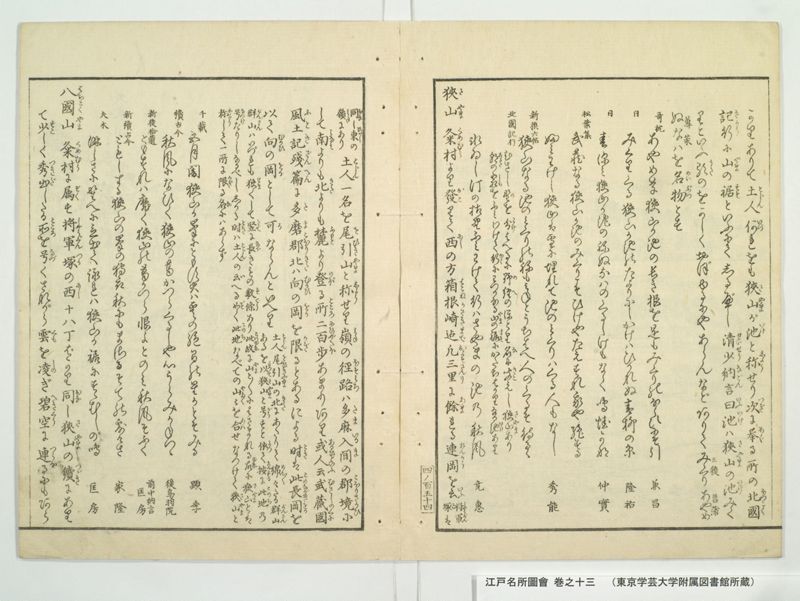
翻刻
【右丁】
かりありて土人(とじん)何(いづ)れをも《振り仮名:狭山が池|さやま いけ》と称(しよう)せり次(つぎ)に挙(あぐ)る所の北国(ほつこく)
記行(きかう)に山(やま)の裾(すそ)といふにてしるべし清少納言曰(せいせうなごんいふ)池(いけ)は狭山(さやま)の池(いけ)みく
りといふ歌(うた)のをかしくおぼゆるにやあらんなどありて みくり( 三陵 )あやめ( 菖蒲 )
ぬなは( 蒪菜 )を名物(めいぶつ)とす
《割書:哥枕》
あやめ草狭山か池の長き根を是もみくりのならひにそ引 兼昌
《割書:同》
みくりくる狭山か池のたよりにしかけはひかれぬ青柳の糸 隆祐
《割書:同》
春深み狭山か池のねぬなはのくるしけもなく鳴蛙かな 仲実
《割書:松葉集》
武蔵なる狭山か池のみくりこそひけやたえすれ我や絶する
ふみわけし狭山は雪に埋れて池のみくりはくる人もなし 秀能
《割書:新撰六帖》
狭山なる池のみくりのねもみねとうちはへ人のくるそ待るゝ
《割書:北国記行 むさし野(の)を分(わけ)はへるに野経(のへ)のほとり名(な)に聞(きこ)えし狭山(さやま)あり| 朝(あした)の霜(しも)をふみわけて行(ゆく)にわつかなる山(やま)の裾(すそ)にかたちはかりなる池(いけ)あり》
氷ゐし汀の枯野ふみわけて行はさやまの池の秋風 堯恵
狭山(さやま) 粂村(くめむら)より発(おこ)りて西(にし)の方 箱根崎(はこねかさき)迄(まで)凡(およそ)三里(さんり)に余(あま)れる連岡(れんかう)を云(いふ)《割書:将軍(しやうぐん)|塚(つか)は》
【左丁】
《割書:同(おな)し東(ひがし)の|嶺(みね)にあり》土人(とじん)一名を尾引山(をひきやま)と称(しよう)せり嶺(みね)の径路(ほそみち)は多麻(たま)入間(いるま)の郡境(こほりさかひ)に
して南(みなみ)よりも北(きた)よりも麓(ふもと)より登(のぼ)る所(ところ)二百歩(にひやくほ)あまりあり或人云(あるひとふ)武蔵国(むさしのくに)
風土記残篇(ふときざんへん)に多磨郡(たまこほり)北(きた)は向(むかひ)の岡(をか)を限(かぎ)るとあるによる時(とき)は此(この)長岡(ながきをか)を
以て向(むかひ)の岡(をか)として可(か)ならんといへり《割書:土人(とじん)尾引山(をひきやま)の北(きた)にあたりて綿々(めん〳〵)たる群山(ぐんさん)|あるを以(もつて)狭山(さやま)と号(がう)すと依(よつ)て按(あんする)に此地(このち)の》
《割書:群山(ぐんさん)はいづれも狹(せま)くして竪(たて)に長(なが)きもの数条(すでう)あり此故(このゆゑ)に山(やま)と〳〵にはさまれる故(ゆゑ)に狭山(さやま)とは|号(なつけ)たりしなるべししかる時(とき)は土人(とじん)の云(い)へる如(ごと)く此地(このち)なべての山々(やま〳〵)を合(あは)せなつけて狭山(さやま)と》
《割書:称(しよう)して一所に限(かぎ)る名(な)にはあらず》
《割書:千載》
五月闇狭山か峯にともす火は雲の絶間の星かとそみる 顕季
《割書:続古今》
秋風になひく狭山の葛かつらくるしや心うらみかねつゝ 後鳥羽院
《割書:新後拾遺》
ともすれは靡く狭山の葛かつら恨よとのみ秋風そふく 《割書:前中納言|匡房》
《割書:新続古今》
ともしする狭山の峯の狩衣秋にもまさるそての露けさ 家隆
《割書:夫木》
淋しさに野へに立出て詠れは狭山か裾にすゝむしの鳴 匡房
八国山(はちこくやま) 粂村(くめむら)に属(ぞく)す将軍塚(しやうぐんつか)の西(にし)十八丁ばかり同(おな)し狭山(さやま)の続(つゞき)にあり
て少(すこ)しく秀出(つきだ)したる所(ところ)を号(なづ)くさながら雲(くも)を凌(しの)ぎ碧空(へきくう)に連(つらな)るにもあら
現代語訳
## 【右丁】
…(何らかの)由来があって、土地の人々はいずれも「狭山が池」と称している。次に挙げる『北国記行』の「山の裾」という記述によって知ることができる。清少納言は「池は狭山の池」と述べており、「みくり」という歌が趣深く感じられるからであろうか、などとある。みくり(三稜草)・あやめ(菖蒲)・ぬなは(蒪菜)を名物とする。
**【歌枕】**
> あやめ草 狭山が池の 長き根を これもみくりの ならひにぞ引く ――兼昌
**【同】**
> みくりくる 狭山が池の 便りにし かけはひかれぬ 青柳の糸 ――隆祐
**【同】**
> 春深み 狭山が池の 根ぬなはの 苦しけもなく 鳴く蛙かな ――仲実
**【松葉集】**
> 武蔵なる 狭山が池の みくりこそ 引けや絶えすれ 我や絶するや
> ふみわけし 狭山は雪に 埋れて 池のみくりは 来る人もなし ――秀能
**【新撰六帖】**
> 狭山なる 池のみくりの 根もみねと うちはへ人の 来るぞ待たるる
**【北国記行】** 「武蔵野を分け行くに、野辺のほとりに名に聞こえし狭山あり。朝の霜を踏み分けて行くに、わずかなる山の裾に、かたちばかりなる池あり」
> 氷ゐし 汀の枯野 ふみわけて 行けばさやまの 池の秋風 ――堯恵
---
**狭山** 粂村より発して西の方、箱根崎まで凡そ三里余りに連なる丘陵を言う。〔割書:将軍塚は〕
## 【左丁】
〔割書:同じ東の嶺にあり〕土地の人々は、一名を「尾引山」と称している。嶺の細道は多摩・入間の郡境にあたり、南からも北からも麓から登ること二百歩あまりある。ある人が言うには、『武蔵国風土記残篇』に「多摩郡の北は、向かいの丘を限りとする」とあることによれば、この長い丘をもって「向かいの丘」とするのが妥当であろうとのことである。
〔割書:土地の人々は、尾引山の北にあたって綿々たる群山があることをもって「狭山」と号すと言う。これによって考察するに、この地の群山はいずれも狭くして縦に長いものが数条あり、このゆえに山と山とに挟まれることから「狭山」と名付けたのであろう。そうであれば土地の人々の言うごとく、この地のすべての山々を合わせて「狭山」と称したものであって、一か所に限る名前ではない。〕
**【千載集】**
> 五月闇 狭山が峯に ともす火は 雲の絶え間の 星かとぞ見る ――顕季
**【続古今集】**
> 秋風に 靡く狭山の 葛かずら 苦しや心 恨みかねつつ ――後鳥羽院
**【新後拾遺集】**
> ともすれば 靡く狭山の 葛かずら 恨めよとのみ 秋風ぞ吹く ――前中納言匡房
**【新続古今集】**
> ともしする 狭山の峯の 狩衣 秋にもまさる 袖の露けさ ――家隆
**【夫木和歌抄】**
> 寂しさに 野辺に立ち出て 眺むれば 狭山が裾に すずむしの鳴く ――匡房
---
**八国山** 粂村に属す。将軍塚の西、十八丁ばかり、同じく狭山の続きにあって、少しく突き出たところをそう名付ける。さながら雲を凌ぎ碧空に連なるというほどのものでもなく……
英語訳
## [Right Page]
…for some reason, the local people call all of these "Sayama-ga-ike" (Sayama Pond). This can be understood through the description "at the foot of the mountain" in the *Hokkoku Kikō* (Northern Provinces Travel Journal) cited below. Sei Shōnagon wrote "as for ponds, Sayama Pond," apparently because the poem using the word *mikuri* struck her as charming. Mikuri (three-edged bulrush, *Scirpus* sp.), ayame (iris), and nunaha (*Brasenia schreberi*, water shield) are the noted local products.
**[Uta-makura — Poetry Anthology]**
> Ayame grass — like the long roots of Sayama Pond, these too are drawn out like mikuri — Kanemasa
**[Same]**
> On the occasion of gathering mikuri at Sayama Pond, the trailing threads of green willow too are drawn along — Ryūyū
**[Same]**
> In the depths of spring, at Sayama Pond, the submerged roots of the nunaha — effortlessly the frogs cry out — Nakazane
**[Matsuba-shū]**
> The mikuri of Sayama Pond in Musashi — pull as one might, it snaps; will I too be cut off?
> Treading through Sayama, now buried in snow — no one comes to gather the mikuri of the pond — Hidenō
**[Shinsen Rokujo]**
> At the pond in Sayama, waiting for someone to keep coming, as if to harvest the mikuri roots down to the very tips
**[Hokkoku Kikō]** "Traversing Musashino, along the edge of the fields, there lies the famed Sayama. Treading through the morning frost, at the foot of a modest hill, there is a pond of modest proportions."
> Treading through the frost-bound, withered fields at the icy water's edge — going on, the autumn wind at Sayama Pond — Gyōe
---
**Sayama** refers to the range of hills extending from Kume Village westward to Hakonegasaki, a distance of some three *ri* (approximately 12 km). [Marginal note: Shōgun-zuka (the General's Mound) is]
## [Left Page]
[Marginal note: located on the eastern peak of the same range.] The local people also call it by the name "Obikiyama." The narrow path along the ridge forms the border between Tama and Iruma districts; from both the south and north, it is about two hundred paces from the foot to the summit. Someone has stated that, according to the *Musashi no Kuni Fudoki Zanpen* (Fragmentary Records of the Musashi Province Gazetteer), which says "the north of Tama District is bounded by the facing hill (*mukai no oka*)," this long ridge may well be that "facing hill."
[Marginal note: The local people refer to the continuous range of mountains to the north of Obikiyama as "Sayama." Considering this, the mountains in this area are all narrow and elongated, running in several parallel ridges; it is therefore likely that the name "Sayama" (Narrow Mountain) comes from being enclosed between mountains. In that case, as the local people say, the name "Sayama" encompasses all the mountains of this area collectively, and is not a name limited to a single location.]
**[Senzai-shū (Anthology of a Thousand Years)]**
> In the darkness of the fifth month, the fire lit on Sayama's peak — is it a star glimpsed through a break in the clouds? — Akinobu
**[Shoku Kokin-shū]**
> In the autumn wind, the kudzu vines of Sayama trail and sway — oh how my heart aches, unable to give voice to my resentment — Emperor Go-Toba
**[Shin-Goshūi-shū]**
> The kudzu of Sayama bends as if it would — the autumn wind blows, as if commanding: resent me — Former Middle Counselor Masafusa
**[Shin-zoku Kokin-shū]**
> The hunting cloak on Sayama's peak, lit by firelight — the sleeve's dampness surpasses even autumn — Ienaga (Ietaka)
**[Fuboku Wakashō]**
> In my loneliness, stepping out into the fields and gazing — at the foot of Sayama, the bell crickets cry — Masafusa
---
**Hachikoku-yama (Eight-Province Mountain)** belongs to Kume Village. Located about eighteen *chō* (approximately 2 km) to the west of Shōgun-zuka, it is part of the same Sayama range, and the name refers to a slightly prominent point along it. It is not at all the kind of peak that soars above the clouds into the blue sky…