翻刻
【右丁】
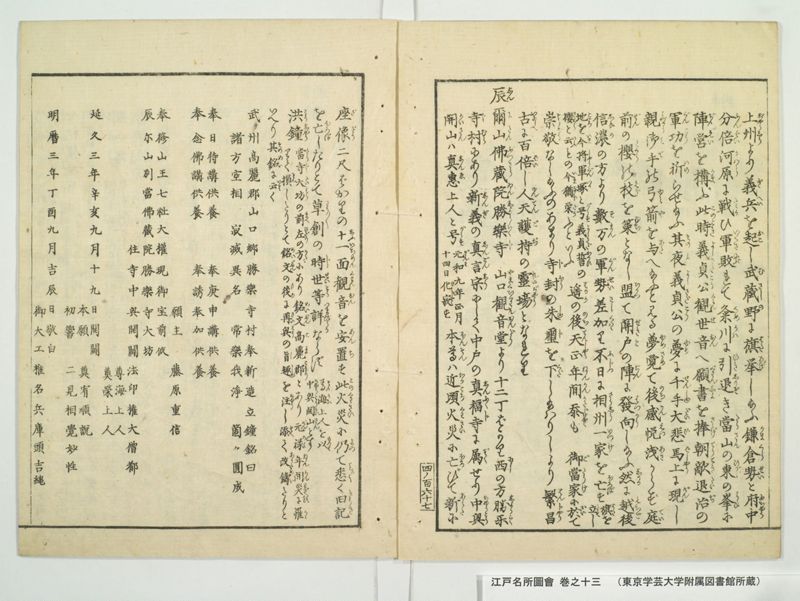
上州(じやうしう)より義兵(ぎへい)を起(おこ)し武蔵野(むさしの)に旗挙(はたあげ)し給ふ鎌倉勢(かまくらせい)と府中(ふちゆう)
分倍河原(ふんばいかはら)に戦(たゝか)ひ軍(いくさ)敗(やぶ)れて粂川(くめかは)に引退(ひきしりぞ)き当山(たうさん)の東(ひがし)の峯(みね)に
陣営(ぢんえい)を構(かま)ふ此時(このとき)義貞公(よしさたこう)観世音(くわんせおん)へ願書(ぐわんしよ)を捧(さゝげ)朝敵(てうてき)退治(たいぢ)の
軍功(ぐんこう)を祈(いの)らせ給ふ其夜(そのよ)義貞公(よしさだこう)の夢(ゆめ)に千手大悲(せんしゆだいひ)馬上(ばしやう)に現(げん)し
親(みづから)御手(みて)の弓箭(ゆみや)を与(あた)へ給ふと見る夢(ゆめ)覚(さめ)て後(のち)感悦(かんえつ)浅(あさ)からず庭(てい)
前(ぜん)の桜(さくら)の枝(えだ)を策(むち)となし盟(ちかつ)て関戸(せきと)の陣(ぢん)に発向(はつかう)し給ふ然(しかる)に越後(えちご)
信濃(しなの)の方より数万(すまん)の軍勢(ぐんせい)差加(さしくはゝ)り不日(ふじつ)に相州(さうしう)一家(いつけ)を亡(ほろば)す《割書:旗(はた)を|立(たて)し》
《割書:地(ところ)を今(いま)将軍塚(しやうぐんつか)と号(がうす)義貞(よしさだ)誓(ちかひ)の|桜(さくら)と云(いふ)もの今猶(いまなほ)栄(さか)ふといふ》遥(はるか)の後(のち)天正年間(てんしやうねんかん)忝(かたじけなく)も 御当家(ごたうけ)に於(おい)て
崇敬(そうけう)なし給ふのあまり寺封(じほう)の朱璽(しゆじ)を下(くだ)し給はりしより繁昌(はんじやう)
古(いにしへ)に百倍( ばい)し人天(にんてん)護持(ごぢ)の霊場(れいぢやう)となれり
辰爾山(しんにさん)仏蔵院(ぶつさうゐん)勝楽寺(しようらくじ) 山口観音堂(やまくちくわんおんだう)より十二丁ばかり西(にし)の方 勝楽(しようらく)
寺村(じむら)にあり新義(しんぎ)の真言宗(しんごんしう)にして中戸の真福寺(しんふくじ)に属(ぞく)せり中興(ちゆうこう)
開山(かいさん)は真恵上人(しんゑ )と号(がうす)《割書:元和(げんわ)九年正月|十四日 化寂(けじやく)す》本尊(ほんそん)は近頃(ちかころ)火災(くわさい)に亡(ほろ)びて新(あらた)に
【左丁】
座像(ざざう)二尺ばかりの十一面観音(しふいちめんくわんおん)を安置(あんち)す此(この)火災(くわさい)に仍(よつ)て悉(こと〴〵)く旧記(きうき)
を亡(ほろぼ)したりとて草創(さう〳〵)の時世(じせい)等(とう)詳(つまびらか)ならず《割書:尊海上人(そんかい )を以(もつて)|中興開山(ちゆうこうかいさん)とす》
洪鐘(こうしやう)《割書:当寺(たうじ)大坊(たいはう)の前(まへ)左(ひだり)の方(かた)にあり銘文(めいぶん)高麗郡(こまこほり)とあり元禄年間(げんろくねんかん)災(わざはひ)に罹(かゝ)|りて損(そん)したりとて銘文(めいぶん)の後(うしろ)に再興(さいこう)の旨趣(ししゆ)を注(ちゆう)し添(そへ)て改鋳(あらためい)たりと》
《割書:いへり其銘(そのめい)に云(いは)く》
武州高麗軍山口郷勝楽寺村奉新造立鐘銘曰
諸方空相 寂滅異名 常楽我浄 箇々円成
奉日待講供養 奉庚申講供養
奉念仏講供養 奉誘奉加供養
願主 藤原重信
奉修山王七社大権現御宝前依
辰尓山別当仏蔵院勝楽寺大坊
住寺中興開闢法印権大僧都
尊海上人
奠栄上人
延久三年辛亥九月十九日開闢
本願 奠宥順説
初響 二見相覚妙性
明暦三年丁酉九月吉辰日敬白
御大工椎名兵庫頭吉縄
現代語訳
【右丁】
上野国(こうずけのくに)より義兵を挙げ、武蔵野に旗を掲げられた新田義貞公は、鎌倉勢と府中・分倍河原にて戦い、軍が敗れて粂川へ退き、当山(この山)の東の峰に陣営を構えられた。このとき義貞公は観世音菩薩へ願書を捧げ、朝敵退治の軍功を祈られた。その夜、義貞公の夢に千手大悲(千手観音)が馬上に現れ、みずからの手の弓矢を授けてくださると見えた。夢から覚めた後、その感激はひとかたならぬものがあり、庭前の桜の枝を鞭として誓いを立て、関戸の陣へと進発された。やがて越後・信濃の方面より数万の軍勢が加わり、ほどなく相模国(鎌倉幕府)の一家を滅ぼした。〔旗を立てた場所を今日「将軍塚」と称し、義貞の誓いの桜と呼ばれるものが今もなお栄えていると伝えられる。〕
はるか後の時代、天正年間には、ありがたくも御当家(徳川家)により崇敬を受け、寺封の朱印が下賜されたことより、寺の繁栄は昔の百倍にも達し、人々と天上の衆生に護持される霊場となった。
辰爾山(しんにさん)仏蔵院(ぶつぞういん)勝楽寺 山口観音堂より西へ十二丁ほどの方角、勝楽寺村にある。新義真言宗に属し、中戸の真福寺の末寺である。中興開山は真恵上人と号す。〔元和九年正月十四日に遷化された。〕本尊は近年の火災により失われ、新たに
【左丁】
座像・高さ二尺ほどの十一面観音を安置している。この火災によってすべての旧記(古い記録)が失われてしまったため、草創の時期等は詳らかでない。〔尊海上人をもって中興開山とする。〕
洪鐘(大梵鐘)〔当寺大坊の前、左の方にある。銘文に「高麗郡」とある。元禄年間に災害にかかって損傷したとして、銘文の後ろに再興の趣旨を注記して添え、改めて鋳直したと伝えられる。その銘に曰く、〕
武州高麗軍山口郷勝楽寺村 鐘を新たに造立し奉る 銘に曰く
諸方空相 寂滅異名 常楽我浄 箇々円成
日待講供養を奉る 庚申講供養を奉る
念仏講供養を奉る 勧誘奉加供養を奉る
願主 藤原重信
山王七社大権現御宝前に依り修し奉る
辰尓山別当仏蔵院勝楽寺大坊
住寺中興開闢法印権大僧都
尊海上人
奠栄上人
延久三年辛亥九月十九日 開闢
本願 奠宥順説
初響 二見相覚妙性
明暦三年丁酉九月吉辰日 敬白
御大工 椎名兵庫頭吉縄
英語訳
**[Right Folio]**
Having raised a righteous army from Kōzuke Province (present-day Gunma Prefecture) and unfurled his banner on the Musashino plain, Nitta Yoshisada engaged the Kamakura forces in battle at Fuchū and Bunbai-kawara. His army was defeated, and he withdrew to the Kume River, establishing his encampment on the eastern peak of this mountain. At that time, Lord Yoshisada presented a written prayer to Kannon (Avalokiteśvara), beseeching divine military merit for the subjugation of enemies of the Imperial Court. That night, in Yoshisada's dream, the Thousand-Armed Kannon of Great Compassion appeared on horseback, personally bestowing upon him a bow and arrows from her own hands. Upon waking from this dream, his gratitude knew no bounds. He fashioned a whip from a branch of a cherry tree in the garden, made a solemn vow, and set forth for the camp at Sekido. Soon thereafter, tens of thousands of troops joined from the direction of Echigo and Shinano Provinces, and in no time the entire Kamakura clan was destroyed. *(The place where the banner was planted is called "Shōgunzuka" (General's Mound) to this day, and the cherry tree known as "Yoshisada's Vow Cherry" is said to still flourish there.)*
Long afterward, during the Tenshō era (1573–1592), the temple was graciously favored with reverence by the reigning house (the Tokugawa), and upon the bestowal of the vermilion-sealed temple domain, its prosperity increased a hundredfold compared to ancient times, and it became a sacred site protected by both humans and heavenly beings.
**Shinni-zan Butsuzō-in Shōraku-ji Temple** — Located approximately twelve *chō* (about 1.3 km) to the west of the Yamaguchi Kannon-dō, in the village of Shōrakuji. It belongs to the Shingi Shingon sect and is affiliated with Shinfuku-ji in Nakato. The founder of the temple's revival (*chūkō kaisan*) is known as the Venerable Shinkei. *(He passed away on the fourteenth day of the first month of Genna 9 [1623].)* The principal object of worship (honzon) was recently lost in a fire, and newly
**[Left Folio]**
a seated image of the Eleven-Faced Kannon, approximately two *shaku* (about 60 cm) in height, has been enshrined. Due to this fire, all old records were entirely destroyed, and thus the date of the temple's original founding and related matters are not known in detail. *(The Venerable Sonkai is regarded as the founder of the temple's revival.)*
**The Great Temple Bell** *(Located to the left in front of the main temple building. The inscription reads "Koma District (高麗郡)." It is said that the bell was damaged in a disaster during the Genroku era [1688–1704], and a postscript noting the circumstances of its restoration was added after the original inscription, and the bell was recast. The inscription reads as follows:)*
> In the village of Shōrakuji, Yamaguchi-gō, Koma District, Musashi Province — herewith a new bell is reverently cast. The inscription reads:
>
> *All directions are empty in nature; extinction has many names; eternal bliss, true self, and purity; each and every one is perfectly fulfilled.*
- Reverently offered for the *Hi-machi-kō* (Day-Waiting Confraternity) — Reverently offered for the *Kōshin-kō* (Kōshin Confraternity)
- Reverently offered for the *Nenbutsu-kō* (Nenbutsu Confraternity) — Reverently offered for the *Yūhōka-kō* (Donation Solicitation Confraternity)
> Vow-maker (*ganshū*): Fujiwara no Shigenobu
> Reverently performed before the sacred shrine of the Mountain King's Seven-Shrine Gongen (*Sannō Shichisha Daigongen*)
> Shinni-zan Bettō Butsuzō-in Shōraku-ji, Main Temple
>
> Residing Abbot, Founder of the Revival, *Hōin Gon-Daisōzu*:
> - The Venerable Sonkai (*Sonkai Shōnin*)
> - The Venerable Tenyō (*Ten'ei Shōnin*)
> Founded: Enkyū 3, *kanoto-i* year, 9th month, 19th day [October 1071]
> Original vow-maker (*hongan*): Ten'yū Junsatsu
> First bell-ringing (*shokyō*): Futami Sōkaku Myōshō
> Meireki 3, *hinoto-tori* year, auspicious day of the 9th month [1657], respectfully stated
> Master Carpenter: Shiina Hyōgonomichi Yoshinawa