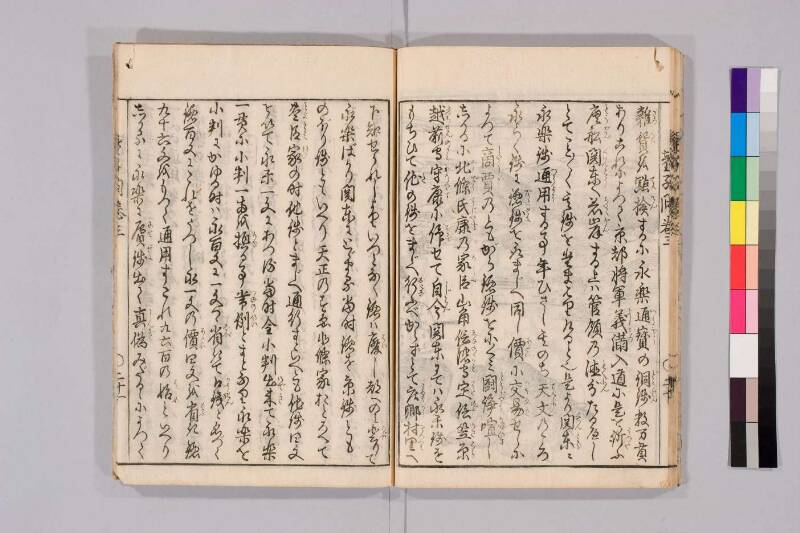
翻刻
雑賃(ざつかい)を點検(てんけん)するに永楽/通宝(つうほう)の銅銭(どうせん)数万貫
ありこれによつて京都将軍/義満(よしみつ)入道に是を訴(うつた)ふ
唐船(とうせん)関東(くわんとう)へ着岸(ちやくがん)する上は管領の徳分(とくぶん)たるへし
とてこと〳〵く其銭をたまはりけると也是より関東(くわんとう)に
永楽銭/通用(つうよう)する事年ひさし其のち天文(てんぶん)のころ
永らく銭に鐚銭(びたせに)を取まじへ同し価(あたい)に交易(こうゑき)せしに
よつて商賈(しやうこ)のともがら鐚銭をにくみ闘浄(とうじやう)喧(かまひす)〳〵
しかるに北(ほう)條(でう)氏(うじ)康(やす)の家臣(かしん)山角/信濃(しなの)守(かみ)定信(さたのぶ)笠原(かさはら)
越前守康(ゑちせんのかみもりやす)に 仰(おほ)せて自今(じこん)関東にては永楽銭を
もちひて他(た)の銭をまじへ行(おこな)ふべからずとて庄郷(しやうがう)村里(そんり)へ
下知せられしよりいつとなく鐚は廃(はい)し都へのみ登(のぼ)りて
永楽ばかり関東にとゞまる当時鐚を京銭とも
のぼり銭ともいへり天正のすゑ北條家おとろへて
豊臣家(とよとみけ)の時他銭とまじへ通行すといへとも他銭四文
を以て永楽一文にあつる当時金小判/出来(いでき)て永楽
一貫に小判一両を換(かゆ)る事/常例(つゆのれい)とすとなり永楽を
小判にかゆる時は永百文に一文つゝ省(はぶ)きて口銭(かうせん)と名づく
鐚百文にこれをうつし永一文の價(あたい)四文を省き鐚
九十六文をもつて通用すこれ九六百の始(はじめ)といへり
しるに永楽に贋銭(にせぜに)出て真偽(しんぎ)みだるゝによつて
現代語訳
雑税(ざつぜい)を点検してみると、永楽通宝の銅銭が数万貫もあった。これによって、京都の将軍・足利義満入道にこの件を訴え出た。唐船が関東に着岸した以上は、管領の得分(とくぶん)であるべきだとして、ことごとくその銭を賜ったということである。これより関東で永楽銭が通用すること久しくなった。
その後、天文年間(1532〜1555年)のころ、永楽銭に鐚銭(びたせん)を混ぜて同じ価値として取引したため、商人たちは鐚銭を嫌い、争いが喧しくなった。
そこで北条氏康の家臣、山角信濃守定信と笠原越前守康安に命じて、「今後、関東においては永楽銭を用い、他の銭を混ぜて流通させてはならない」と、庄郷・村里へ通達した。それ以来、いつとなく鐚銭は廃れ、都へのみ流れ上って、永楽銭だけが関東に残った。当時、鐚銭を「京銭」とも「のぼり銭」とも言った。
天正年間(1573〜1592年)の末に北条家が衰えて、豊臣家の時代になると、他の銭と混ぜて流通したといえども、他の銭四文をもって永楽一文に当てることとなった。当時、金の小判が出来て、永楽一貫に対して小判一両を換えることが慣例となった。
永楽銭を小判に換える時は、永楽百文ごとに一文ずつ省いて「口銭(こうせん)」と名づけた。これを鐚銭百文に換算すると、永楽一文の価値は四文であるから四文を省き、鐚九十六文をもって通用した。これが「九六百(くろくひゃく)」の始まりと言われている。
さらに記すに、永楽銭に贋銭が出回り、真偽が乱れるようになったので、(以下次ページへ続く)
英語訳
Upon inspecting the miscellaneous taxes, it was found that there were tens of thousands of kan of Eiraku Tsūhō copper coins. This matter was brought before the shogun of Kyoto, the monk Ashikaga Yoshimitsu. It was declared that since the Chinese ship had arrived at a port in the Kantō region, the coins should rightfully be the profit of the kanrei (deputy shogun), and accordingly all the coins were received as such. From this point on, the Eiraku coins circulated in the Kantō region for many years.
After that, around the Tenbun era (1532–1555), Eiraku coins were mixed with bita coins (inferior copper coins) and traded at the same value, causing merchants to despise the bita coins and disputes became rampant.
Thereupon, Yamagaku Shinano-no-kami Sadanobu and Kasahara Echizen-no-kami Moriyasu, retainers of Hōjō Ujiyasu, were ordered to issue directives to villages and hamlets throughout the region, stating: "Henceforth in the Kantō, only Eiraku coins shall be used, and no other coins shall be mixed into circulation." From that time on, the bita coins gradually fell out of use, flowing up to the capital, while only Eiraku coins remained in the Kantō. At that time, bita coins were called "Kyō-sen" (Kyoto coins) or "nobori-sen" (coins going up [to the capital]).
At the end of the Tenshō era (1573–1592), as the Hōjō clan declined and the Toyotomi clan came to power, other coins were again mixed into circulation; however, four mon of other coins were equated to one mon of Eiraku coins. Around that time, gold koban coins came into existence, and it became the customary practice to exchange one ryō of koban for one kan of Eiraku coins.
When exchanging Eiraku coins for koban, one mon was deducted for every hundred mon of Eiraku coins, and this deduction was called "kōsen" (commission fee). Converting this into bita coins: since one mon of Eiraku was worth four mon, one mon (four bita) was deducted, leaving 96 bita mon in circulation per hundred. This is said to be the origin of the term "96-hyaku" (96 per hundred).
Furthermore, as counterfeit Eiraku coins appeared and the distinction between genuine and false coins became confused... (continues on next page)