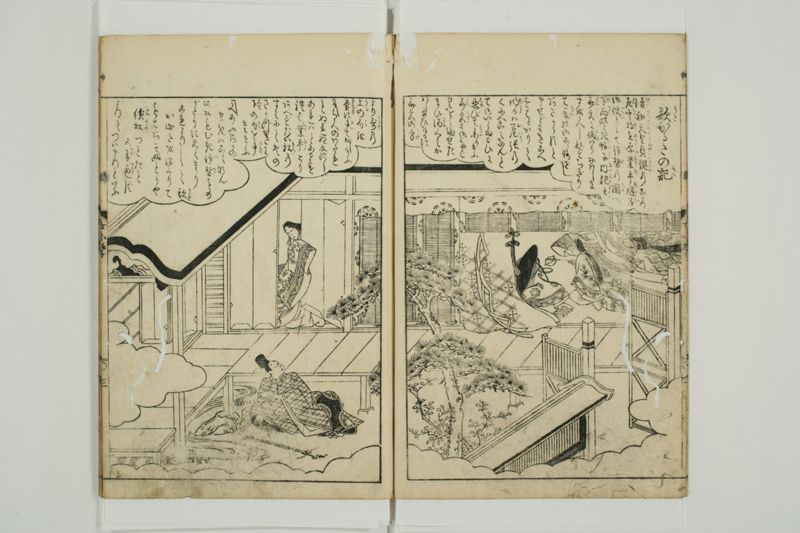
翻刻
【右丁】
歌(うた)かるたの記(き)
清和天皇(せいわてんのう) 貞観(ぢやうくわん)のころ
左中将(さちうしやう)在原業平(ありわらのなりひら)朝臣
御 使(つかい)として伊勢(いせ)の国(くに)へ
下向(けかう)のとき帖子(てんし)【ママ】 内親王(ないしんわう)
斎宮(さいぐう)に備(そな)はりおはしま
すを人しれずちぎり
て互(たがい)の御こゝろざし
あさからずと
申せどもきこへ
をはゞかりて
明日(あす)は尾張(おはり)の
くにへこしなんと
て御いとまごひに
忍(しの)びて参(まい)り給ふ
斎宮(さいくう)も御なご
りをしませた
まひ酒(さけ)くみか
はし給ひけるに
斎宮の方(かた)
【左丁】
より哥(うた)の
上(かみ)の句(く)を
盃(さかづき)に書(かい)て出し給ふ
〽かち人のわたれ
とぬれぬゑにし
あればとありけ
れば業平(なりひら)とり
あへずたい松(まつ)の
すみにてその
さかづきに
下(しも)の句を書(かき)
たまふ
〽又あふさかの
せきはこゝなん
此おもむき伊勢(いせ)もの
がたりに見えたり
これよりして歌(うた)
かるたをつくりて
もてあそぶとかや
続松(たいまつ)つとたと
又 音通(いんつう)ず
よつてついまつといふ
現代語訳
**歌かるたの記**
清和天皇の貞観年間のころ、左中将・在原業平朝臣が、勅使として伊勢の国へ下向された折、斎宮である帖子(よしこ)内親王がそこにいらっしゃいました。二人は人知れず愛を契り、互いの心の底にある思いは浅くはないといわれますが、世間の評判をはばかって、「明日は尾張の国へ参ります」と、お暇乞いのために、こっそりと斎宮のもとへお参りになりました。
斎宮も名残を惜しんでおられ、二人でお酒を酌み交わしていたところ、斎宮の方から、和歌の上の句を盃に書いてお出しになりました。
〽 かち人のわたれとぬれぬ えにしあれば
(徒歩で渡る人が濡れないほどの浅い縁でもあるのなら)
と書かれていたので、業平はすかさず、たいまつの炭を使ってその盃に下の句を書かれました。
〽 またあふさかの せきはここなん
(また逢坂の関でお会いしましょう、ここがその関です)
このいきさつは『伊勢物語』に見えております。これより歌かるたを作って遊ぶようになったといわれています。
※「続松(たいまつ)」は「つと」とも「たと」とも読み、また音通じて「ついまつ」ともいう。
英語訳
**On the Origin of Uta Karuta (Poem Cards)**
During the Jōgan era of Emperor Seiwa's reign, Ariwara no Narihira, the Assistant Captain of the Left Imperial Guard, traveled down to the province of Ise as an imperial envoy. There he found Princess Yoshiko (Teishi), who was serving as the High Priestess of Ise (Saigū). The two secretly pledged their love to one another, and it is said that their feelings for each other ran deep. However, mindful of public reputation, Narihira visited the princess quietly to bid her farewell, saying, "Tomorrow I must depart for the province of Owari."
The princess, too, was reluctant to part. As they exchanged cups of sake, the princess wrote the upper verse (*kami no ku*) of a poem on a sake cup and presented it to him:
〽 *Kachihito no / watare to nurenu / enishi areba*
(If we share a bond shallow enough that a traveler on foot could ford it without getting wet...)
Narihira, without a moment's hesitation, took a piece of charcoal from a torch (*taimatsu*) and wrote the lower verse (*shimo no ku*) on the same cup:
〽 *Mata ōsaka no / seki wa koko nan*
(Then let this be our Barrier of Ōsaka, where we shall meet again.)
This episode can be found in *The Tales of Ise (Ise Monogatari)*. It is said that from this occasion, the game of uta karuta was created and enjoyed by people.
※ Note: The word *続松 (taimatsu)*, meaning "torch," can also be read as *tsuto* or *tato*, and by phonetic correspondence is also pronounced *tsuimatsu*.