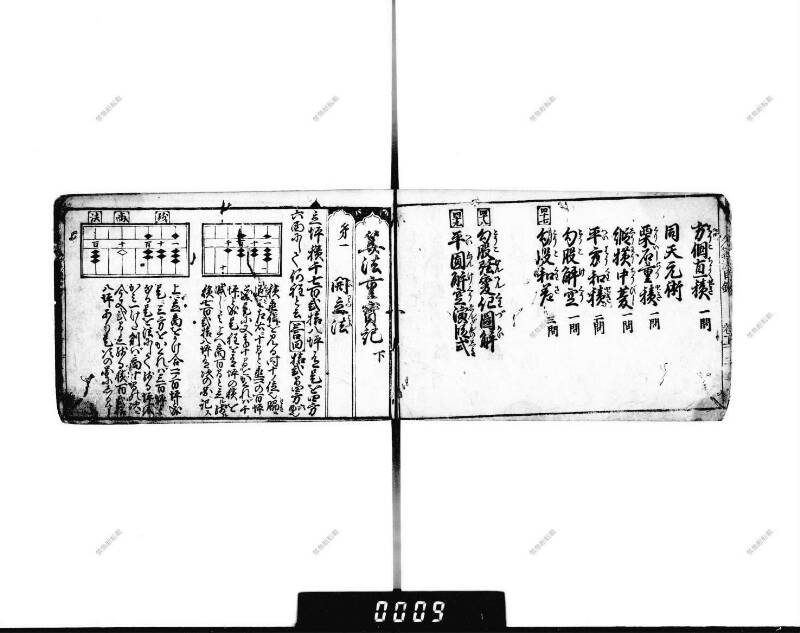
翻刻
方個直積(はうこちよくせき) 一問
同天元術
栗石量積(くりいしぢうせき) 一問
縱橫中菱(しうわうちうびし) 一問
平方和積(へいはうくわせき) 二問
勾股解空(こうこけくう) 一問
[四十七] 勾股和差(こうこくわさ) 三問
[四十八] 勾股弦變化圖解(こうこけんへんくわづかい)
[四十九] 平圓解空演段式(へいゑんけくうゑんだんのしき)
《題:算法重寶記 下》
《題:第一 開立法(かいりつはふ)》
▲立坪積千七百弐拾八坪有是を四方
六面にして何程と云[答曰]拾弐間四方六面也
積置位を見る時十ノ位也 脇(わき) ̄ニ
退(しりそく)□左右 ̄ニ十間置一一の百坪
と成是に又高十間をかくれば千
坪と成是程を有坪の積を
滅じ其上へ商百間と立 ̄ル残 ̄ル
積七百弐拾八坪有次の図 ̄ニ記 ̄ス
上 ̄ニ立商をかけ合一一ノ百坪と成
是 ̄ニ三方をかくらは三百坪と
なる是を法にして残る坪□
かミ一けた割ば商十間の次 ̄ニ
今又弐間三立残る積百弐拾
八坪あり是次の図にしるす
現代語訳
方個直積(はうこちよくせき) 一問
同天元術
栗石量積(くりいしぢうせき) 一問
縦横中菱(しうわうちうびし) 一問
平方和積(へいはうくわせき) 二問
勾股解空(こうこけくう) 一問
[四十七] 勾股和差(こうこくわさ) 三問
[四十八] 勾股弦変化図解(こうこけんへんくわづかい)
[四十九] 平円解空演段式(へいゑんけくうゑんだんのしき)
《題:算法重宝記 下》
《題:第一 開立法(かいりつほう)》
▲立坪積1728坪があり、これを四方六面にして何程と云う
[答え]12間四方六面なり
積を置く位を見る時、十の位なり。脇に
退いて左右に十間置くと、1の100坪
となる。これにまた高十間をかければ1000
坪となる。この程を有坪の積を
減じ、その上へ商100間と立てる。残る
積728坪あり。次の図に記す。
上に立商をかけ合わせ、1の100坪となる。
これに三方をかければ300坪と
なる。これを法にして残る坪数を
かけて一桁割れば、商十間の次に
今また2間を立て、残る積120
8坪あり。これ次の図に記す。
英語訳
Square-form Direct Product (hōko chokuсeki) - 1 problem
Same Tenyuan Technique
Chestnut Stone Volume Product (kuriishi jūseki) - 1 problem
Vertical-Horizontal Middle Diamond (shūō chūhishi) - 1 problem
Square Sum Product (heihō waseki) - 2 problems
Pythagorean Void Resolution (kōko kekū) - 1 problem
[Forty-seven] Pythagorean Sum and Difference (kōko wasa) - 3 problems
[Forty-eight] Pythagorean Hypotenuse Transformation Diagram (kōko ken henka zukai)
[Forty-nine] Planar Circle Void Resolution Performance Formula (heien kekū endan no shiki)
《Title: Sanpō Juhōki Volume 2》
《Title: Chapter 1 - Cube Root Extraction Method (kairitsu hō)》
▲There is a cubic area of 1,728 tsubo. When made into a four-sided six-faced [cube], how much is it?
[Answer] 12 ken on all four sides and six faces.
When looking at the position where the product is placed, it is in the tens place. Setting aside to the side, placing ten ken on the left and right makes 1 × 100 tsubo. If you multiply this by a height of ten ken, it becomes 1,000 tsubo. Subtract this amount from the given area product, and place the quotient 100 ken above it. The remaining product is 728 tsubo. This is recorded in the next diagram.
Multiply the standing quotient above to get 1 × 100 tsubo. If you multiply this by three directions, it becomes 300 tsubo. Using this as the divisor, multiply by the remaining tsubo and divide by one digit, then next to the quotient of ten ken, now place 2 ken, and there remains a product of 1,208 tsubo. This is recorded in the next diagram.