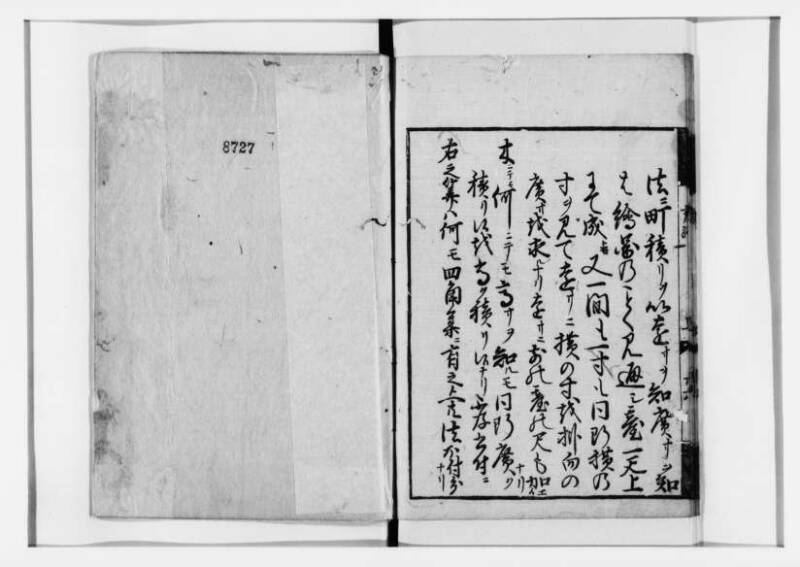
翻刻
法ニ町積リヲ以遠サヲ知広サヲ知
は絵図のことく見通シ台一尺上
にて成トモ又一間も一寸も同断横の
寸ヲ見て遠サニ横の寸を掛向の
広サを求ルナリ遠サニ前の台の尺も加エ候ナリ
木ニテモニ何テモ高サヲ知ルモ同断広ク
積り候を高ク積リ候ナリ不存書付ニ
右之算ハ何モ四角集ニ有之上共法不付分ナリ
現代語訳
【広間積りの法(続き)】
法として、町積りをもって遠さ(奥行き)を知り、広さを知るには、絵図(図面)のごとく見通して、台(基準単位)が一尺であっても、また一間であっても、一寸であっても同様である。横の寸法を見て、それを遠さ(奥行き)に横の寸法を掛けて、向こう側の広さを求めるものである。遠さには、前の台の尺をも加えるものである。
木であっても何であっても、高さを知るのも同じことである。広く積もったものを高く積もったものとして(換算して)計算するのである。
---
【奥書・編者注】
右の算(計算法)は、いずれも「四角集」(別書)に収められているが、上記のうち法の付いていない(説明が省かれている)部分について、知らない者のために書き付けたものである。
英語訳
**[Method for Wide Space Measurements (continued)]**
Using the town-area (*chō*-zumi) method to determine distance (depth) and width: as shown in a diagram, whether the base unit (*dai*) is 1 shaku, 1 *ken*, or 1 sun, the procedure is the same. One looks at the lateral measurement, multiplies it by the depth measurement, and thereby obtains the width of the far side. To the depth, one also adds the shaku value of the preceding base unit.
The same principle applies to determining heights — whether of timber or anything else. What has been measured/accumulated broadly is here converted into and calculated as something accumulated vertically (i.e., horizontal measurements are transposed into vertical ones).
---
**[Colophon / Editor's Note]**
The calculations presented above are all to be found in the *Shikakushū* ("Collection of Square/Rectangular Calculations"); however, among those treated above, the portions to which no formal method (*hō*) was attached — i.e., those left without full explanation — have been written down here for the benefit of those who are unfamiliar with them.