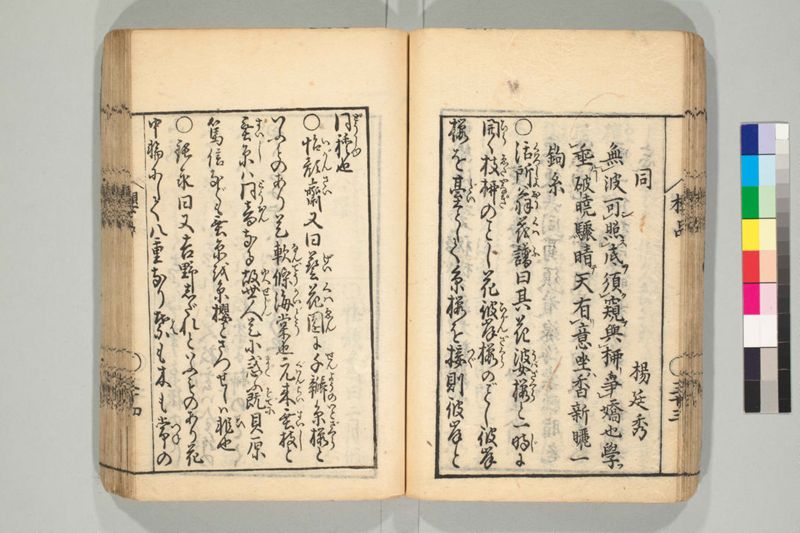
翻刻
【右丁】
同 楊廷秀
無_レ波可 ̄シ_レ照 ̄ス_レ底 ̄ヲ須 ̄ク_レ窺 ̄フ与_レ柳-争_レ嬌也学 ̄フ
《返り点:_レ》垂 ̄ルヿ破-暁驟晴 ̄テ天有 ̄リ_レ意坐 ̄ハ香新曬一
-鉤糸
○活所翁(くはつしよおう)花譜(くはふ)曰其花 婆桜(うばざくら)と一 時(じ)に
開(ひら)く枝(ゑだ)柳(やなぎ)のことし花 彼岸桜(ひがんざくら)のごとし彼岸
桜を台(だい)として糸桜を接(つぐ)則彼岸と
【左丁】
同種(どうしゆ)也
○怡顔斎(いがんさい)又曰 芸花園(げいくはゑん)に千弁糸桜(せんようのいとざくら)と
いふものあり是 軟条海棠(なんでうかいどう)也 元来(ぐはんらい)垂枝(すいし)と
垂糸(すいし)は同音(とうおん)なる故(ゆへ)世人(せじん)是に惑(まど)ふ既(すてに)貝原
篤信なども垂糸を糸桜とさつせしは非(ひ)也
○鈍永曰又吉野しだれといふものあり花
中輪にして八重なり葉(は)も木も常(つね)の
現代語訳
【右丁】
同 楊廷秀
波がなければ底を照らすことができ、柳と嬌を争うのを窺うべきである。垂れることを学び、夜明け頃に俄かに晴れて天に意あり、香に座して新たに一鉤の糸を曬す。
○活所翁の『花譜』に曰く「その花は婆桜と同時に開く。枝は柳のようで、花は彼岸桜のようである。彼岸桜を台木として糸桜を接木すると、彼岸桜と
【左丁】
同種である」と。
○怡顔斎また曰く「芸花園に千弁糸桜というものがある。これは軟条海棠である。元来、垂枝と垂糸は同音であるため、世人はこれに惑わされる。すでに貝原篤信なども垂糸を糸桜としたのは間違いである」と。
○鈍永曰く「また吉野しだれというものがある。花は中輪で八重である。葉も木も普通の
英語訳
【Right page】
Same Yang Tingxiu
Without waves, one can illuminate the bottom; one should observe how it competes with willows in charm. Learning to droop, at daybreak when it suddenly clears and heaven has intention, sitting in fragrance, newly drying a single hook of thread.
○According to Kasshōō's "Flower Records": "Its flowers bloom at the same time as uba-zakura (old woman cherry). The branches are like willows, and the flowers resemble higanzakura (equinox cherry). When thread cherry is grafted onto equinox cherry as rootstock, it becomes
【Left page】
the same species."
○Igansai also said: "In the flower garden there is something called thousand-petaled thread cherry. This is nanjō-kaidō (soft-branched begonia). Originally, suishi (drooping branch) and suishi (drooping thread) have the same pronunciation, so people are confused by this. Already, even Kaibara Atsunobu and others mistakenly called suishi 'thread cherry,' which was incorrect."
○Ton'ei said: "There is also something called Yoshino weeping cherry. The flowers are medium-sized and double-petaled. Both the leaves and tree are ordinary