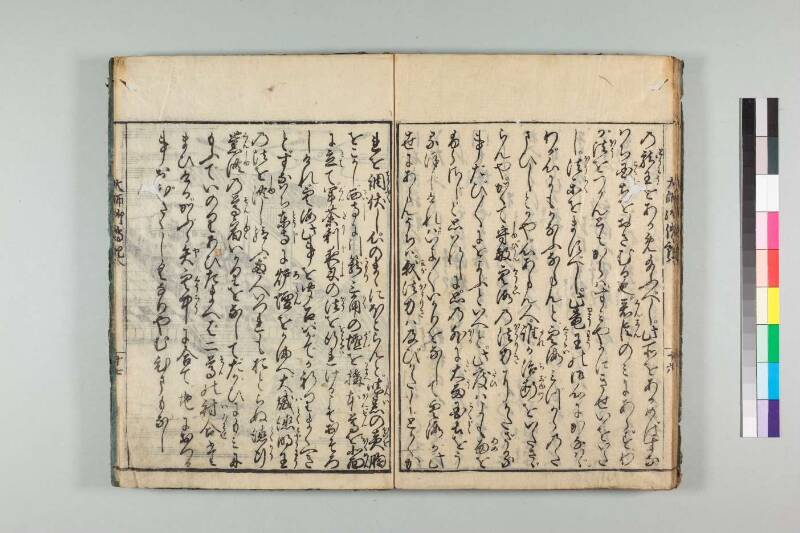
翻刻
【調伏法戦の事】
の竜王(りうわう)をあかめ給ふべし。此所をあかめばすな
はち国土(こくど)をおさむる也。君臣(くんしん)のみにあらず。わ
が法(ほう)をつがんともからは。すみやかにきせいをいた
し。法楽(ほうらく)をますべし。此 竜王(りうわう)の御心にかなはゞ。
わが心にもかなふならんと。空海(くうかい)みづからのた
まひしとかや。心あらん人。誰(たれ)か治術(ちじゆつ)をいたさゞ
らんや。かくて守敏(しゆびん)空海(くうかい)の法力(ほうりき)にかたざる
事たび〳〵にをよぶといへど。此 度(たひ)はよも雨(あめ)を
ふらさじと思はれしに。思の外(ほか)大雨(たいう)国土(こくど)をう
るほしければ。いよ〳〵いかりをなして。空海が此
世にあらんうちは。我(わが)法力(ほうりき)は及びかたし。とかくか
れを調伏(てうふく)し。心のままにほこらんと。瞋恚(しんい)の炎(ほのを)胸を
をこがし。西寺(さいじ)に引籠(こもり)三角(かく)の壇(だん)を構(かまへ)。本尊(ほんぞん)を北面(ほくめん)
に立(たて)て。軍荼利(ぐんだり)夜叉(やしや)の法(ほう)を行(をこなは)れけるこそおそろ
しけれ。空海此事を聞召。いがでか祈りまくべき
と。すなはち東寺(とうじ)に炉壇(ろたん)をかまへ。大 威徳(いとく)明王(みやうわう)
の法を修(しゆ)し給ふ。両人いつれもおとらぬ徳行(とくこう)
薫修(くんしゆ)の尊宿(そんしゆく)いかりをなしてたがひにもみに
もふでいのりあひたまへば。二 尊(そん)の射(い)合(あわせ)た
まひける。かぶら矢(や)空中(くうちう)に合て。地におつる
事おびたゝしくなりやむひまもなし
現代語訳
【調伏法戦の事】
(前頁より続き)……かの龍王を崇め申し上げるべきである。この場所を崇めることは、すなわち国土を治めることにほかならない。君臣のみならず、我が法(仏法)を継ごうとする者は、速やかに帰誠(きせい)を尽くし、法楽(ほうらく)を増すべきである。この龍王の御心にかなうならば、我が心にもかなうことになろう」と、空海みずからがおっしゃったと伝えられている。心ある人であれば、誰が(この地の)治術(ちじゅつ)を尽くさずにいられようか。
さて、守敏は空海の法力に及ばないことがたびたびあったとはいえ、この度こそは雨を降らすまいと思っていたところ、思いがけなく大雨が国土を潤したため、いよいよ怒りをなして、「空海がこの世にある限り、我が法力は及びがたい。何とかしてかれを調伏し、心のままに誇ろう」と、瞋恚(しんい)の炎が胸を焦がし、西寺(さいじ)に引き籠もって三角の壇を設け、本尊を北面に立てて、軍荼利夜叉(ぐんだりやしゃ)の法を行ったのは、まことに恐ろしいことであった。
空海はこの事を聞き召されて、「いかでか祈らずにいられようか」と、すなわち東寺(とうじ)に炉壇を構えて、大威徳明王(だいいとくみょうおう)の法を修し給うた。両人はいずれも劣らぬ徳行・薫修(くんしゅ)の尊い高僧であって、怒りをなして互いにもみ合うようにして祈り合いなさったので、二尊(の像)が射(い)合わせなさるかのように、かぶら矢が空中でぶつかり合い、地に落ちることおびただしく、止む間もなかった。
英語訳
**[The Matter of the Subjugation Dharma Battle]**
(Continued from previous page)…one must venerate that Dragon King. To venerate this place is, in and of itself, to govern the realm. Not only lords and their ministers, but all those who aspire to carry on our Dharma should swiftly offer sincere devotion and increase the offerings of Dharma-joy (hōraku). If this accords with the Dragon King's heart, then it shall accord with my heart as well" — so Kūkai himself is said to have proclaimed. What person of conscience could fail to apply every art of governance to this place?
Now, although Shūbin had repeatedly failed to match Kūkai's Dharma power, he was determined that this time, at least, he would prevent rain from falling. But contrary to his expectations, a great rain fell and moistened the realm, and at this Shūbin's fury grew all the greater. "So long as Kūkai remains in this world, my Dharma power cannot prevail," he raged. "I must somehow subjugate him by ritual means and then boast freely as I please." The flames of his wrath and malice (shini) scorched his breast. He shut himself away in Saiji Temple, constructed a triangular ritual altar, placed the principal image facing north, and performed the rite of Gundari Yaksha — a truly terrifying thing to behold.
Upon hearing of this, Kūkai declared, "How could I possibly fail to pray in response?" He immediately constructed a fire altar (rodan) at Tōji Temple and performed the ritual of Daiitoku Myōō (Yamāntaka, the Wisdom King of Great Awe-inspiring Virtue). Both men were venerable monks of equally unrivaled virtue and spiritual cultivation. As they prayed against one another with fierce intensity, as though grappling in a struggle, it was as if the two sacred images themselves were exchanging arrow fire — turnip-headed arrows clashed in mid-air, falling to the ground in great numbers, without so much as a moment's pause.