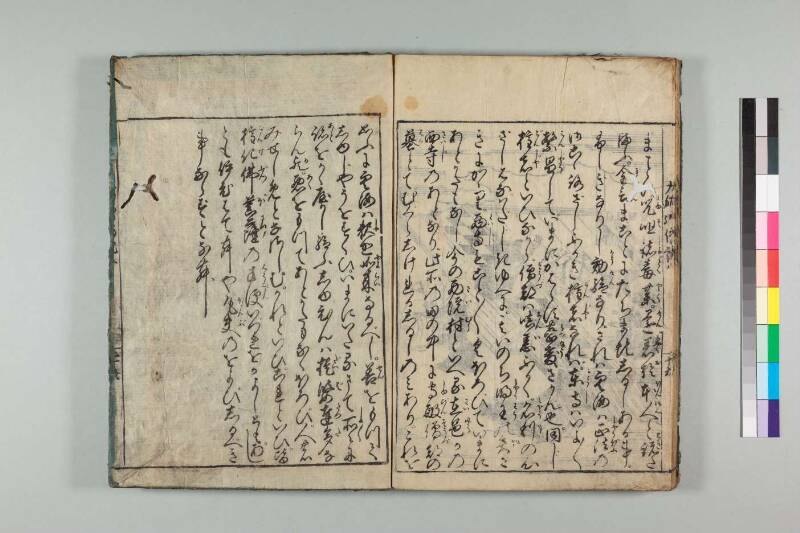
翻刻
まことに呪詛(しゆそ)諸毒薬(しよどくやく)。還着(げんちやく)於(お)本人(ほんにん)と説(とき)た
まふ。金言(きんげん)まことにたちまちしるしある事
ふしぎなりし。効験(かうけん)なり。されは空海は正法(しやうぼふ)の
御こゝろざしふかき権者(ごんじや)なれば。東寺(とうじ)はいよ〳〵
繁昌(はんじやう)して。いまにかはらす密教(みつけう)さかん也。同じ
権者(ごんじや)といひながら。僧都(そうづ)は瞋恚(しんい)ふかく。名利(みやうり)の心
ざしはなはだしきゆへに。其いのち明王(みやうおう)の矢(や)さ
きにかゝり。西寺(さいじ)のこと〳〵くほろびて。いまに
あとがたもなし。今の西院(さい)村(むら)といへる在邑(ざいゆう)かの
西寺(さいじ)のあとなり。此所の田の中に守敏(しゆびん)僧都(そうづ)の
墓(はか)とて。むぐらしげれるしるしのみあり。これを
思ふに空海は釈迦(しやか)如来(によらい)なるべし。善(ぜん)をもつて
しゆじやうをすくひ。いまにいたるまて所々(しよ〳〵)に
跡(あと)をかゝやかし給ふしゆびんは提婆達多(だいばだつた)な
らん歟(か)。悪(あく)をもつてあとかたもなくほろび。人の
みせしめとなせしむ。かれといひ。これといひ。皆
権化(ごんけ)仏(ぶつ)菩薩(ぼさつ)の方便(はうべん)いづれをかよしとも。あし
ともいひはてむや。凡夫(ぼんぶ)のをよびしるべき
事ならすとなむ
現代語訳
まことに「呪詛・諸々の毒薬は、もとの本人に還り着く」と説かれている。この金言はまことにたちまちのうちに験が現れたことは、不思議なことであった。そういうわけで、空海は正法の志深き権者であるから、東寺はいよいよ繁昌して、今に変わらず密教が盛んである。同じ権者といいながら、僧都(守敏)は瞋恚が深く、名誉や利益を求める心が甚だしかったために、その命は明王の矢先にかかり、西寺はことごとく滅びて、今に跡形もない。今の「西院村」という在邑が、かの西寺の跡である。この地の田の中に守敏僧都の墓として、葛が茂る印のみがある。これを思うに、空海は釈迦如来であったに違いない。善をもって衆生を救い、今に至るまで各地に輝かしい御跡を残しておられる。守敏は提婆達多であったのであろうか。悪をもって跡形もなく滅び、人の戒めとなった。あれといい、これといい、皆、権化の仏・菩薩の方便であり、どちらが良いとも悪いとも言い切ることができようか。凡夫の及び知るべきことではない、ということである。
英語訳
Indeed, it has been taught that "curses and all manner of poisonous arts return to strike their original sender." This golden saying proved its truth with immediate and wondrous effect. Thus, because Kūkai was a manifestation of enlightened beings (gonsha) with a deep commitment to the true Dharma, Tō-ji flourished ever more greatly, and its esoteric Buddhism (Mikkyō) remains vibrant to this day, unchanged. Although Shūbin was likewise said to be such a manifestation, the Sōzu harbored deep hatred and an excessive desire for fame and gain; and so his life was struck down by the arrow of the Wisdom Kings (Myō-ō), and Sai-ji was utterly destroyed, leaving not a single trace today. The present hamlet known as "Saiin Village" is the remnant of that former Sai-ji. In the midst of the rice fields of this place, there exists only a marker overgrown with creeping vines, said to be the grave of Sōzu Shūbin. Reflecting on all this, Kūkai must have been Śākyamuni Tathāgata himself, saving sentient beings through goodness and leaving a brilliant legacy across many places to this very day. Shūbin, for his part, must have been Devadatta. Through evil, he perished without a trace and became a cautionary example for humanity. Whether one speaks of the one or the other, both were manifestations (gonke) of Buddhas and Bodhisattvas acting through skillful means (hōben)—how could one say which was good or which was bad? These are matters beyond the comprehension of ordinary mortals.