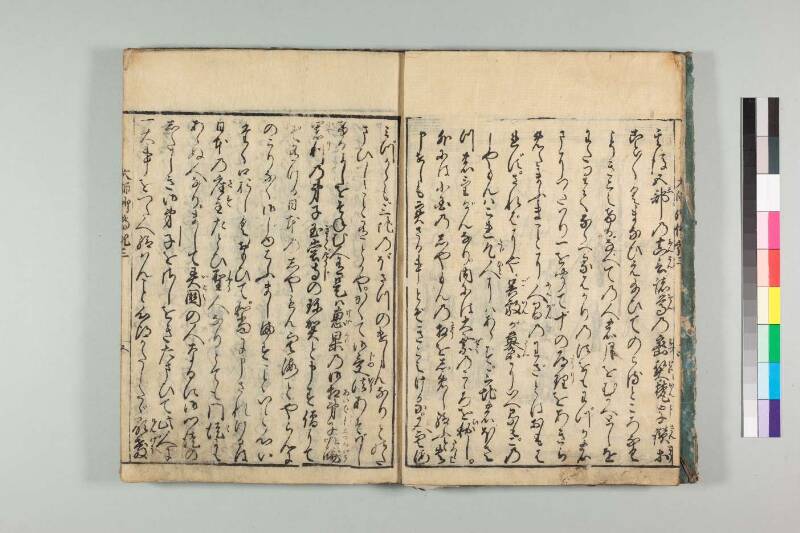
翻刻
其後五 部(ぶ)の真言(しんこん)諸 尊(そん)の密契(みつけい)梵字(ほんじ)讃(さん)等(とう)
こと〳〵くまなひえ給ひてのこるところなく
ようきこえける。なべての人の月をむかへとしを
わたりてならへるはかりの法をもわづかの
まにつかはり一を聞て十の道理(たうり)をあきら
めたまふまことに人間のわざとはおもは
れず。さればにや。呉(ご)殷(いん)の纂(さん)にいへるも。この
しやもんはこれ凡(たゞ)人(ひと)にはあらず。三地のぼさ
つのけげんなり。内には大 乗(ぜう)のこゝろを秘(ひ)し。
外には小国のしやもんの相(さう)をしめし給ふと貴(たつとみ)
申せしも実さる事とぞきこえける。又空海
【順暁阿闍梨弟子珍賀の事】
みづからも。三地のぼさつのけしんなりとのた
まひしこと有とかや。かくて御 受法(じゆほう)あそばし
けるよしをそねむ人有。是は恵果(けいくは)の御 相(あい)弟子(でし)順暁(しゆんけう)
闍梨(じやり)の弟子 玉堂(ぎよくだう)寺(じ)の珍賀と申す僧にて
ぞ有ける。日本のしやもん空海とやらんに
のこりなく御じゆはふましますこといと心い
たく口おしくおもひて。和尚に申されけるは
日本の座主(ざす)たとひ聖(しやう)人なりとても門 徒(と)にも
あらぬ人なり。まして異国(いこく)の人なるに御門徒の
したしき御弟 子(し)をさしをきたまひて此人に
一大事をつたへ給はんこと心得かたしたゞ顕教(けんげう)
現代語訳
その後、五部の真言・諸尊の密契・梵字・讃等をことごとく余すところなく習い覚えられたとのことである。普通の人が月日をかけ年を重ねて学ぶほどの法をも、わずかな間に習得され、一つを聞いて十の道理を悟られた。まことに人間の業とは思われない。それゆえであろうか、呉殷の著述にも、「この沙門はただの人ではない。三地の菩薩の化現である。内には大乗の心を秘め、外には小乗の沙門の相を示し給う」と尊んで申したことも、まことにそのとおりのことと聞こえた。また空海
【順暁阿闍梨の弟子・珍賀のこと】
自らも、「三地の菩薩の化身である」とおっしゃったことがあったとか。こうして御受法(じゅほう)あそばされたことを妬む人がいた。これは恵果の同門弟子・順暁阿闍梨の弟子で、玉堂寺の珍賀と申す僧であった。日本の沙門・空海とやらに、すべて余すところなく御受法なさることを、大変心痛く、口惜しく思って、和尚(恵果)に申し上げるには、「日本の座主は、たとい聖人であったとしても、(当寺の)門徒でもない人です。まして異国の人であるのに、御門徒の親しい御弟子を差し置いて、この人に一大事を伝えられることは、合点がいきません。ただ顕教(けんぎょう)だけを
英語訳
After that, it is said that [Kūkai] mastered without exception all of the mantras of the Five Divisions, the secret mudras of the various honoured deities, Sanskrit characters, hymns, and so forth. He acquired in a mere instant what ordinary people would take months and years to learn, and from hearing one thing, he illuminated ten principles. Truly, it seemed beyond the capacity of any ordinary human being. And so it was, perhaps, that in the writings of Wu Yin it was stated: "This monk is no ordinary person. He is a manifestation of a bodhisattva of the Third Bhūmi. Inwardly, he conceals the mind of the Mahāyāna; outwardly, he displays the appearance of a Hīnayāna monk." That this was said with such veneration was heard to be entirely true. Furthermore, Kūkai
[Concerning Chinga, Disciple of Ājārya Jungyō]
himself is said to have declared that he was indeed a manifestation of a bodhisattva of the Third Bhūmi. While he was thus receiving the Dharma transmissions, there was someone who was jealous of him. This was a monk called Chinga of Gyokudō-ji Temple, a disciple of Ājārya Jungyō, who was a fellow disciple under Huìguǒ. Feeling deeply grieved and resentful that the Japanese monk known as Kūkai was receiving complete and thorough transmissions, he went to the master (Huìguǒ) and said: "The head monk of Japan, even if he be a holy person, is not a member of our community. Moreover, being a person from a foreign land, while setting aside your own intimate disciples within the community, to transmit these most important matters to this person is something I cannot comprehend. It would be enough simply to transmit the Exoteric teachings—"