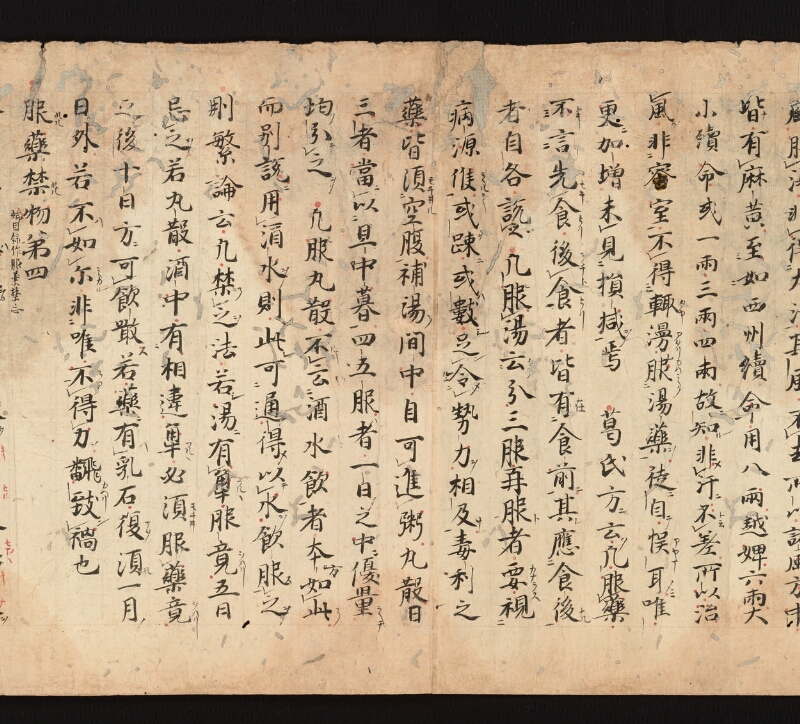
翻刻
皆 ̄ナ有_レ麻₋黄至_三如_二西州続命_一用八両越婢六両大
小続命或一両三両四両故 ̄ニ知 ̄ル非 ̄メ_レ汗 ̄ニ不 ̄ト云_レ差所₋以治
_レ風非_二密室_一不_レ得_三輙(タヤ)漫(アタリ)服(カハミク)_二湯₋薬 ̄ヲ_一徒 ̄ニ自 ̄テ誤(アヤマ)耳(ノミ)唯
更 ̄ニ加₋増未_レ見_二損減 ̄ヲ_一焉 葛氏方 ̄ニ云 ̄ク凡服_レ薬
不 ̄トキ_三言_二先(サキ)_レ食 ̄ヨリ後(ノチト)_レ食 ̄ヨリ_一者皆 有(在)_二食₋前 ̄ニ_一其 ̄レ応_二食₋後 ̄ナル_一
者自各説_レ之 ̄ヲ凡服_レ湯云_二分三服再服 ̄ト_一者 要(カナラス)視_二
病₋源候(シルシ)_一或疎 ̄ニ或 ̄ハ数 ̄シ足 ̄ン_レ《振り仮名:冷|メ|ルニ》_二レ勢力 ̄ヲ相及 ̄サ_一毒₋利之
薬皆 須(モチヰル)_二空₋腹_一補₋湯 ̄ノ間中自可_レ進_レ粥丸散日
三者当 ̄ニ_レ以_二旦₋中暮_一 四₋五₋服者一₋日之中 ̄ニ優量 ̄シテ
均 ̄ク分 ̄テ_レ之 ̄ヲ 凡服丸散不 ̄ルハ_レ云_二酒水飲_一者本₋[方]如_レ此 ̄ノ
而別₋説 ̄ニ用_レ酒₋水 ̄ヲ則此 ̄レ可_二通₋得 ̄メ以 ̄テ_レ水 ̄ヲ飲₋服 ̄ス_一レ之 ̄ヲ
刪繁論云凡禁 ̄ノ_レ之 ̄ヲ法若 ̄シ湯 ̄ニ有_レ触(フルヽ)#1服₋竟(ヲハリ)五日
忌_レ之 ̄ヲ若丸₋散酒₋中有_二相違 触(フルヽ)必 須(モチヰ)服_レ薬竟(ヲハリ)
之後十日方 ̄ニ可_レ飲₋散 ̄ス若薬 ̄ニ有 ̄ハ_レ乳₋石復(マタ)須 ̄ル一月 ̄ノ
日外若不 ̄ハ_レ如_レ尓(シカル)非_二唯不_一レ得_レ力 ̄ヲ翻 ̄カハリ致 ̄ン_レ禍也
服 ̄スル薬禁 ̄スル物第四
《割書:端目録作服薬禁忌|》
現代語訳
## 【服薬節度 第三・続き/服薬禁物 第四】
(前ページより続き:)……(諸風の処方の中に)皆、麻黄(まおう)が用いられている。西州続命湯(さいしゅうぞくめいとう)に至っては八両(はちりょう)を用い、越婢湯(えっぴとう)には六両、大続命湯・小続命湯(だい・しょうぞくめいとう)にはあるいは一両・三両・四両(を用いる)。このことから、汗をかかなければ(病が)差える(いえる)とは言えないことが知られる。それゆえ風を治するには密室(みっしつ)でなければならず、軽々しく漫然と湯薬(とうやく)を服してはならない。(そのような不注意は)いたずらに自ら誤るだけである。(正しく服すれば)さらに(効果が)増すことはあっても、損なわれ減ずることは(かつて)見られない。
葛氏方(かつしほう)に云う:およそ薬を服する際、(処方に)「食前(しょくぜん)より」「食後(しょくご)より」と言及していない場合は、皆、食前(しょくぜん)に服するものとする。食後(しょくご)に服すべきものは、それぞれ処方の中に自ずとその旨が述べられている。およそ湯(とう)を服するに際し、「三服(さんふく)に分けて服す」「再服(さいふく)す」と言う場合は、必ず病の根源(こんげん)・徴候(ちょうこう)をよく観察し、(服用の間隔を)あるいは疎(まばら)に、あるいは数(しば)しばにして、(薬の)勢力(せいりょく)が途切れず相及ぶことで(病に)力が届くよう(間隔を)整えるのがよい。毒利(どくり)の薬(下剤・峻薬の類)は皆、空腹時(くうふくじ)に服さなければならない。補湯(ほとう・補う働きをする湯薬)を服する間には、自ずと粥(かゆ)を進めてよい。丸(がん)・散(さん)を一日三服(さんぷく)する場合は、朝(あした)・昼(ひる)・暮(くれ)の三回(に服すべき)である。四服・五服の場合は、一日の間に(それぞれの間隔を)よく量(はか)って均等(きんとう)に分けて服せよ。
およそ丸・散を服するに際し、(処方に)「酒(さけ)・水・飲(のみもの)」について言及していない場合は、本の処方がそのように(規定している)のであり、一方、別の説では酒あるいは水を用いると言う場合は、水をもってこれを飲み服することで(酒の代わりにも)通じて用いることができる。
『刪繁論(さんぱんろん)』に云う:およそ(食物の)禁忌(きんき)の方法は次のとおりである。もし湯(とう)に(食物との)触れ(ふれ・禁忌の相触れるもの)があれば、服し終えた後、五日間これを忌(い)むべし。もし丸・散(がん・さん)あるいは酒(さけ)の中に(禁忌と)相違(そうい)・触れ(ふれ)があれば、必ず薬を服し終えた後、十日を経て(初めて)(その禁じられたものを)飲んだり食べたりすることができる。もし薬に乳石(にゅうせき)が含まれている場合は、さらに一ヶ月(ひとつき)を経た後でなければならない。もしこのようにしなければ、(薬の)効力(こうりょく)が得られないばかりか、かえって禍(わざわい)を招くことになろう。
---
## 服薬禁物(ふくやくきんもつ) 第四
(端の目録には「服薬禁忌(ふくやくきんき)」と記す。)
英語訳
## [Section Three: The Proper Measure of Taking Medicine, Continued / Section Four: Things Prohibited When Taking Medicine]
[Continuing from the previous page:] …All [of the prescriptions for wind disorders] contain *maō* (麻黄, *Ephedra*, ephedra herb). The *Saishū-zoku-mei-tō* (西州続命湯, Saizhou Life-Continuing Decoction) uses as much as eight *ryō* (両) of it; the *Eppi-tō* (越婢湯, Maidservant-Surpassing Decoction) uses six *ryō*; and the Major and Minor Life-Continuing Decoctions (*Dai-* and *Shō-zoku-mei-tō*, 大・小続命湯) use one, three, or four *ryō*, as the case may be. From this, it can be understood that without inducing sweating, the illness cannot be said to be cured. It is therefore necessary to treat wind disorders in a sealed, draft-free room; one must not recklessly and carelessly take decoctions and medicines without due preparation. To do so is merely to err of one's own accord. [When done correctly,] the effect will only increase further; a reduction or diminution [in benefit] has never been observed.
The *Kasshi-hō* (葛氏方, Formulary of Master Ge [Hong]) states: In general, when a prescription makes no mention of whether the medicine should be taken before or after meals, all such medicines should be taken before a meal (*shoku-zen*, 食前). Those that are to be taken after a meal (*shoku-go*, 食後) will each have that stated explicitly within their respective prescriptions. In general, when a prescription for a decoction (*tō*, 湯) states "divide into three doses" or "take twice," one must carefully observe the origin and signs (*shirushi*, 候) of the illness and adjust the intervals — sometimes wider apart, sometimes more frequent — so that the potency of the medicine reaches [the illness] in an unbroken, continuous manner. Medicines of a drastic or purgative nature (*doku-ri no kusuri*, 毒利之薬) must all be taken on an empty stomach (*kū-fuku*, 空腹). During the course of taking restorative decoctions (*ho-tō*, 補湯), one may freely eat some gruel (*kayu*, 粥) in between doses. For pills (*gan*, 丸) and powders (*san*, 散) prescribed at three doses a day, they should be taken in the morning, at midday, and in the evening. For four or five doses per day, one should carefully measure out the intervals and divide them as evenly as possible throughout the day.
In general, when taking pills and powders and no mention is made of using sake (*sake*, 酒), water, or any other liquid to take the medicine, the original prescription is simply written in this way. In cases where a separate commentary states that sake or water is to be used, it is permissible to take the medicine with water as a general substitute [for sake].
The *Sanpan-ron* (刪繁論, *Treatise on the Reduction of Complexities*) states: The general rules regarding food prohibitions (*kinki*, 禁忌) are as follows. If there is a [food or substance] that conflicts (*fure*, 触) with a decoction, one must abstain from it for five days after finishing the course of the decoction. If there is a conflict or incompatibility (*sōi*, 相違 / *fure*, 触) within a pill, powder, or wine [formula], one must without fail wait until ten days after completing the medicine before consuming [the prohibited substance]. If the medicine contains *nyū-seki* (乳石, mineral substances such as stalactite or other mineral/lapidary drugs), one must additionally wait more than one full month. If one does not follow these rules, not only will the efficacy of the medicine not be obtained, but it will instead bring about harm (*wazawai*, 禍).
---
## Section Four: Things Prohibited When Taking Medicine (*Fuku-yaku Kin-motsu*, 服薬禁物)
(Note: The table of contents at the head [of the scroll] renders this title as *Fuku-yaku Kin-ki*, 服薬禁忌 — "Prohibitions and Taboos in Taking Medicine.")