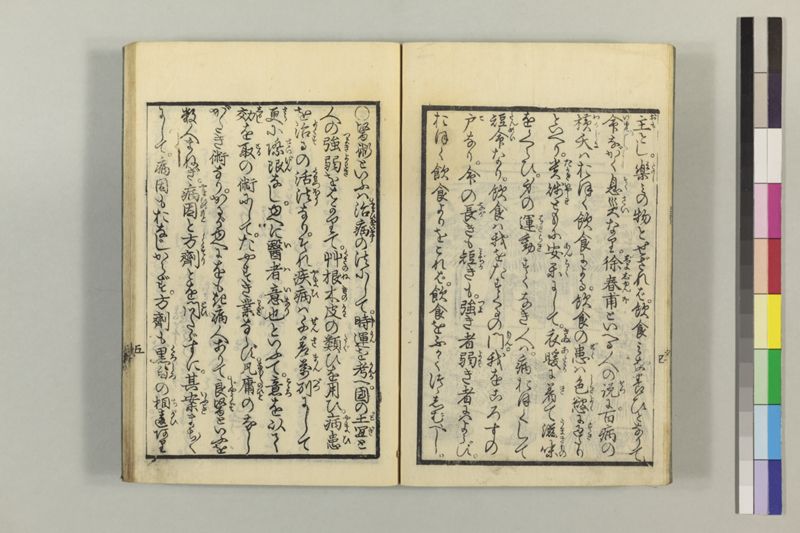
翻刻
【右丁】
主(おも)とし。楽(たのし)みの物とせざれば。飲食みな養ひとなりて
命(いのち)ながく息災(そくさい)なり。徐春甫(じよじゆんほ)といへる人の説(せつ)に。百病の
横夭(わかじに)はおほく飲食による。飲食の患(どく)は色欲(しきよく)に過(すき)たり
といへり。貴賎(たかきいやしき)ともに安楽にして。衣(きぬ)暖(あたか)に着(き)て滋味(うまきもの)
をくらひ。身の運動(はたらき)すくなき人は。病おほくして
短命(たんめい)なり。飲食は我をたすくるの門(もん)。吾をころすの
戸(こ)なり。命の長(なが)きも短(みぢか)きも。強(つよ)き者 弱(よわ)き者にはよらず。
おほく飲食よりをこれば。飲食をふかくつゝしむべし。
【左丁】
○医術といふは。治病(やまひをいやす)の法にして。時運(じうん)を考(かんか)へ。国の土宜(どぎ)と
人の強弱(つよきよわき)をはかりて。草(くさの)【艸】根(ね)木皮(きのかわ)の類(たぐ)ひを用ひ。病患(やまひ)
を治(よくす)るの活法(くわつほう)なり。それ疾病(やまひ)は千差(せんさ)万別(まんべつ)にして
更(さら)に際限(さいげん)なし。ゆへに医者(いは)意(い)也(なり)といふて。意(こゝろ)を以て
効(しるし)を取(とる)の術にして。たやすき業(わざ)ならず。凡庸(なみ〳〵のひと)のなし
がたき術なり。かるがゆへにをもき病人ありて。良医(じやうず)といふを
数人まねぎ。病因(やまひのもと)と方剤(くすり)とを問(とひ)たゞすに。其 案(いふこと)まち〳〵
にして。病因もおなじからず。方剤も黒白の相違(ちがひ)あり
現代語訳
【右丁】
主として楽しみの物としなければ、飲食はみな養いとなって命長く息災である。徐春甫という人の説によると、百病の横死は多く飲食による。飲食の害は色欲に過ぎるという。身分の高い低いに関わらず安楽にして、衣服を暖かく着て美味しいものを食べ、身体の運動が少ない人は、病気が多くて短命である。飲食は我を助ける門であり、我を殺す戸である。命の長短も、強い者弱い者にはよらず、多くは飲食から起これば、飲食を深く慎むべきである。
【左丁】
○医術というのは、治病の方法であって、時運を考え、国の土地の性質と人の強弱を測って、草根木皮の類を用い、病患を治すための活法である。そもそも疾病は千差万別であってまったく際限がない。ゆえに医者の「医」は「意」なりといって、意を以て効を取る術であって、たやすい技ではない。凡庸な人には難しい術である。だからこそ重い病人がいて、良医という者を数人招き、病因と処方について問いただすと、その案は様々であって、病因も同じではなく、処方も黒白ほどの相違がある。
英語訳
【Right page】
If one does not primarily treat food as a source of pleasure, all food and drink become nourishment, leading to a long and healthy life. According to the teachings of a man named Xu Chunfu, most premature deaths from various diseases are caused by food and drink. The harm from food and drink exceeds that of sexual desire. Regardless of high or low social status, those who live in comfort, wear warm clothing, eat delicious food, and have little physical exercise suffer from many illnesses and live short lives. Food and drink are the gate that helps us and the door that kills us. Whether life is long or short does not depend on whether one is strong or weak, but mostly arises from food and drink, so one should deeply exercise caution with food and drink.
【Left page】
○Medical arts are methods for treating illness. They involve considering the times, measuring the nature of the country's land and people's strengths and weaknesses, using things like plant roots and tree bark, and are living methods for curing diseases. Illnesses come in countless varieties with no limits whatsoever. Therefore, it is said that the character for "doctor" (医) comes from "intention" (意), meaning it is an art that achieves results through intention, and is not an easy skill. It is an art that ordinary people find difficult to master. For this reason, when there is a seriously ill patient and several good doctors are invited to inquire about the cause of illness and prescriptions, their opinions vary greatly—the causes they identify are not the same, and their prescriptions differ as much as black and white.