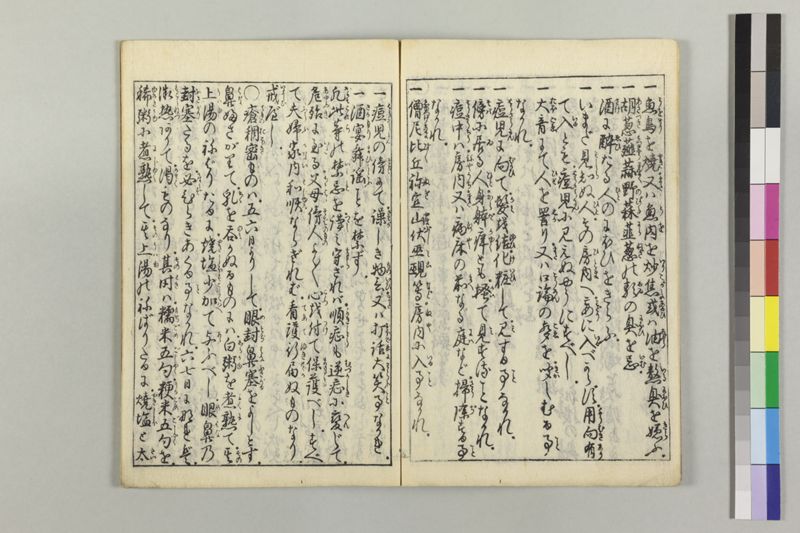
翻刻
【右丁】
一 魚鳥(うをとり)を焼(やき)。又(また)は魚肉(うを)を炒焦(いりこがし)。或(あるひ)は油(あぶら)を熬(いる)臭(にほひ)を嫌(きら)ふ。
一 胡葱(あさつき)薤(らつきやう)蒜(にんにく)野蒜(のびる)韮(にら)葱(ねぎ)の類(るゐ)の臭(にほひ)を忌(いむ)。
一 酒(さけ)に酔(ゑひ)たる人(ひと)のにほひをきらふ。
一いまだ見知(みしら)ぬ人(ひと)。その房内(ひとま)へ。妄(みだり)に入(いる)べからず。用向(ようむき)有(あり)
て入(いる)とも。痘児(はうさうにん)に見えぬやうにすべし。
一 大音(おほごゑ)にて人(ひと)を詈(しか)り。又(また)は口論(こうろん)の声(こゑ)を。聞(きか)しむる事(こと)
なかれ。
一 痘児(はうさうにん)に向(むかひ)て。髪(かみ)を結(ゆひ)。化粧(けはひ)して。見(み)する事(こと)なかれ。
一 傍(そば)に居(ゐ)る人(ひと)。身体(からだ)痒(かゆく)とも。掻(かい)て見(み)することなかれ。
一 痘中(はうさうちう)は。房内(ねやうち)。又(また)は病床(ねや)の前(まへ)なる庭(には)など。掃除(さうぢ)する事(こと)
なかれ。
一 僧(しゆつけ)尼(あま)比丘(びく)禰宜(ねぎ)山伏(やまぶし)巫覡(みこ)等(など)。房内(ねや)に入(いる)事(こと)なかれ。
【左丁】
一 痘児(はうさうにん)の傍(そば)にて。噪(さわが)しき物云(ものいひ)。又(また)は打話大笑(おほごゑにわらふ)事(こと)なかれ。
一 酒宴(さかもり)舞謡(まひうたふ)ことを禁(きん)ず
凡(およそ)此等(これら)の禁忌(いみこと)を。謹(つゝし)み守(まもら)ざれば。順症(よきしよう)も逆症(むづかしき)に変(へん)じて。
危殆(あやふき)に至(いた)る。父母(ちゝはゝ)傍人(そばのもの)よく〳〵心(こゝろ)を付(つけ)て保護(まもる)べし。すべ
て夫婦(ふうふ)家内(かない)和順(わじゆん)ならざれば。看護(てあて)行届(ゆきとゞか)ぬものなり。
戒(いましむ)べし。
○瘡(でもの)稠密(おほき)ものは。五六日よりして。眼封(めとぢ)鼻塞(はなふさがる)をよしとす。
鼻(はな)ふさがりて。乳(ちゝ)を吞(のみ)かぬるものには。白粥(しらかゆ)を煮熟(よくに)て。其(その)
上湯(うはゆ)のねばりたるに。焼塩(やきしほ)少(すこし)加(くはへ)て与(あた)ふべし。眼鼻(めはな)の
封塞(ふさがり)たるを。必(かならず)ひらきあくる事(こと)なかれ。六七日になれば。
微熱(すこしねつ)ありて。渇(かわく)ものなり。其時(そのとき)は。糯米(もちごめ)五勺(ごしやく)。粳米(うるごめ)五勺(ごしやく)を。
稀粥(ゆるきかゆ)に煮熟(にじゆく)して。其(その)上湯(うはゆ)のねばりたるに。焼塩(やきしほ)と太(たい)
現代語訳
【右丁】
一、魚や鳥を焼く、または魚肉を炒り焦がす、あるいは油を熬る(煎る)臭いを嫌う。
一、アサツキ・ラッキョウ・ニンニク・ノビル・ニラ・ネギの類の臭いを忌む。
一、酒に酔った人の臭いを嫌う。
一、まだ見知らぬ人は、その部屋へみだりに入ってはならない。用事があって入るとしても、痘瘡患者に見えないようにすべきである。
一、大声で人を叱る声、または口論の声を、(患者に)聞かせてはならない。
一、痘瘡患者に向かって、髪を結い、化粧をして見せてはならない。
一、そばにいる人は、身体が痒くとも、掻いて見せてはならない。
一、痘瘡の期間中は、寝室の中、または病床の前にある庭などを掃除してはならない。
一、僧・尼・比丘・禰宜・山伏・巫覡(みこ)などは、寝室に入ってはならない。
【左丁】
一、痘瘡患者のそばで、騒がしく話すこと、または大声で笑うことをしてはならない。
一、酒宴や舞い歌うことを禁ずる。
およそこれらの禁忌を謹んで守らなければ、順調な症状も悪化して、危険な状態に至る。父母や傍らにいる者は、くれぐれも注意を払って保護すべきである。そもそも夫婦・家内が和やかに仲良くしていなければ、看護が行き届かないものである。よく戒めるべきである。
○できもの(痘瘡)が多いものは、五・六日目から、目が閉じ鼻が塞がるのを良い(状態)とする。
鼻が塞がって、乳を飲めないものには、白粥をよく煮て、その上澄みのねばりのあるものに、焼き塩を少し加えて与えるべきである。目や鼻が塞がっているのを、必ず開けてはならない。六・七日目になれば、少し熱があって、喉が渇くものである。その時は、糯米(もち米)五勺・粳米(うるち米)五勺を、薄い粥によく煮て、その上澄みのねばりのあるものに、焼き塩と太(鯛)〔以下次ページへ続く〕
英語訳
**[Right folio]**
- The smell of grilling fish or fowl, scorching fish flesh in a pan, or frying oil is to be avoided.
- The smells of Welsh onion (asatsuki), rakkyo (Japanese shallot), garlic, wild garlic (nobiru), Chinese chives (nira), and green onion (negi) are to be avoided.
- The smell of a person drunk on sake is to be avoided.
- A person not yet acquainted with the household must not enter the patient's room without due cause. Even if there is reason to enter, care should be taken that the smallpox patient does not see them.
- The sound of a person being scolded loudly, or the sound of a quarrel, must not be allowed to reach the patient's ears.
- One must not dress one's hair and apply makeup in the presence of the smallpox patient.
- Those attending at the bedside must not scratch themselves, even if their body itches, in the patient's presence.
- During the period of smallpox, the interior of the sickroom, or the garden in front of the sickroom, must not be swept or cleaned.
- Buddhist monks, nuns, bhikkhus (mendicant monks), Shinto priests (negi), mountain ascetics (yamabushi), and shrine mediums/shamanesses (miko) must not enter the sickroom.
**[Left folio]**
- Noisy talking or laughing loudly in the presence of the smallpox patient is forbidden.
- Sake banquets, dancing, and singing are prohibited.
If these prohibitions and taboos are not carefully observed, even a favorable case may turn adverse and reach a dangerous state. Parents and those attending the patient should be most attentive in their care and protection. In general, if husband and wife and the household are not harmonious and at peace with one another, nursing care will not be thorough. This is a matter to be strictly heeded.
○ In cases where the pox eruptions are numerous, it is considered favorable for the eyes to become sealed shut and the nose to become blocked from around the fifth or sixth day.
When the nose is blocked and the infant cannot drink breast milk, well-cooked plain rice gruel should be prepared, and the viscous liquid from the top of the gruel should be given with a small amount of roasted salt added. The sealed eyes and blocked nose must never be forcibly opened.
By the sixth or seventh day, there will be some mild fever, and the patient will experience thirst. At that time, five shaku of glutinous rice (mochigome) and five shaku of non-glutinous rice (uruchi-mai) should be cooked into a thin gruel, and the viscous liquid from the top should be given with roasted salt and tai (sea bream)... [continued on next page]