翻刻
【右丁】
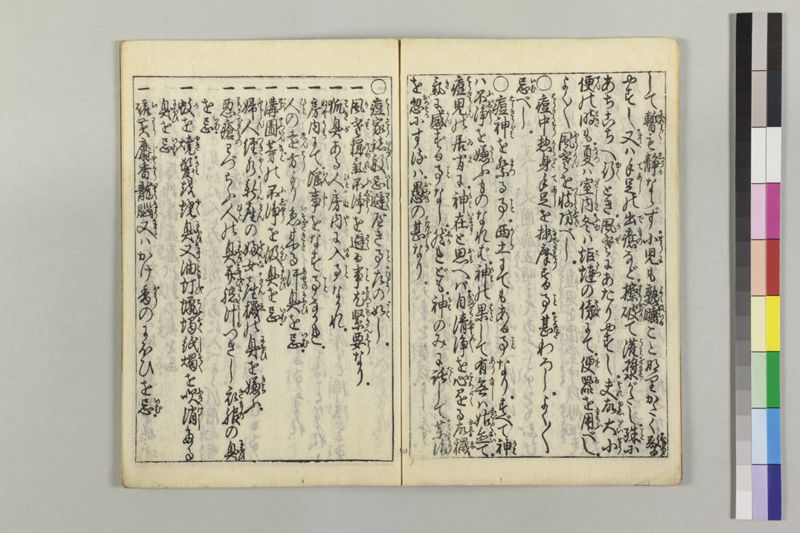
して。暫(しばらく)も静(しづか)ならず。小児(せうに)も熟睡(よくねいる)ことなりかたく。驚(おどろき)
やすし。又(また)は手足(てあし)の出瘡(でもの)など。擦破(すりやぶり)て灌漿(うみをもち)がたし。殊(こと)に
あちこちへ行(ゆく)とき。風寒(かぜ)にあたりやすし。夫故(それゆゑ)大小(だいせう)
便(べん)の時(とき)も。夏(なつ)は室内(ざしき)。冬(ふゆ)は炬燵(こたつ)の傍(そば)にて。便器(まる)を用(もちふ)べし。
よく〳〵風寒(ふうかん)を慎(つゝしみ)防(ふせぐ)べし。
○痘中(はうさうちう)惣身(からだ)手足(てあし)を按摩(なでさすり)する事(こと)。甚(はなはだ)わろし。よく〳〵
忌(いむ)べし。
○痘神(はうさうがみ)を祭(まつ)る事(こと)。西土(から)にてもある事(こと)なり。すべて神(かみ)
は不浄(ふじやう)を嫌(きら)ふものなれば。神(かみ)の果(はた)して有無(ありなし)は姑(しばらく)置(おい)て。
痘児(はうさうにん)の居間(ゐま)に。神(かみ)在(います)と思(おも)へば。自(おのづから)清浄(しやう〴〵)を心懸(こゝろがく)る故(ゆゑ)。穢(ゑ)
気(き)に感(かん)ずる事(こと)なし。然(しか)れども。神(かみ)のみに託(たく)して。薬治(くすり)
を忽(おろそか)にするは。愚(おろか)の甚(はなはだしき)なり。
【左丁】
○痘家(はうさう)諸般(いろ〳〵)忌避(いみさく)べき事(こと)。左(ひだり)の如(ごと)し。
一 風寒(かぜ)穢気(けがれ)不浄(ふじやう)を避(さく)る事(こと)。尤(もつとも)緊要(きんえう)なり。
一 狐臭(わきが)ある人(ひと)。房内(ねや)に入(いる)事(こと)なかれ。
一 房内(ねやうち)にて。淫事(いんじ)をなす事(こと)なかれ。
一 人(ひと)の遠方(ゑんはう)より急来(いそぎきた)る汗臭(あせのにほひ)を忌(いむ)。
一 溝(どぶ)圊(せついん)等(など)の不浄(ふじやう)を汲(くむ)臭(にほひ)を忌(いむ)。
一 婦人(ふじん)経水(つきやく)。新産(しんさん)の婦女(をんな)。産穢(さんゑ)の臭(にほひ)を嫌(きら)ふ。
一 悪瘡(わろきできもの)わづらふ人(ひと)の臭(にほひ)。幷(ならびに)膿汁(うみしる)つきし衣服(きもの)の臭(にほひ)
を忌(いむ)。
一 蚊(か)を焼(やき)。髪(かみ)を焼(やく)臭(にほひ)。又(また)油灯(ともしび)蠟燭(らふそく)紙燭(しそく)を吹消(ふきけし)たる
臭(にほひ)を忌(いむ)。
一 硫黄(いわう)麝香(じやかう)竜脳(りうなう)又(また)はかけ香(がう)のにほひを忌(いむ)。
現代語訳
【右丁】
して、しばらくも静かにならない。子供もよく眠ることが難しく、驚きやすい。また、手足のできものなどを擦り破って、膿を持ちにくくなる。特に、あちこちへ移動するときに、風邪(かぜ)に当たりやすい。それゆえ、大小便のときも、夏は部屋の中で、冬は炬燵のそばで、便器を使うべきである。くれぐれも風寒を慎み防ぐべきである。
○痘瘡の期間中、全身・手足をなで擦ること(按摩)は、非常に良くない。十分に慎むべきである。
○痘神を祭ることは、中国でもある習慣である。そもそも神は不浄を嫌うものであるから、神が果たして実在するかどうかはひとまず置いておいて、痘瘡患者の居間に神がいると思えば、自然と清潔を心がけるので、穢れた気に感染することがない。しかしながら、神だけに頼って、薬による治療をおろそかにするのは、この上なく愚かなことである。
【左丁】
○痘瘡(の治療)に際して、さまざまに忌み避けるべきことは、以下の通りである。
一、風寒・穢気・不浄を避けることが、最も重要である。
一、腋臭(わきが)のある人は、寝室に入ってはならない。
一、寝室の中で、性行為を行ってはならない。
一、遠方から急いでやって来た人の汗の臭いを忌む。
一、溝や便所などの不浄なものを汲む臭いを忌む。
一、婦人の月経、出産直後の女性、産後の穢れの臭いを嫌う。
一、悪い瘡(できもの)を患う人の臭い、および膿汁のついた衣服の臭いを忌む。
一、蚊を焼く臭い、髪を焼く臭い、また油灯・蠟燭・紙燭を吹き消したときの臭いを忌む。
一、硫黄・麝香・竜脳、またはかけ香の臭いを忌む。
英語訳
**[Right folio]**
...and the child is not calm even for a moment. The child also finds it difficult to sleep soundly and is easily startled. Furthermore, the sores on the hands and feet may be rubbed and broken open, making it difficult for them to fill with pus properly. Especially when moving about from place to place, the child is easily exposed to cold wind. For this reason, even at the time of urination and defecation, a bedpan should be used — indoors in summer, and beside the kotatsu in winter. Every effort should be made to guard carefully against wind and cold.
○ During smallpox, rubbing and stroking the entire body, including the hands and feet (i.e., massage), is extremely harmful. It should be strictly avoided.
○ The practice of enshrining and venerating the Smallpox Deity (Hōsōgami) exists even in China. Since the gods in general abhor impurity, setting aside for the moment the question of whether the god truly exists, if one believes that the deity resides in the room of the smallpox patient, one will naturally be mindful of maintaining cleanliness, and thus there will be no exposure to noxious, impure air. However, relying solely on the deity and neglecting medical treatment with medicines is the height of foolishness.
**[Left folio]**
○ The various things that should be avoided and shunned during smallpox are as follows:
- Avoiding wind, cold, noxious vapors, and impurity is of the utmost importance.
- Persons who have body odor (osmidrosis/bromhidrosis) must not enter the sickroom.
- Sexual acts must not be performed within the sickroom.
- The odor of sweat from a person who has traveled quickly from a distant place is to be avoided.
- The smell arising from drawing out or handling the filth of gutters and privies is to be avoided.
- The menstrual discharge of women, women who have recently given birth, and the smell of post-natal impurity are to be avoided.
- The odor of a person afflicted with foul sores (malignant ulcers), as well as the smell of clothing stained with pus, is to be avoided.
- The smell of burning mosquitoes, the smell of burning hair, and the smell produced when blowing out an oil lamp, candle, or paper taper are to be avoided.
- The smells of sulfur, musk, borneol (ryūnō / camphor), and sachets (kakekō) are to be avoided.