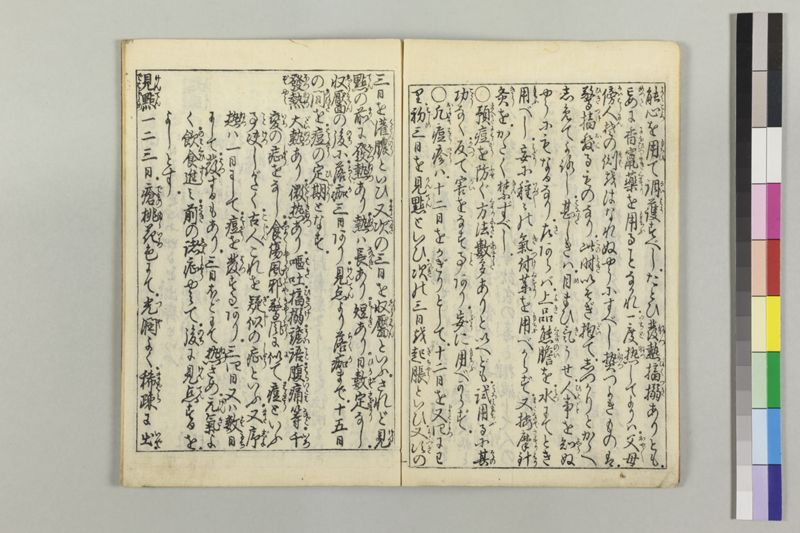
翻刻
【右丁】
能(よく)心(こゝろ)を用(もちひ)て調護(かいはう)すべし。たとひ発熱(ねつ)搐搦(びくつき)ありとも。
妄(めつた)に香竄薬(にほひつよきくすり)を用(もちふ)ることなかれ。一度(いちど)熱(ねつ)してよりは。父母(おや〳〵)
傍人(かいはうにん)その側(そば)をはなれぬやうにすべし。熱(ねつ)つよきものは。
驚搐(ひきつけ)発(おこ)るものなり。此時(このとき)いそぎ抱(だい)て。しつかりとかゝへ
しめてよろし。甚(はなはだ)しきは。目(め)まひ気(き)うせ。人事(ひとごと)を知(しら)ぬ
やうにもなるなり。左(さ)あらば。上品(よき)熊胆(くまのい)を。水(みづ)にてとき
用(もちふ)べし。妄(みだり)に種々(いろ〳〵)の気付薬(きつけぐすり)を用(もちふ)べからず。又(また)按摩(なでさすり)針(はり)
灸(きう)を。かたく禁(きん)ずべし。
○預(まへかたに)痘(はうさう)を防(ふせ)ぐ方法(くすりしかた)。数多(あまた)ありといへども。試用(こゝろみもちふ)るに其(その)
功(こう)なく。反(かへつ)て害(がい)をなす事(こと)あり。妄(みだり)に用(もちふ)べからず。
○凡(およそ)痘疹(はうさう)は。十二日をかぎりとして。十二日を又(また)四(よつ)にわ
り。初(はじめ)三日を見点(けんてん)といひ。次(つぎ)の三日を起脹(きちやう)といひ。又(また)次(つぎ)の
【左丁】
三日を灌膿(くわんのう)といひ。又(また)次(つぎ)の三日を収靨(しうえん)といふ。されど見(けん)
点(てん)の前(まへ)に発熱(ほつねつ)あり。熱(ねつ)は長(ねがき)あり。短(みじかき)あり。日数(ひかず)定(さだまり)なし。
収靨(しうえん)の後(のち)に。落痂(らくか)三日あり。見点(けんてん)より落痂(らくか)まで。十五日
の間(あひだ)を。痘(はうさう)の定期(ひどり)となす。
発熱(ほつねつ|ぞやみ )大熱(だいねつ)あり。微熱(すこしきねつ)あり。嘔吐(はき)。搐搦(ひきつけ)。譫語(うはこと)。腹痛(はらいたみ)等(など)。千(いろ)
変(いろ)の症(しよう)をなし。食傷(しよくしやう)風邪(ふうじや)驚風(きやうふう)に似(に)て。痘(はうさう)といふ
事(こと)決(けつ)しががたく。古人(こじん)これを疑似(ぎじ)の症(しよう)といふ。又(また)序(じよ)
熱(ねつ)は一日にして。痘(はうさう)を発(はつ)するあり。三四日又は数日(すにち)
にして。発(はつ)するもあり。三日ほどにて熱(ねつ)さめ。元気(げんき)よ
く。飲食(のみくひ)進(すゝ)み。前(さき)の諸症(しよしよう)やみて。後(のち)に見点(けんてん)するを。
よしとす。
見点(けんてん|ではじめ )一二三日。瘡(でもの)桃花色(もゝいろ)にて。光潤(つや)よく。稀疎(まばら)に出(いで)。
現代語訳
【右丁】
よく心を用いて看病すべきである。たとえ発熱・けいれんがあっても、むやみに強い香りのする薬を使ってはならない。一度熱が出てからは、父母・看病人がその傍を離れないようにすべきである。熱の強いものは、ひきつけを起こすものである。この時は急いで抱いて、しっかりと抱えるようにするのがよい。ひどい場合は、目まいや気絶をして、意識を失うようになることもある。そのような場合は、上質の熊の胆汁を水に溶かして用いるべきである。むやみに様々な気付け薬を用いてはならない。また、按摩・鍼・灸は固く禁じるべきである。
○あらかじめ痘瘡(天然痘)を防ぐ方法は数多くあるといっても、試してみると効果がなく、かえって害をなすことがある。むやみに用いてはならない。
○およそ痘瘡は十二日を区切りとして、その十二日をさらに四つに分け、最初の三日を「見点」といい、次の三日を「起脹」といい、またその次の
【左丁】
三日を「灌膿」といい、またその次の三日を「収靨」という。しかし見点の前に発熱があり、熱は長いものもあれば短いものもあり、日数は一定しない。収靨の後に「落痂」の三日がある。見点から落痂まで十五日の間を、痘瘡の定まった期間とする。
発熱(初期の発熱)には高熱もあれば微熱もあり、嘔吐・けいれん・うわごと・腹痛など、様々な症状を呈し、食傷・風邪・驚風に似ていて、痘瘡と断定しがたく、古人はこれを「疑似の症」と呼んだ。また、序熱は一日で痘瘡が発疹することもあれば、三四日あるいは数日を経て発疹することもある。三日ほどで熱が収まり、元気よく飲み食いが進み、以前の諸症状がおさまった後に見点となるのを良しとする。
見点(発疹開始)の一・二・三日目は、でき物が桃の花の色(薄紅色)をして、つやよく、まばらに出てきて、
英語訳
**[Right folio]**
One should take great care in nursing the patient. Even if fever and convulsions occur, one must not recklessly use strongly scented medicines. Once a fever has started, parents and caregivers should not leave the patient's side. Those with strong fevers are prone to convulsions. At such times, one should quickly hold and firmly embrace the child. In severe cases, dizziness and loss of consciousness may occur, leaving the patient unaware of their surroundings. In such situations, one should dissolve high-quality bear bile in water and administer it. One must not recklessly use various kinds of restorative medicines. Furthermore, massage, acupuncture, and moxibustion should be strictly forbidden.
○ Although there are numerous methods said to prevent smallpox in advance, when tried, they are found to have no effect and may even cause harm. One must not use them recklessly.
○ Smallpox generally takes twelve days as its standard course, which is further divided into four stages. The first three days are called "kenken" (appearance of spots), the next three days are called "kichō" (rising and swelling), and the next
**[Left folio]**
three days are called "kannō" (suppuration/filling with pus), and the final three days are called "shūen" (crusting/scabbing). However, before the kenken stage there is an initial fever, which may be long or short, with no fixed number of days. After shūen, there are three days of "rakka" (falling of scabs). The period from kenken to rakka, spanning fifteen days, constitutes the fixed course of smallpox.
During the initial fever (jōnetsu), there may be high fever or mild fever, and various symptoms such as vomiting, convulsions, delirium, and abdominal pain occur, resembling indigestion, the common cold, or fright convulsions, making it difficult to definitively identify smallpox. The ancients called this the "doubtful condition" (giji no shō). Furthermore, the prodromal fever may last only one day before the rash appears, or three to four days, or even several days before eruption. It is considered favorable when the fever subsides after about three days, the patient recovers their vitality, eating and drinking improve, the previous symptoms resolve, and the kenken stage follows.
During kenken (eruption stage), days one through three: the sores appear in a peach-blossom color (light pink), with a good luster, appearing sparsely,