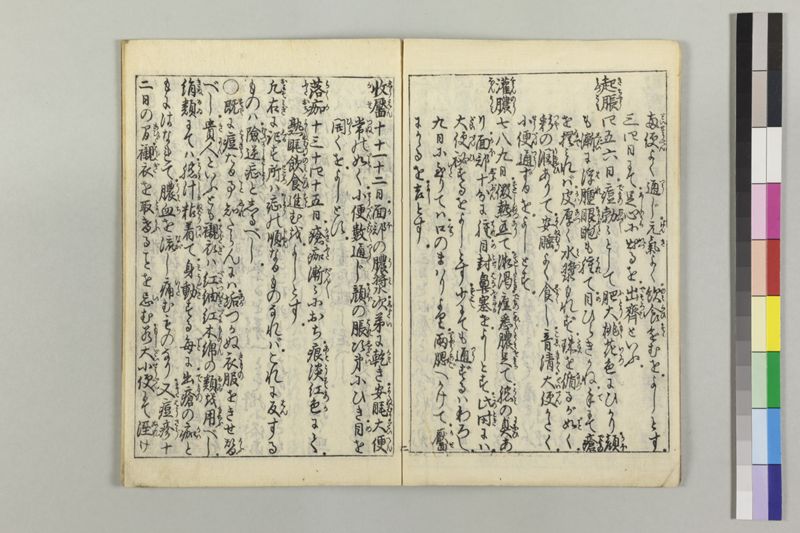
翻刻
【右丁】
両便(だいせうべん)よく通(つう)じ。元気(げんき)よく。飲食(のみくひ)進(すゝ)むを。よしとす。
三四日にて。足心(あしのうら)に出(いづ)るを。出斉(でそろひ)といふ。
起脹(きちやう|みづうみ )四五六日。痘(でもの)勃々(ぶつ〳〵)として肥大(ふとり)。桃花色(もゝいろ)にひかり。顔(かほ)
も漸(しだい)に浮腫(はれ)。眼胞(まぶた)も腫(はれ)て。目(め)ひらきかね。手(て)にて瘡(でもの)
を撫(なで)みれば。皮(かは)厚(あつ)く水漿(みづ)もれず。珠(たま)を循(なづ)るが如(ごと)く。
彩(つや)の潤(うるほひ)ありて。安睡(よくねむり)。よく食(しよく)し。音(こゑ)清(きよく)。大便(だいべん)かたく。
小便(せうべん)通(つう)ずるを。よしとす。
灌膿(くわんのう|ほんうみ )七八九日。微熱(すこしねつ)有(あり)て。漸渇(すこしかわき)。痘(でもの)悉(こと〴〵く)膿足(うみをもち)て。膿(うみ)の臭(にほひ)あ
り。面部(かほ)十分(じふぶん)に腫(はれ)。目封(めとぢ)鼻塞(はなふさがる)を。よしとす。此時(このとき)には。
大便(だいべん)秘(ひ)するをよしとす。少(すこし)にても通(つう)ずるはわろし。
九日に至り(いた)りては。口(くち)のまはりより。両腮(りやうあご)へかけて。靨(かせ)
にかゝるを。吉(よし)とす。
【左丁】
収靨(しうえん|かせ )十十一十二日。面部(かほ)の膿漿(うみ)。次第(しだい)に乾(かわ)き。安睡(よくねむり)。大便(だいへん)
常(つね)の如(ごと)く。小便(せうべん)数(たび〳〵)通(つう)じ。顔(かほ)の脹(はれ)次第(しだい)にひき。目(め)を
開(ひら)くを。よしとす。
落痂(らくか|ふたおち )十三十四十五日。瘡痂(かさふた)漸々(だん〳〵)におち。痕(あと)淡紅色(うすあか)にて。
熟睡(よくねむり)。飲食(のみくひ)進(すゝ)むを。よしとす。
凡(およそ)右(みぎ)に記(しる)す所(ところ)は。症(しよう)の順(じゆん)なるものなれば。これに反(はん)する
ものは。険逆症(むづかしきしよう)としるべし。
○既(すで)に痘(はうさう)たる事(こと)知(しれ)たらんには。垢(あか)つかぬ衣服(きもの)をきせ替(かふ)
べし。貴人(きにん)といふとも。襯衣(はだぎ)は紅紬(べにつむぎ)紅木綿(べにもめん)の類(るゐ)を用(もちふ)べし。
絹類(きぬるゐ)にては。種汁(うみしる)粘着(ねばりつい)て。身動(みうごき)する毎(ごと)に。出瘡(でもの)の痂(かは)と
もにはなれて。膿(うみ)血(ち)を流(なが)し痛(いた)むものなり。又(また)痘疹(はうさう)十
二日の間(あひだ)。襯衣(はだぎ)を取替(とりかふ)ることを忌(い)む。若(もし)大小便(だいせうべん)にて湿(ぬれ)け
現代語訳
【右丁】
大小便がよく通じ、元気よく、飲み食いが進むのを良しとする。
三・四日目に足の裏にまで出そろうことを「出斉」という。
起脹(みずうみ)四・五・六日目。できものがぶつぶつと肥大し、桃の花の色(薄紅色)に光り、顔も次第に腫れ、まぶたも腫れて目を開けにくくなる。手でできものを触れてみると、皮が厚く水が漏れず、玉を撫でるように、つやと潤いがあり、よく眠り、よく食べ、声が澄んでいて、大便が固く、小便が通じるのを良しとする。
灌膿(ほんうみ)七・八・九日目。微熱があり、少し渇きが出て、できものがことごとく膿を持ち、膿の臭いがある。顔が十分に腫れ、目が閉じ、鼻がふさがるのを良しとする。この時期には、大便が出ないのを良しとする。少しでも通じるのは良くない。九日目に至っては、口のまわりから両顎にかけて、瘡蓋(かさぶた)ができ始めるのを吉とする。
【左丁】
収靨(かせ)十・十一・十二日目。顔の膿が次第に乾き、よく眠り、大便が普段どおりとなり、小便が度々通じ、顔の腫れが次第に引いて、目を開けるようになるのを良しとする。
落痂(ふたおち)十三・十四・十五日目。瘡蓋が段々と落ち、跡が淡い紅色となり、よく眠り、飲み食いが進むのを良しとする。
およそ右に記したことは、症状が順調な場合のことであるから、これに反するものは危険・逆症と知るべきである。
○すでに痘瘡(天然痘)であることが知れたならば、垢のついていない衣服に着替えさせるべきである。身分の高い方であっても、肌着は紅紬・紅木綿の類を用いるべきである。絹類では、膿の汁が粘りついて、身動きするたびに、できものの瘡蓋ともども剥がれて、膿・血を流して痛むものである。また、痘瘡の十二日の間は、肌着を取り替えることを忌む。もし大小便で濡れた場合は
英語訳
**[Right folio]**
Both bowel movements and urination should be regular, the patient should be in good spirits, and eating and drinking should be progressing well — these are considered favorable signs.
On the third or fourth day, when the eruptions have spread all the way to the soles of the feet, this is called "desoi" (complete eruption).
**Kichō (rising and swelling stage) — days four, five, and six.** The sores swell up vigorously, shining in a peach-blossom color (light pink), the face gradually becomes puffy, the eyelids swell so that the eyes can barely be opened. When one strokes the sores with the hand, the skin is thick and no fluid leaks, as if feeling a smooth bead, with a lustrous sheen. Sleeping well, eating well, a clear voice, firm stools, and regular urination are all considered favorable signs.
**Kannō (suppuration stage) — days seven, eight, and nine.** There is a mild fever with some thirst; the sores are entirely filled with pus and emit a smell of pus. The face is fully swollen, the eyes are sealed shut, and the nose is blocked — these are considered favorable signs. During this period, constipation (no bowel movement) is considered favorable; even a slight bowel movement is considered unfavorable. By the ninth day, the beginning of scab formation (靨) spreading from around the mouth to both jaws is considered auspicious.
**[Left folio]**
**Shūen (crusting/scabbing stage) — days ten, eleven, and twelve.** The pus on the face gradually dries up; the patient sleeps well, bowel movements return to normal, urination becomes frequent, the swelling of the face gradually subsides, and the eyes begin to open — these are considered favorable signs.
**Rakka (falling of scabs stage) — days thirteen, fourteen, and fifteen.** The scabs gradually fall away, the remaining marks are a pale reddish color, the patient sleeps well, and eating and drinking progress well — these are considered favorable signs.
In general, what is recorded above describes cases where symptoms follow a favorable course; anything contrary to this should be recognized as a dangerous or adverse condition.
○ Once it has become known that the illness is indeed smallpox, the patient should be dressed in clean clothing free of grime. Even for persons of high rank, the undergarment should be made of red-dyed pongee silk (beni tsumugi) or red cotton (beni momen) of that kind. With silk fabrics, the pus adheres stickily, and each time the patient moves, the scabs of the sores are pulled away together with the fabric, causing pus and blood to flow and inflicting pain. Furthermore, during the twelve days of smallpox, changing the undergarment is to be avoided. If it becomes wet from urination or defecation,