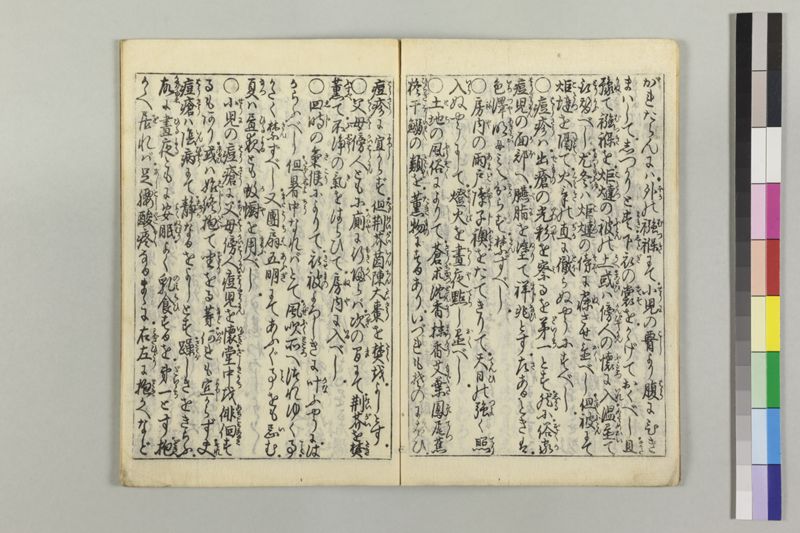
翻刻
【右丁】
がれたらんには。外(ほか)の襁褓(むつき)にて。小児(せうに)の腰(こし)より腹(はら)にひき
まはして。しつかりと巻(まき)。下衣(したぎ)の裳(すそ)を。かゝげておくべし。且(また)
予(かね)て襁褓(むつき)を。炬燵(こたつ)の被(ふとん)の上(うへ)。或(あるひ)は傍人(かんびやうにん)の懐(ふところ)に入(いれ)。温置(あたゝめおい)て
取替(とりかふ)べし。尤(もつとも)冬(ふゆ)は炬燵(こたつ)の傍(そば)に寐(ね)させ置(おく)べし。但(たゞし)被(ふとん)にて
炬燵(こたつ)を隔(へだて)て。火気(くわき)の直(ぢか)に徹(とほ)らぬやうにすべし。
○痘疹(はうさう)は。出瘡(でもの)の光彩(いろつや)を察(み)るを第一(だいゝち)とす。然(しかる)に。俗家(ぞくか)
痘児(はうさうにん)の面部(かほ)へ。臙脂(べに)を塗(ぬり)て祥兆(まじなひ)とす。左(さ)あるときは。
色沢(いろつや)明(あきらか)にみへ分(わか)らず。禁(きん)ずべし。
○房内(ねや)の雨戸(あまど)障子(しやうじ)襖(ふすま)をたてきりて。天日(てんひ)の強(つよ)く照(てり)
入(いら)ぬやうにして。灯火(ともしび)を昼夜(ちうや)点(てら)し置(おく)べし。
○土地(とち)の風俗(ふうぞく)によりて。蒼朮(さうぢゆつ)沈香(ぢんかう)抹香(まつかう)艾葉(もぐさ)鳳尾蕉(そてつ)
柊(ひゝらぎ)干鰯(ほしいわし)の類(たぐひ)を。薫物(たきもの)にするあり。いづれもそのにほひ。
【左丁】
痘疹(はうさう)に宜(よろし)からず。但(ただ)荊芥(けいがい)茵陳(いんちん)大棗(たいさう)を焚(たく)を。よしとす。
○父母(ちゝはゝ)傍人(かいはうにん)ともに。厠(かはや)に行帰(ゆきかへ)らば。次(つぎ)の間(ま)にて。荊芥(けいがい)を焚(たき)
薫(ふすべ)て。不浄(ふじやう)の気(き)をはらひて。房内(ねや)に入(いる)べし。
○四時(しじ)の気候(きこう)によりて。衣服(きせもの)よろしきに叶(かな)ふやうに。は
からふべし。但(ただし)暑中(しよちう)なればとて。風(かぜ)吹(ふく)所(ところ)へつれゆく事(こと)。
かたく禁(きん)ずべし。又(また)団扇(うちは)五明(あふぎ)にてあふぐ事(こと)をも忌(い)む。
夏(なつ)は昼夜(ひるよる)とも蚊幮(かや)を用(もちふ)べし。
○小児(せうに)の痘瘡(はうさう)に。父母(ちゝはゝ)傍人(かいはうにん)。痘児(はうさうにん)を懐(いだき)。堂中(ざしきうち)を徘徊(あちこちあるき)す
るもあり。或(あるひ)は始終(しじう)抱(だい)て坐(すわり)をる等(など)。何(いづ)れも宜(よろし)からず。夫(それ)
痘瘡(はうさう)は陰病(いんびやう)にて。静(しづか)なるをよしとす。躁(さわが)しきをきらふ。
故(かるがゆゑ)に昼夜(ひるよる)ともに安眠(よくねむり)。よく乳食(のみくひ)するを。第一(だいゝち)とす。抱(だき)
かゝへ居(を)れば。足腰(あしこし)酸疼(だるく)なるまゝに。右左(みぎひだり)に抱(だき)かへなど
現代語訳
【右丁】
れた場合には、別のおむつで、子供の腰から腹にかけて引き回して、しっかりと巻き、下着の裾をたくし上げておくべきである。また、あらかじめおむつを炬燵の布団の上、あるいは看病人の懐に入れて温めておいてから取り替えるべきである。特に冬は炬燵のそばに寝かせておくべきである。ただし、布団で炬燵を隔てて、火の熱気が直接当たらないようにすべきである。
○痘瘡は、できものの色つやを観察することを第一とする。しかるに、一般の家庭では、痘瘡の患者の顔に紅(べに)を塗って、おまじないとすることがある。そのようにすると、色つやが明らかに見分けられなくなる。これは禁ずべきことである。
○寝室の雨戸・障子・襖を閉め切って、太陽の光が強く差し込まないようにして、灯火を昼夜ともに点し置くべきである。
○土地の風俗によっては、蒼朮・沈香・抹香・艾葉・蘇鉄・柊・干鰯の類を焚き物にすることがある。いずれもその匂いは、
【左丁】
痘瘡には良くない。ただし、荊芥・茵陳・大棗を焚くのは良しとする。
○父母・看病人ともに、厠(便所)に行き帰りした場合には、次の間で荊芥を焚いて燻らせ、不浄の気を払ってから、寝室に入るべきである。
○四季の気候によって、衣服が適切に合うように配慮すべきである。ただし、夏の暑い時期であっても、風の吹くところへ連れて行くことは、かたく禁ずべきである。また、団扇や扇であおぐことも忌むべきである。夏は昼夜ともに蚊帳を使用すべきである。
○子供の痘瘡に際して、父母・看病人が痘瘡の患者を抱いて部屋の中をあちこち歩き回ることがあり、あるいは始終抱いて座っているなどすることがあるが、いずれも良くない。そもそも痘瘡は陰の病であって、静かであることを良しとし、騒がしいことを嫌う。それゆえに、昼夜ともによく眠り、よく乳食することを第一とする。抱きかかえていると、足腰がだるくなるままに、右左へと抱き替えなど
英語訳
**[Right folio]**
If it has become wet, another diaper (cloth) should be wrapped around the child from the waist to the abdomen and wound firmly, and the hem of the undergarment should be lifted up. Moreover, diapers should be warmed in advance on top of the kotatsu quilt, or placed inside the caregiver's breast fold, and then used for changing. Especially in winter, the child should be laid to sleep beside the kotatsu. However, a quilt should be used to create a barrier between the child and the kotatsu so that the heat does not reach the child directly.
○ In the treatment of smallpox, observing the color and luster of the sores is of the utmost importance. Nevertheless, in ordinary households, some apply rouge (beni) to the face of the smallpox patient as a charm or talisman. When this is done, the color and luster of the sores can no longer be clearly discerned. This practice should be prohibited.
○ The rain shutters, shoji screens, and fusuma sliding doors of the sickroom should all be kept shut so that strong sunlight does not shine in, and a lamp should be kept lit both day and night.
○ Depending on local customs, some burn items such as cangzhu (sōjutsu), agarwood (jinkō), incense powder (makkō), mugwort leaves (mogusa), cycad (sotetsu), holly (hiiragi), or dried sardines (hoshi iwashi) as fumigants. However, the smell of any of these is
**[Left folio]**
not beneficial for smallpox. However, burning jingjie (keigai / Schizonepeta), yinchen (inchin / Artemisia capillaris), and jujube (taisō / Ziziphus jujuba) is considered acceptable.
○ Both parents and caregivers, upon returning from the toilet, should burn and fumigate with jingjie (keigai) in the adjoining room to dispel the impure air before entering the sickroom.
○ Clothing should be arranged to be appropriate for the weather of the four seasons. However, even during the heat of summer, it is strictly forbidden to take the patient to a place where the wind blows. Likewise, fanning with a round fan (uchiwa) or a folding fan (ōgi) is also to be avoided. In summer, a mosquito net should be used both day and night.
○ During a child's smallpox illness, there are parents and caregivers who carry the patient in their arms and walk about the room here and there, or who sit holding the child the entire time — none of these practices are good. Smallpox is a yin disease and favors quiet; it dislikes disturbance and agitation. Therefore, the most important thing is for the patient to sleep well and nurse (eat and drink) well, both day and night. When the child is held in the arms, as the caregiver's legs and back grow weary, they shift the child from one arm to the other,