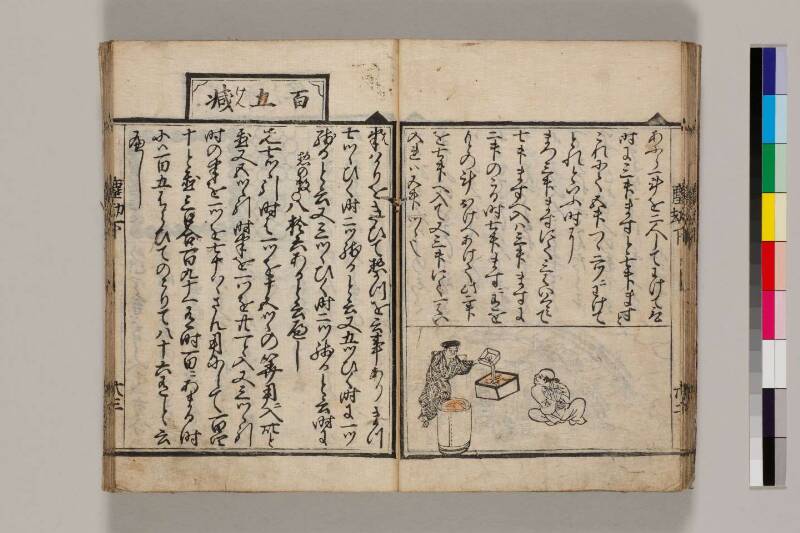
翻刻
【下巻廿二丁裏】
▲あふら一斗を二人してわけて取
時に三升ますと七升ますと
これにて五升つゝ二つにわけて
とれといふ時に
まつ三升ますにて三はいくみて
七升ますへ入は三升ますに
二升のこる時七升ますに有を
もとの斗おけへあけて此二升
を七升へ入て又三升にて一はい
入れは五升つゝ也
[下に二人の図---一人が三升升から七升ますへ油を移す]
【下巻廿三丁表】
[頁の頭に条目名] 百五/減(けん)
▲半(は)はかりをきひて惣かつを云事あり まつ
七つゝひく時二つ残ると云 又五つひく時に一つ
残ると云 又三つゝひく時二つ残ると云時に
惣の数
○八拾六あると云へし
先七つゝ引時は一つを十五つゝの算用に入卅と
置 又五つゝ引時半を一つを廿一と入 又三つゝ引
時の半を一つを七十つゝさん用にして百四
十と置 三口合百九十一有時 百にあまる時
には百五はらひてのこりて八十六有と云
へし
現代語訳
【下巻二十二丁裏】
▲油一斗を二人で分けて取る時、三升枡と七升枡とを使って、五升ずつ二つに分けて取れと言う。その方法は次の通り:
まず三升枡で三杯くみ取って七升枡へ入れると、三升枡に二升残る。その時、七升枡にある油をもとの一斗桶へ空けて、この二升を七升枡へ入れ、さらに三升枡で一杯入れると、五升ずつになる。
[下に二人の図―一人が三升枡から七升枡へ油を移す]
【下巻二十三丁表】
[頁の頭に条目名] 百五減(ひゃくごのけん)
▲おおよその数を聞いて、合計数を求めることがある。まず七つずつ引いた時に二つ残ると言う。また五つずつ引いた時に一つ残ると言う。またさらに三つずつ引いた時に二つ残ると言う。この時、合計の数は
○八十六であると言うべし。
まず七つずつ引いた時の余り(二つ)を、一つあたり十五として算用に入れ、三十と置く。また五つずつ引いた時の余り(一つ)を、一つあたり二十一として算用に入れ、二十一と置く。また三つずつ引いた時の余り(二つ)を、一つあたり七十として算用にして、百四十と置く。三口合わせて百九十一になる時、百を超える時は百五を払って、残って八十六があると言うべし。
英語訳
**[Volume 3, Folio 22, Verso]**
▲ When two people divide one *to* (斗, approx. 18 liters) of oil using a three-*shō* measure and a seven-*shō* measure, and are told to divide it into two equal portions of five *shō* each, the method is as follows:
First, fill the three-*shō* measure three times and pour it into the seven-*shō* measure; two *shō* will remain in the three-*shō* measure. At that point, pour what is in the seven-*shō* measure back into the original one-*to* bucket, then pour this remaining two *shō* into the seven-*shō* measure, and add one more full three-*shō* measure — this gives five *shō* each.
[Below: an illustration of two people, one transferring oil from the three-*shō* measure into the seven-*shō* measure]
---
**[Volume 3, Folio 23, Recto]**
**[Section title at top of page]: The Hundred-and-Five Reduction (百五減, *Hyakugo no Ken*)**
▲ There is a method for determining a total number by asking about remainders. First, it is said that when subtracting seven at a time, two remain. Next, when subtracting five at a time, one remains. Further, when subtracting three at a time, two remain. In this case, the total number:
○ **Should be said to be eighty-six.**
First, take the remainder when dividing by seven (which is two), and enter it into the calculation at fifteen per unit, placing thirty. Next, take the remainder when dividing by five (which is one), and enter it at twenty-one per unit, placing twenty-one. Then take the remainder when dividing by three (which is two), and use seventy per unit in the calculation, placing one hundred and forty. When the three entries are combined, they total one hundred and ninety-one. When this exceeds one hundred, subtract one hundred and five, and the remainder is eighty-six.