翻刻
【下巻廿三丁裏】
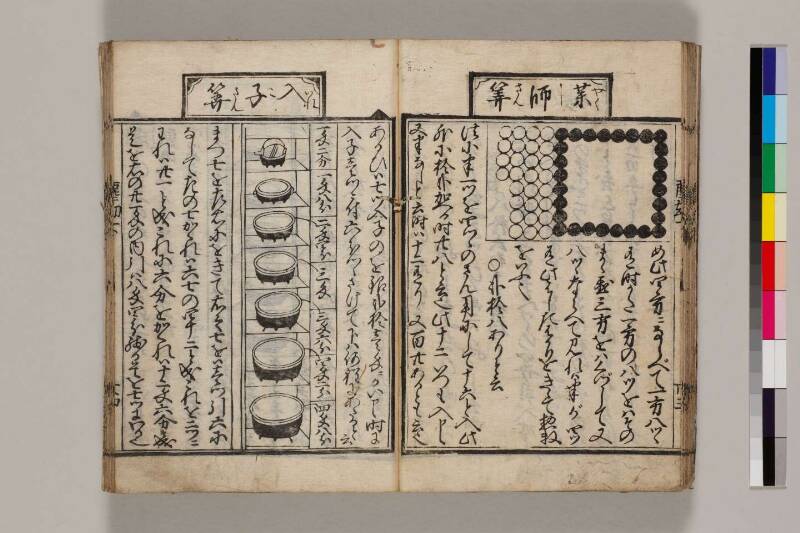
《題:薬(やく)師(し)算(さん)》
[右上部に黒白の碁石を用いた図,その下に問題文]
如此四方にならべて一方八つゝ
有時かた一方の八つをはその
まゝ置 三方をはくづして又
八つゝならへて見れは半が四つ
有 此はしたはかりをきゝて惣数
をいふ也
○弍拾八ありと云
法に半一つを四つゝのさん用にして十六と入 此
外に拾弍加へる時廿八と云也 此十二いつも入申候
又半なしと云時は十二有り 又百廿あるとも云也
【下巻廿四丁表】
《題:入(いれ)子(こ)算(さん)》
▲あるひは七つ入子のを銀弐拾壱匁にかい申時に
入子壱つに付六分つゝさけて下は何程にあたると云
[縦に段階的に大きくなる七個の鍋の図---各鍋の右に値段]
一匁二分 一匁八分 二匁四分 三匁 三匁六分 四匁二分 四匁八分
まつ七を左右にをきて右之七をは壱つ引六に
なして左の七かくれは六七の四十二と成 これを二つに
われは廿一と成 これに六分をかくれは十二匁六分と成
是を右の廿一匁の内引は八匁四分残る 是を七つにわる也
現代語訳
【下巻二十三丁裏】
《題:薬師算(やくしさん)》
[右上部に黒白の碁石を用いた図、その下に問題文]
このように四方に並べて、一辺に八つずつある時、片方の一辺の八つはそのまま置き、三方を崩してまた八つずつ並べてみると、半分(端数)が四つある。この端数だけを聞いて合計数を言う方法である。
○二十八あると言うべし。
方法として、半分(端数)の一つを四つずつの算用にして十六と入れ、これに加えて十二を加えると、二十八と言える。この十二はいつも加える数である。
また端数なしと言う時は十二ある。また百二十あるとも言える(*注:最大値の場合)。
---
【下巻二十四丁表】
《題:入子算(いれこさん)》
▲ある人が七つ組の入れ子(重ね鍋)を銀二十一匁で買った時に、入れ子一つごとに六分ずつ差をつけて、一番下(最小)のものはいくらになるかと言う問題。
[縦に段階的に大きくなる七個の鍋の図―各鍋の右に値段]
一匁二分 一匁八分 二匁四分 三匁 三匁六分 四匁二分 四匁八分
まず七を左右に置いて、右の七を一つ引いて六とし、左の七をかければ六七四十二となる。これを二つに割れば二十一となる。これに六分をかければ十二匁六分となる。これを右の二十一匁の内から引くと、八匁四分残る。これを七つに割る。
(一番小さい入れ子の値段は八匁四分÷七=一匁二分となる。)
英語訳
**[Volume 3, Folio 23, Verso]**
**[Section title]: The Yakushi Algorithm (薬師算, *Yakushi-san*)**
[Upper right: a diagram using black and white *go* stones; below it, the problem text]
When stones are arranged in a square with eight on each side, leave one side's eight stones in place, break up the remaining three sides, and rearrange them again in groups of eight — a remainder (*half*) of four is left over. From this remainder alone, one can state the total number.
○ **There are twenty-eight, it should be said.**
The method: take one unit of the remainder (*half*) and enter it into the calculation as four per unit, giving sixteen. Add twelve to this, and you get twenty-eight. This twelve is always added.
When there is no remainder, the answer is twelve. It may also be said that the maximum is one hundred and twenty.
---
**[Volume 3, Folio 24, Recto]**
**[Section title]: The Nested-Box Algorithm (入子算, *Ireko-san*)**
▲ When someone buys a set of seven nested cooking pots (*ireko*) for 21 *monme* of silver, and the price increases by 6 *bu* for each successive pot, how much does the smallest (bottom) pot cost?
[Diagram of seven pots increasing in size from top to bottom, with prices written to the right of each:]
1 *monme* 2 *bu* — 1 *monme* 8 *bu* — 2 *monme* 4 *bu* — 3 *monme* — 3 *monme* 6 *bu* — 4 *monme* 2 *bu* — 4 *monme* 8 *bu*
First, place seven on both the left and right. Subtract one from the right-hand seven to get six, then multiply by the left-hand seven: six times seven is forty-two. Divide this by two to get twenty-one. Multiply this by 6 *bu* to get 12 *monme* 6 *bu*. Subtract this from the right-hand 21 *monme*, leaving 8 *monme* 4 *bu*. Divide this by seven.
(The price of the smallest pot is 8 *monme* 4 *bu* ÷ 7 = 1 *monme* 2 *bu*.)