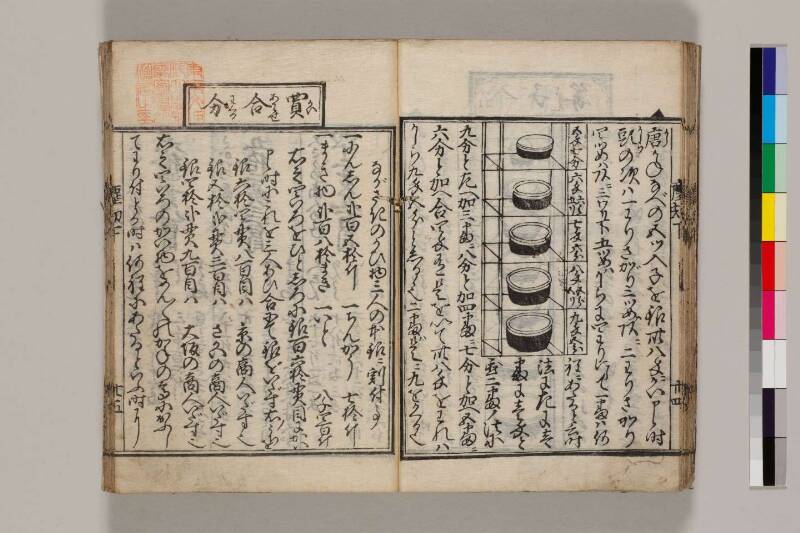
翻刻
【下巻廿四丁裏】
▲唐(たう)かねなべの五つ入子を銀卅八匁にかい申候時
頭(かしら)の次は一わりさがり三つめは頭に二わりさかり
四つめは頭に三わり下五つめはかしらに四わりにして一番は何
程にあたると云時
[五段の棚に並ぶ五個の鍋の絵---各鍋の右に]
五匁七分 六匁六分五り 七匁六分 八匁五分五り 九匁五分
法に左に壱
番に壱文と
置 二番の法に
九分と左へ加三番に八分と加四番に七分と加へ五番に
六分と加へ 合四匁有 是を以て卅八匁をわれは
かしら九匁五分としるゝ也 二番は是に九をかくる也
【下巻廿五丁表】
《題:買(かい)合(あわせ)分(わくる)》
ながさきのかひ物三人の本銀に割付事
一にんしん弐百五拾斤 一ちんかう七拾斤
一まき物弐百八拾まき 一いと八千四百斤
右之四いろをひとしろに銀百六拾貫目にかい
申候時にこれを三人あひ合にて銀をいだす 右のうちを
銀六拾四貫八百目は 京の商人いだす也
銀五拾弐貫三百目は さかいの商人いだす也
銀四拾弐貫九百目は 大坂の商人いだす也
右之四いろのかい物をめんめんのかねの高におふし
てわり付とる時は何程にあたるといふ時に
【上部余白に蔵書印---コマ4参照】
東京文理/科大学附/属図書館/図書之印
現代語訳
【下巻二十四丁裏】
▲唐(中国製)の金なべの五つ組入れ子を銀三十八匁で買った時、頭(一番大きいもの)の次(二番目)は頭より一割下がり、三番目は頭より二割下がり、四番目は頭より三割下がり、五番目は頭より四割下がるとして、一番(最大の鍋)はいくらになるかと言う問題。
[五段の棚に並ぶ五個の鍋の絵―各鍋の右に値段]
五匁七分 六匁六分五厘 七匁六分 八匁五分五厘 九匁五分
方法として、左(の列)に、一番目に一文と置き、二番目の法として九分(=0.9)を左へ加え、三番目に八分(=0.8)を加え、四番目に七分(=0.7)を加え、五番目に六分(=0.6)を加えると、合計四匁になる。これをもって三十八匁を割ると、頭(一番大きい鍋)の値段は九匁五分と知れる。二番目はこれに九(分、すなわち0.9)を掛ける。
---
【下巻二十五丁表】
《題:買い合わせ分ける》
長崎での買い物を三人の元手の銀に割り付ける問題
・人参 二百五十斤
・沈香 七十斤
・巻物 二百八十巻
・糸 八千四百斤
右の四品を一括して銀百六十貫目で買い申した時に、これを三人が共同で銀を出し合った。右の内を、
銀六十四貫八百目は 京の商人が出した
銀五十二貫三百目は 堺の商人が出した
銀四十二貫九百目は 大坂の商人が出した
右の四品の買い物を、それぞれの出した金額の割合に応じて分け取る時、それぞれ何程になるかという問題。
【上部余白に蔵書印】
東京文理科大学附属図書館図書之印
英語訳
**[Volume 3, Folio 24, Verso]**
▲ When someone buys a set of five nested Chinese-style (*tō*) gold pots for 38 *monme* of silver, with the second pot priced 10% (*ichi-wari*) below the first (the largest, the "head"), the third 20% below the first, the fourth 30% below the first, and the fifth 40% below the first — how much does the first (largest) pot cost?
[Diagram of five pots arranged on a five-tiered shelf, with prices written to the right of each:]
5 *monme* 7 *bu* — 6 *monme* 6 *bu* 5 *rin* — 7 *monme* 6 *bu* — 8 *monme* 5 *bu* 5 *rin* — 9 *monme* 5 *bu*
The method: In the left column, place 1 (*monme*) for the first pot. For the second, add 9 *bu* (= 0.9) to the left; for the third, add 8 *bu* (= 0.8); for the fourth, add 7 *bu* (= 0.7); and for the fifth, add 6 *bu* (= 0.6). These sum to 4 *monme*. Divide 38 *monme* by this, and the price of the first (largest) pot is found to be 9 *monme* 5 *bu*. For the second pot, multiply this by nine-tenths (0.9).
---
**[Volume 3, Folio 25, Recto]**
**[Section title]: Dividing Up a Joint Purchase (買い合わせ分ける, *Kaiawase wakeru*)**
A problem concerning the allocation of goods purchased at Nagasaki among three merchants, proportionate to their respective capital contributions.
- Ginseng: 250 *kin*
- Aloes-wood (*jinkō*): 70 *kin*
- Bolts of cloth (*makimono*): 280 rolls
- Thread (*ito*): 8,400 *kin*
The four kinds of goods above were purchased together for 160 *kanme* of silver. Three merchants pooled their money to pay for them, as follows:
64 *kanme* 800 *monme* was contributed by the Kyoto merchant.
52 *kanme* 300 *monme* was contributed by the Sakai merchant.
42 *kanme* 900 *monme* was contributed by the Osaka merchant.
When the four kinds of purchased goods are allocated to each merchant in proportion to the amount of silver each contributed, how much of each item does each merchant receive?
**[Library seal in the upper margin:]**
*Tokyo Bunrika Daigaku Fuzoku Toshokan Tosho no In*
(Seal of the Library of the Tokyo University of Literature and Science)