翻刻
【中巻五丁裏】
分 分 分 8(赤)
一 7 一 3 一 7(赤)9(白抜赤)3(白) 一
十 8 十 十 1(赤)6(黒)4(白抜赤)4(白) 十 4
百 9 百 8 百 4(黒)3(白) 百 9
千 2 千 9(赤)2(黒) 千 2
万 1 万 2(赤)1(黒)
億 3 億 3(黒)
兆 兆
京 2 京 2(黒) 下法八十を
三乗し一位遍退商次七立法にて下法に商以遍乘
[二九]一万八千[二八]千六百[二七]百四十[九九]八千百[八九]七百廿[七九]六十三[四九]三百六十
[四八]卅二[四七]二八分再上り商の七以乗之[二七]一京四兆[七九]六兆三億[一七]七千
[七七]四千九百[七八]五百六十実除之不尽三百四十三有り
是は七の小角に拂也不尽なし
【中巻六丁表】
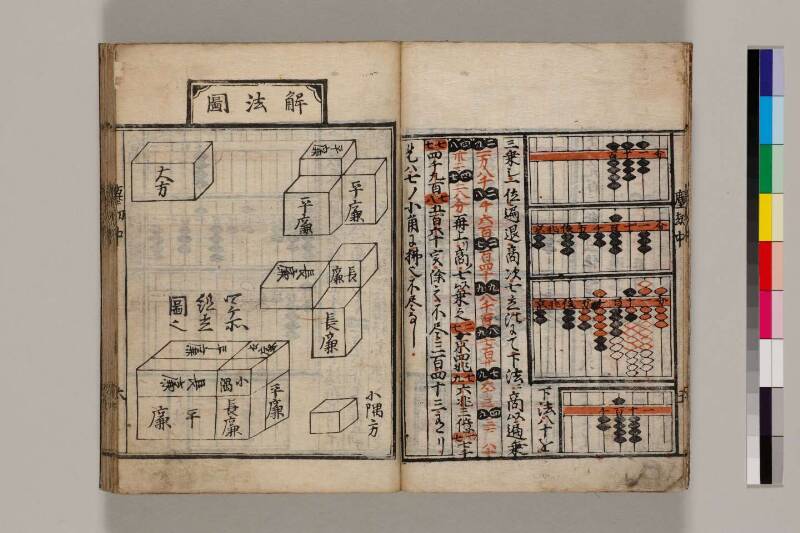
《題:解法図》
平廉 長廉 小隅方
四ケ所組立図也 平廉 長廉 小隅
大方
現代語訳
【中巻五丁裏】
```
分(位) 分(位) 分(位) 8(赤)
一(位) 7 一(位) 3 一(位) 7 9 3 一(位)
十(位) 8 十(位) 十(位) 1 6 4 4 十(位) 4
百(位) 9 百(位) 8 百(位) 4 3 百(位) 9
千(位) 2 千(位) 9 2 千(位) 2
万(位) 1 万(位) 2 1
億(位) 3 億(位) 3
兆(位) 兆(位)
京(位) 2 京(位) 2 下法八十を
```
〔下法八十を〕三乗して一位を遍(あまね)く退き、商の次に七を立てる。法にて下法に商をもって遍乗(へんじょう)する。
「二九(にく)」一万八千、「二八(にはち)」千六百、「二七(にしち)」百四十、「九九(くく)」八千百、「八九(はっく)」七百二十、「七九(しちく)」六十三、「四九(しく)」三百六十、「四八(しはち)」三十二、「四七(しひち)」二十八。
分(ぶ)。再び上り(繰り上げ)、商の七をもって乗ずる。
「二七(にしち)」一京四兆、「七九(しちく)」六兆三億、「一七(いちしち)」七千、「七七(しちしち)」四千九百、「七八(しちはち)」五百六十。
実(じつ)にて之を除く。不尽(ふじん)三百四十三あり。
これは七の小角(しょうかく)にて払(はら)うなり。不尽なし。
---
【中巻六丁表】
《題:解法図(かいほうず)》
平廉(へいれん) 長廉(ちょうれん) 小隅方(こぐりかた)
四ヶ所組立図(よんかしょくみたてず)なり
平廉 長廉 小隅
大方(だいほう)
英語訳
【Middle Volume, 5th Sheet, Verso】
```
Fractional Fractional Fractional 8 (red)
Ones 7 Ones 3 Ones 7 9 3 Ones
Tens 8 Tens Tens 1 6 4 4 Tens 4
Hundreds 9 Hundreds 8 Hundreds 4 3 Hundreds 9
Thousands 2 Thousands 9 2 Thousands 2
Ten-thous. 1 Ten-thous. 2 1
Hundred-m. 3 Hundred-m. 3
Trillions Trillions
Quadr. 2 Quadr. 2 [Lower divisor eighty →]
```
[The lower divisor eighty is] cubed and one place is uniformly retreated; seven is placed next in the quotient. Then, using the divisor (*hō*), multiply the lower divisor throughout by the quotient:
"2×9" [= 18] → eighteen thousand; "2×8" [= 16] → one thousand six hundred; "2×7" [= 14] → one hundred forty; "9×9" [= 81] → eight thousand one hundred; "8×9" [= 72] → seven hundred twenty; "7×9" [= 63] → sixty-three; "4×9" [= 36] → three hundred sixty; "4×8" [= 32] → thirty-two; "4×7" [= 28] → twenty-eight.
[Result in] fractional (*bu*) units. Carry up again, then multiply using the quotient digit seven:
"2×7" [= 14] → one *kei* four trillion; "7×9" [= 63] → six trillion three hundred million; "1×7" [= 7] → seven thousand; "7×7" [= 49] → four thousand nine hundred; "7×8" [= 56] → five hundred sixty.
Divide the dividend (*jitsu*) by these. There is a remainder (*fujin*) of three hundred forty-three.
This is cleared by the *shōkaku* (minor-corner term) of seven. No remainder remains.
---
【Middle Volume, 6th Sheet, Recto】
*Title: Diagram of the Solution Method*
*Hei-ren* (flat face) *Chō-ren* (long face) *Ko-guri-kata* (small corner piece)
Assembly diagram of the four positions
*Hei-ren* *Chō-ren* *Ko-guri*
*Dai-hō* (large cube / great square)