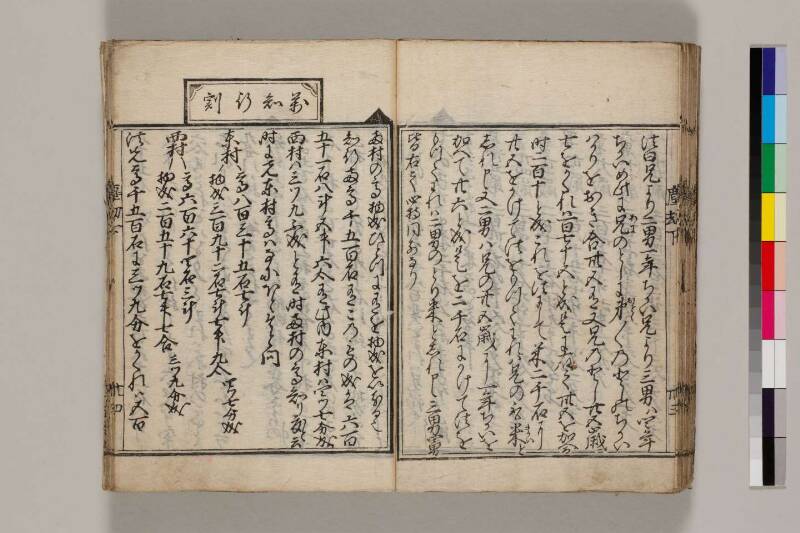
翻刻
【下巻卅三丁裏】
法曰 兄より二男一年ちかい 兄より三男は四年
ちかい 如此に兄(あに)のとしに弟(おとゝ)弟のとしのちかい
はかりをおき合卅五有 又兄のとし廿五歳に
七をかくれは百七十五と成 是に右の卅五を加へる
時二百十と成 これを法にして米二千石に
廿五をかけて法をもつてわれは兄の取/米(まい)と
しれ申候 又二男は兄の廿五歳に一年ちかいを
加へて廿六と成 是を二千石にかけて法を
もつてわれは二男のとり米としれ申候 三男四男
皆右の心持同前なり
【下巻卅四丁表】
《題:萬知行割》
▲両村の高物成ひとつに有を物成を以分る也
知行両高千五百石有 このもの成は六百
五十一石八斗五升六合有 此内東村は四つ七分成
西村は三つ九ふ成と有時両村の高知り度と云
時に先東村高はなにほとそと問
東村《割書:高 八百三十五石七斗 四つ七分成|物成三百九十二石七斗七升九合》
西村《割書:高 六百六十四石三斗 三つ九分成|物成二百五十九石七升七合》
法先高千五百石に三つ九分をかくれは五百
現代語訳
【下巻三十三丁裏】
〔解法〕
兄より二男は一年年が近い(年齢差が一年少ない)。兄より三男は四年年が近い。このように、兄の年齢に対して弟それぞれの年齢の「近さ(年齢差の縮まり分)」を合計すると三十五となる。また兄の年齢二十五歳に七(人)をかけると百七十五となる。これに右の三十五を加えると二百十となる。これを法(除数)として、米二千石に二十五をかけ、その法で割ると兄の取り米が求まります。また二男は兄の二十五歳に一年近さを加えて二十六とする。これを二千石にかけて法で割ると、二男の取り米が求まります。三男・四男以下、皆同じ要領で計算します。
【下巻三十四丁表】
《題:万知行割》
▲両村の高(石高)と物成(年貢収量)が合わせて一つにまとめられており、物成をもって(各村の石高を)分けるという問題である。
知行両村合わせて高千五百石あり、この物成は六百五十一石八斗五升六合ある。この内、東村は四つ七分成(収納率四割七分)、西村は三つ九分成(収納率三割九分)とある時、両村の高(石高)をそれぞれ知りたいという。まず東村の高はいくらかと問う。
東村 高 八百三十五石七斗 四つ七分成
物成 三百九十二石七斗七升九合
西村 高 六百六十四石三斗 三つ九分成
物成 二百五十九石七升七合
〔解法〕
まず高千五百石に三つ九分をかけると五百〔八十五石五斗……〕
英語訳
**[Volume 3, Folio 33, Verso]**
*[Method of Solution]*
The second son is one year "closer" (i.e., one year less age difference from the eldest) than the eldest. The third son is four years closer than the eldest. In this way, summing up the "closeness" (the accumulated reduction in age gap relative to the eldest) of each younger sibling gives a total of 35. Furthermore, multiplying the eldest son's age of 25 by 7 (the number of children) gives 175. Adding the above 35 to this yields 210. Using this as the divisor (*hō*), multiply 2,000 *koku* of rice by 25 (the eldest son's age) and divide by the divisor to obtain the eldest son's share of rice. For the second son, add 1 (his one year of "closeness") to the eldest son's 25, making 26. Multiply this by 2,000 *koku* and divide by the divisor to find the second son's share of rice. For the third son, fourth child, and so on, the same approach applies throughout.
---
**[Volume 3, Folio 34, Recto]**
**《Problem Title: Division of *Chigyō* (Fiefs) Among Many》**
▲ A problem in which the total yield (*bunarinari*, tax revenue in rice) of two villages is known as a combined figure, and each village's assessed land value (*daka*) is to be determined from the respective tax rates (*narinari*).
The combined assessed yield (*daka*) of the two villages is 1,500 *koku*, and the combined tax revenue (*mono nari*) is 651 *koku* 8 *to* 5 *shō* 6 *gō*. Of this, the eastern village has a tax rate of 4 *tsu* 7 *bu* (47%), and the western village has a rate of 3 *tsu* 9 *bu* (39%). What is the assessed *daka* of each village?
First: what is the *daka* of the eastern village?
| | Eastern Village | Western Village |
|---|---|---|
| *Daka* (assessed yield) | 835 *koku* 7 *to* | 664 *koku* 3 *to* |
| Tax rate | 4 *tsu* 7 *bu* (47%) | 3 *tsu* 9 *bu* (39%) |
| *Mono nari* (tax revenue) | 392 *koku* 7 *to* 7 *shō* 9 *gō* | 259 *koku* 7 *shō* 7 *gō* |
*[Method of Solution]*
First, multiply the combined *daka* of 1,500 *koku* by the western village's rate of 3 *tsu* 9 *bu* to get 500-something [*koku*...] *(text continues on next page)*