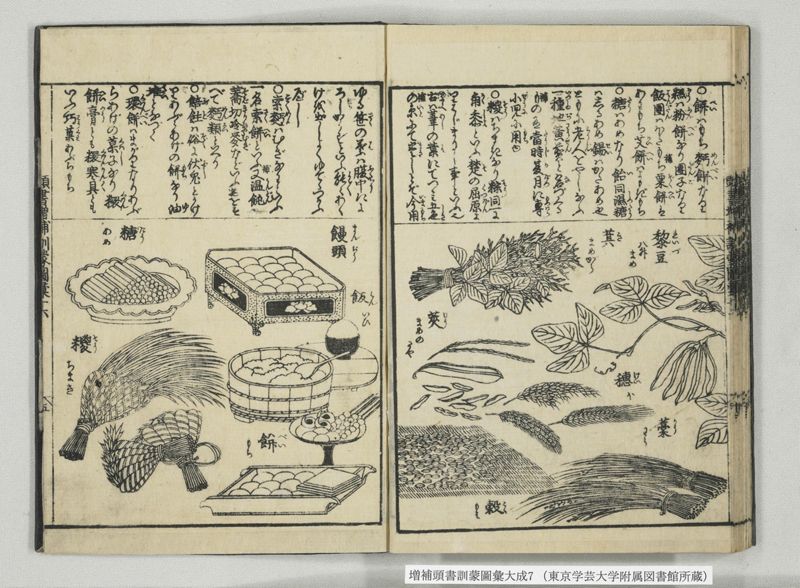
翻刻
【上段】
○餅(べい)はもち麺餅(めんべい)なり
糕(かう)は粉餅(ふんべい)なり団子(だんご)なり
飯団(はんだん)はほたもち補 粟餅(ぞくへい)は
あわもち艾餅(かいへい)はよもぎもち
○糖(たう)はあめなり飴(い)同 湿糖(しつたう)
はしるあめ𩛿(せい)はかたあめ也
ともに老人(らうじん)をやしなふ
一種(いつしゆ)地黄煎(ぢわうせん)と名づくる
補 もの有 当時(たうじ)夏月(かげつ)に専(もつはら)
小児(せうに)に用(もち)ゆ
○糉(そう)はちまきなり粽(そう)同一に
角黍(かくしよ)といふ楚(そ)の屈原(くつげん)よ
りはじまりし事といふ也
古(いにしへ)は葦(あし)の葉(は)にてつゝみ五 色(しき)
の補 糸(いと)にて巻(まき)しとぞ今用(いまもち)
ゆる笹(さゝ)の葉(は)は腹中(ふくちう)によ
ろしからずといふ能々(よく〳〵)あく
けを出しよくゆてゝつかふ
べし
○索麺(そくめん)はむぎなわといふ
一名 索餅(さくへい)といふ補 又 温飩(うんどん)
蕎切(そばきり)冷麦(ひやむぎ)などいふ物をす
べて麺類(めんるい)といへり
○餢飳(ぶと)は俗(そく)に伏兎(ふと)とかけ
りあぶらあげの餅(もち)なり油(ゆ)
堆(たい)となづく
○環餅(くはんべい)はまがりなりあぶ
らあげの菓子(くはし)なり糫(くはん)
餅膏(へいかう)とも糫寒具(くはんかんく)とも
いふ巧菓(こうくわ)あぶらもち
【下段】
黎豆(れいづ)
八升まめ
萁(き)
まめがら
穂(けい) ほ
藁(かう)
わら
莢(けう)
まめのさや
穀(こく)
もみ
饅頭(まんぢう)
飯(はん) いひ
餅(べい)
もち
糖(たう)
あめ
糉(そう)
ちまき
現代語訳
【上段】
○餅(ベイ)は餅のことで、麺餅(メンベイ)である。糕(コウ)は粉で作った餅のことで、団子である。飯団(ハンダン)はぼた餅のこと。補:粟餅(ゾクヘイ)は粟餅、艾餅(カイヘイ)はよもぎ餅である。
○糖(トウ)は飴のことである。飴(イ)も同じ。湿糖(シットウ)は水飴、𩛿(セイ)は固い飴である。どちらも老人を養う効果がある。一種に地黄煎(ジオウセン)と名付けるものがある。補:現在、夏の季節に専ら小児に用いている。
○糉(ソウ)はちまきのことである。粽(ソウ)も同じで、角黍(カクショ)ともいう。楚の屈原から始まったものだという。昔は葦の葉で包み、五色の糸で巻いたという。現在用いる笹の葉は腹中によろしくないというので、よくよくあく抜きをして、よく茹でて使うべきである。
○索麺(ソクメン)は麦縄という。別名を索餅(サクヘイ)という。補:また温飩(ウンドン)、蕎切(ソバキリ)、冷麦(ヒヤムギ)などというものをすべて麺類(メンルイ)という。
○餢飳(ブト)は俗に伏兎(フト)と書く。油で揚げた餅である。油堆(ユタイ)と名付ける。
○環餅(カンベイ)は輪の形をした油で揚げた菓子である。糫餅膏(カンヘイコウ)とも糫寒具(カンカング)ともいう。巧菓(コウカ)、油餅ともいう。
【下段】
黎豆(レイズ)
八升豆
萁(キ)
豆がら
穂(ケイ) 穂
藁(コウ)
藁
莢(キョウ)
豆の莢
穀(コク)
籾
饅頭(マンジュウ)
飯(ハン) 飯
餅(ベイ)
餅
糖(トウ)
飴
糉(ソウ)
ちまき
英語訳
【Upper Section】
○Rice cakes (bei) are mochi, specifically noodle cakes (men-bei). Cake (kō) refers to flour cakes, which are dumplings. Rice balls (han-dan) are botamochi (sweet rice balls covered with bean paste). Supplement: Millet cakes (zoku-hei) are millet mochi, mugwort cakes (kai-hei) are mugwort mochi.
○Sugar (tō) refers to candy/syrup. Malt syrup (i) is the same. Wet sugar (shitsu-tō) is liquid syrup, 𩛿 (sei) is hard candy. Both nourish the elderly. One type is named rehmannia decoction (ji-ō-sen). Supplement: Currently used especially for children during summer months.
○Rice dumplings (sō) are chimaki (wrapped rice dumplings). Zongzi (sō) is the same, also called horn millet (kaku-sho). It is said to have originated with Qu Yuan of the Chu state. In ancient times, they were wrapped in reed leaves and tied with five-colored threads. The bamboo leaves used today are said to be bad for the stomach, so one should thoroughly remove the bitterness and boil them well before use.
○Thin noodles (soku-men) are called wheat ropes. Also called rope cakes (saku-hei). Supplement: Also, udon, buckwheat noodles (soba-kiri), cold noodles (hiya-mugi) and such things are all called noodle varieties (men-rui).
○Fried cake (bu-to) is commonly written as "crouching rabbit" (fu-to). It is deep-fried mochi, named oil mound (yu-tai).
○Ring cakes (kan-bei) are ring-shaped deep-fried confections. Also called sweet cake paste (kan-hei-kō) or cold ingredients (kan-kan-gu). Also called skillful confections (kō-ka) or oil cakes.
【Lower Section】
Black beans (rei-zu)
Eight-measure beans
Bean stalks (ki)
Bean stems
Ears of grain (kei) - ears
Straw (kō)
Straw
Pods (kyō)
Bean pods
Grain (koku)
Unhulled rice
Steamed buns (manjū)
Cooked rice (han) - rice
Rice cakes (bei)
Mochi
Sugar (tō)
Candy/syrup
Rice dumplings (sō)
Chimaki