翻刻
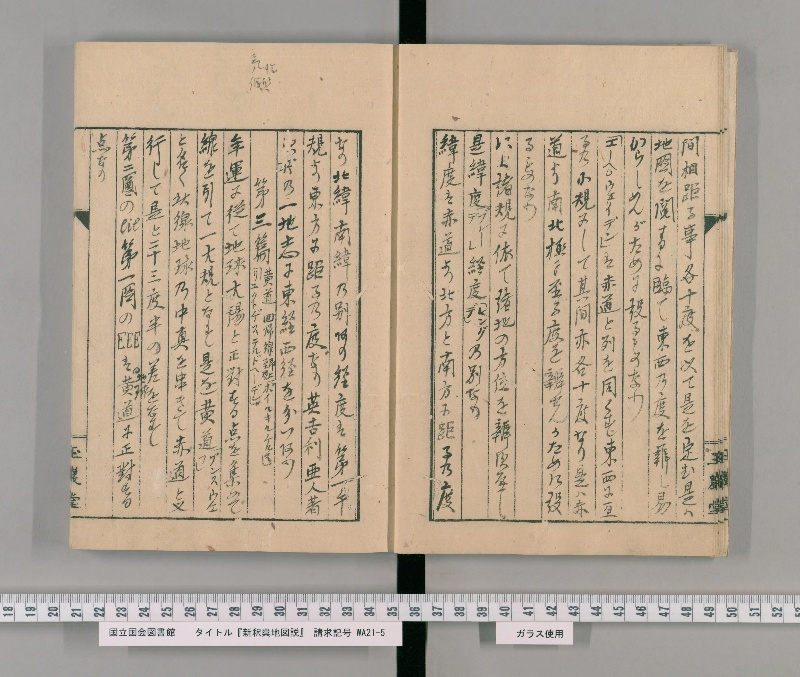
間相距る事各十度を以て是を定む是は
地図を閲するに臨て東西の度を弁し易
からしめんがために設るものなり
「エーヘ・ウェイデン」は赤道と列を同くす東西に亘
るの小規にして其間亦各十度なり是は赤
道より南北極に至る度を弁せんかために設
るものなり
以上諸規に依て諸地の方位を弁すへし
是緯度《割書:「ブレー|デ」》経度《割書:「レング|デ」》の別なり
緯度は赤道より北方と南方に距るの度
なり北緯南緯の別あり経度は第一午
規より東方に距るの度なり英吉利亜人著
す所の一地志に東経西経を分つあり
第三篇《割書:黄道回帰線《割書:即二|至規》「ポイルキルケルス」|「リユクトゲステルドヘーデン」》
年運に従て地球大陽と正対する点を集めて
線を引て一大規となる是を黄道《割書:「ブンスウエ|フ」》
と名く此線地球の中真を串きて赤道と叉
行して是と二十三度半の差をなす
第二図のeie第一図のEEEは地球黄道に正対する
点なり
現代語訳
間の相互の距離は各十度をもってこれを定める。これは地図を見る際に東西の度数を判別しやすくするために設けられたものである。
「エーヘ・ウェイデン」は赤道と同じ列に属し、東西に渡る小円であって、その間もまた各十度である。これは赤道より南北極に至る度数を判別するために設けられたものである。
以上の諸々の円によって各地の方位を判別すべきである。これが緯度(「ブレーデ」)経度(「レングデ」)の区別である。
緯度は赤道より北方と南方に距離する度数である。北緯南緯の別がある。経度は第一子午線より東方に距離する度数である。イギリス人が著した地誌には東経西経を分けるものがある。
第三篇 黄道回帰線(すなわち至線)「ポイルキルケルス」「リユクトゲステルドヘーデン」
年運に従って地球が太陽と正対する点を集めて線を引いて一大円となる。これを黄道(「ブンスウエフ」)と名づける。この線は地球の中心を貫いて赤道と交差し、これと二十三度半の差をなす。
第二図のeie、第一図のEEEは地球の黄道に正対する点である。
英語訳
The mutual distances between them are determined by ten degrees each. This is established to make it easier to distinguish the degrees of east and west when viewing maps.
"Evenwijden" (parallels) belong to the same series as the equator, being small circles spanning east to west, with intervals of ten degrees each. These are established to distinguish the degrees from the equator to the north and south poles.
By means of all the above circles, one should distinguish the directions of various places. This is the distinction between latitude ("Brede") and longitude ("Lengte").
Latitude is the degree of distance north and south from the equator. There is a distinction between north latitude and south latitude. Longitude is the degree of distance eastward from the prime meridian. In geography books written by the English, there is a division between east longitude and west longitude.
Chapter Three: Ecliptic and Tropics (namely solsticial lines) "Poolkirkels" "Rugtkesteldheeden"
Following the annual revolution, the points where the Earth directly faces the Sun are collected and a line is drawn to form one great circle. This is called the ecliptic ("Zonneweg"). This line pierces through the center of the Earth and intersects with the equator, forming a difference of twenty-three and a half degrees with it.
The eie in the second figure and EEE in the first figure are the points where the Earth directly faces the ecliptic.