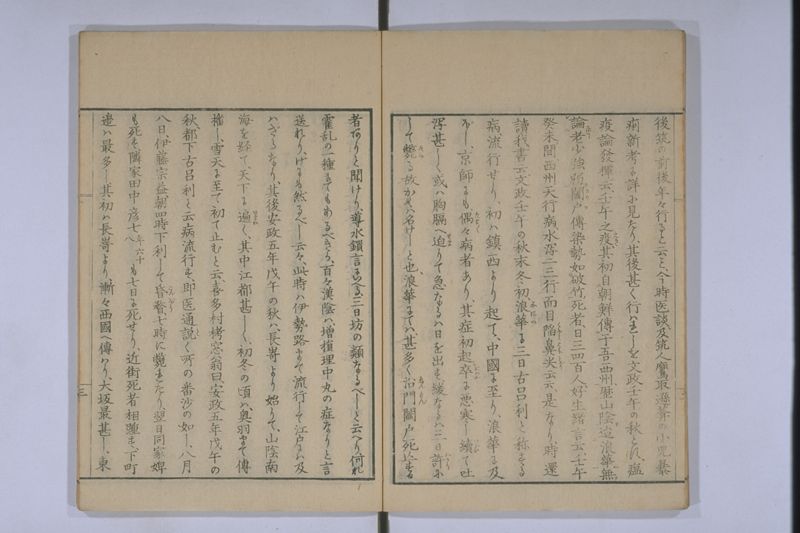
翻刻
【右】
後筑の前後年々行ると伝こと、今時医談、及筑人鷹取遜弇の小児暴
痢新考に詳に見たり、其後甚く行はれしを文政壬年の秋とす、瘟
疫論發揮 ̄に伝、壬午の疫(えき)、其初自_二朝鮮_一傳_二干吾西州_一、歴山陰 ̄に迨_二
浪華 ̄ニ_一無 ̄く
_レ論 ̄するに_二老少強弱 ̄ヲ_一闔(カウ)戸(コ)傳染勢如_二破竹 ̄ノ_一死者、日三四百人、好生緒言伝、壬午
癸未、間、西州天行病、水瀉二三行而目陥鼻尖(くほみはなとがり)伝、是なり、時還
読我書伝、文政壬午の秋末冬初、浪華(なには)に三日古呂利と称する
病、流行せり、初は鎮西より起て、中国に至り、浪華に及
ぼし、京師にも、偶々(たま〳〵)病者あり、其症初起卒(にわか)に悪寒し続(つゞい)て吐
瀉甚しく或は胸膈へ迫りて急なるは日を出す、緩なるは三日許(はかり)に
して斃(たゆ)る故かくは名けしと也、浪華にては、甚多く沿門(ゑんもん)闔戸死兦する
【左】
者ありと聞けり、導水鎖言にいへる、三日坊の類なるべしと伝へり、何れ
霍乱の一種にてもあるべきか、百々漢陰は、増損理中丸の症なりと言
送れり、げにも然るべし伝々、此時は伊勢路にて流行して江戸には及
はざるなり、其後安政五年戌午の秋は、長崎より始りて、山陰南
海を経て、天下に遍(あまね)く、其中江都甚しく、初冬の頃は、奥羽まで傳
播し、雪天に至て初て止むと伝、喜多村栲窓翁曰、安政五年戌午の
秋、都下古呂利と伝病流行す、即医通説(と)く所の番沙の如し、八月
八日、伊藤宗益、朝四時下利して昏瞀(こんぼう)、七時に斃れたり、翌日同家婢
も死す、隣家田中彦七《割書:年六十|八》も七日に死せり、近街死者相踵す、下町
邉は最多し、其初は長崎より、漸々西国へ傳はり、大阪最甚し、東
現代語訳
【右】
その後筑前筑後で毎年流行したと伝えられることは、今時医談や筑前の人鷹取遜弇の『小児暴痢新考』に詳しく見ることができる。その後甚だしく流行したのを文政壬午年の秋とする。『瘟疫論発揮』に伝えるところによれば、壬午の疫病は、その初め朝鮮から我が西州に伝わり、山陰道を経て大阪に至り、老若強弱を論ずることなく全戸に伝染し、その勢いは破竹のごとく、死者は日に三、四百人であった。『好生緒言』に伝えるところでは、壬午・癸未の間、西州で流行病があり、水様の下痢を二、三回して目が窪み鼻が尖ったという。これがそれである。『時還読我書』に伝えるところでは、文政壬午の秋末から冬初めにかけて、大阪で三日コレラと称する病気が流行した。初めは九州から起こって中国地方に至り、大阪に及び、京都にもたまたま病者があった。その症状は初め起こると急に悪寒がして続いて吐瀉が甚だしく、あるいは胸に迫って急なものは一日で死に、緩やかなものは三日ばかりで死ぬので、このように名付けたのである。大阪では甚だ多く、家ごと戸ごとに死亡する
【左】
者があったと聞いている。『導水鎖言』にいうところの三日坊の類であろうと伝えられている。いずれも霍乱の一種でもあるだろうか。百々漢陰は、増損理中丸の症であると言い伝えている。なるほどそうであろう。この時は伊勢路で流行して江戸には及ばなかった。その後安政五年戌午の秋は、長崎から始まって、山陰・南海を経て天下に広く広がり、その中でも江戸が甚だしく、初冬の頃には奥羽まで伝播し、雪の降る頃に至って初めて止んだと伝えられている。喜多村栲窓翁が言うには、安政五年戌午の秋、都下でコレラという病気が流行した。すなわち医書で通常説くところの番沙のようなものである。八月八日、伊藤宗益が朝四時に下痢して意識朦朧となり、七時に死んだ。翌日同家の女中も死んだ。隣家の田中彦七《年六十八》も七日に死んだ。近所では死者が相次ぎ、下町辺りが最も多かった。その初めは長崎から、次第に西国へ伝わり、大阪が最も甚だしく、東
英語訳
【Right】
The subsequent annual epidemics in Chikuzen and Chikugo provinces are detailed in contemporary medical discussions and in "Shōni Bōri Shinkō" (New Considerations on Childhood Violent Diarrhea) by Takatori Sonken from Chikuzen. The most severe outbreak thereafter occurred in the autumn of Bunsei Jinba year (1822). According to "Oneki-ron Hakki" (Exposition on Epidemic Theory), the Jinba epidemic initially spread from Korea to our western provinces, passed through the San'in region to reach Osaka, and infected entire households regardless of age or physical strength, with momentum like splitting bamboo, causing 300-400 deaths daily. "Kōsei Shogen" records that between Jinba and Kimihibitsuji years, there was an epidemic in the western provinces where people had watery diarrhea two or three times, with sunken eyes and pointed noses. This was that disease. "Jikan Dokuga Sho" records that from late autumn to early winter of Bunsei Jinba year, a disease called "three-day cholera" epidemic spread in Osaka. It initially arose in Kyushu, reached the Chūgoku region, spread to Osaka, and occasionally had patients in Kyoto. The symptoms began with sudden chills followed by severe vomiting and diarrhea, sometimes pressing on the chest—acute cases died within a day, while milder cases died after about three days, hence the name. In Osaka, it was extremely widespread, with entire households dying.
【Left】
It is said to be similar to what "Dōsui Sagen" calls "three-day monk." It was probably a type of cholera. Dōdō Kan'in said it was a condition for Zōson Richū pills. Indeed, that seems reasonable. At this time it epidemic in the Ise region but did not reach Edo. Later, in the autumn of Ansei 5 Tsuchinoe-uma year (1858), it began in Nagasaki, spread through San'in and Nankai regions throughout the country, with Edo being particularly severe. By early winter it had spread to Ōshū, finally stopping when snow fell. Elder Kitamura Kōsō said that in the autumn of Ansei 5 Tsuchinoe-uma year, a disease called cholera epidemic in the capital. This was like what medical texts commonly describe as bansa. On August 8th, Itō Sōeki had diarrhea at 4 AM, became delirious, and died at 7 AM. The next day, a maidservant of the same house also died. The neighbor Tanaka Hikoshichi (age 68) also died on the 7th. Deaths occurred consecutively in the neighborhood, with the downtown area being most affected. Initially it spread from Nagasaki gradually to western provinces, with Osaka being most severely affected, then to the east.