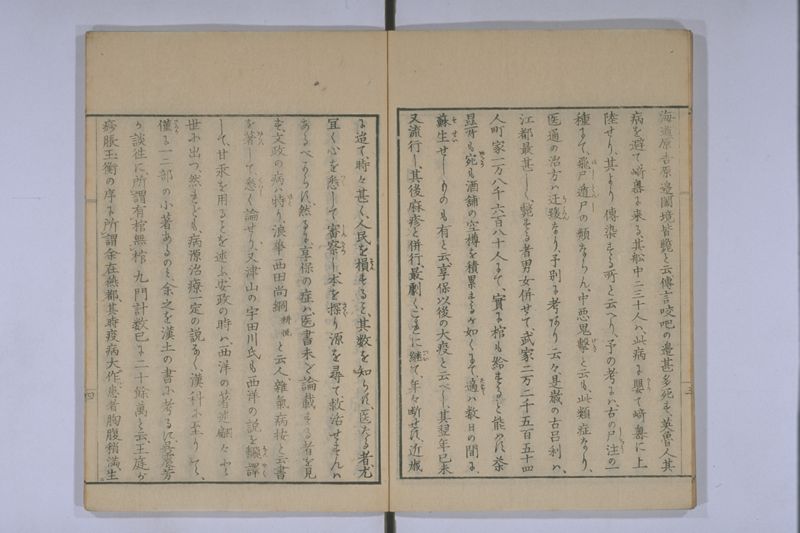
翻刻
【右】
海道、原吉原邉、闔境皆斃と伝、傳言咬吧の邉甚多死す、英魯人其
病を避て、崎嶴に来る、其舩中二三十人は、此病に嬰(かゝり)て崎嶴に上
陸せり、其より、傳染する所と伝へり、予の考には、古の尸注(しちう)の一
種にて、飛尸遁尸(ひしとんし)の類ならん、中悪鬼撃(げき)と伝も、此類症なり、
医通の治法は迂緩(うからん)なり、予別に考あり伝々、是歳の古呂利は、
江都最甚しく、斃する者男女併せて、武家二万二千五百五十四
人町家一万八千六百八十人にて、實に棺も給すると能はす茶
昆一所も宛(おつら)も酒舗の空樽を積累するが如くにて適(たお〳〵)は数日の間に、
蘇生(そせい)せしものも有と伝、享保以後の大疫と伝べし、其翌年巳未
又流行し、其後麻疹と併行、最劇く、これに継(つい)て、年々断せす、近歳
【左】
に迨て、時々甚く、人民を損(そん)すること。其数を知らす、医たる者尤
宜く心を悉(つく)して審察(しんさつ)し、本を探(さぐ)り源を尋て、救活せすんは
あるべからず、然るに、享保の症は、医書未だ論載する者を見
ず、文政の病は特(ひと)り、浪華西田尚綱《割書:耕悦|》と伝人、雑氣病按と伝書
を著(あらは)して、悉(くはし)く論せり、又津山の宇田川氏も西洋の説を飜譯(ほんやく)
して、甘汞を用ることを述ふ、安政の時は、西洋の著述翩々と
世に出つ、然れども、病源治療一定の説なく、漢科に至りて、
僅(わつか)に一二部の小著あるのみ、余之を漢土の書に考るに、呉震芳
か談往に、所_レ謂有_レ棺無_レ棺 九門計数巳に二十餘萬と伝、王庭が
痧脹玉衡の序に所_レ謂余在_二燕都_一、其時疫病大 ̄ニ作 ̄ル、患者胸腹稍満、生_二
現代語訳
【右】
海道、原吉原辺りまで、全域が死亡したと伝えられている。伝聞によると、ジャワ(咬吧)の辺りで非常に多くの死者が出た。イギリス・ロシア人がその病気を避けて長崎に来たが、その船中で二、三十人がこの病気にかかって長崎に上陸した。それから伝染したところだと伝えられている。私の考えでは、古の尸注の一種で、飛尸遁尸の類であろう。中悪鬼撃というものも、この類の症状である。医学書通常の治法は迂遠で緩慢である。私には別の考えがある。この年のコレラは、江戸が最も甚だしく、死亡した者は男女合わせて、武家二万二千五百五十四人、町家一万八千六百八十人で、実に棺も間に合わず、茶屋の一箇所にも当てがいもなく、酒屋の空樽を積み重ねるような有様で、中には数日の間に蘇生した者もあったと伝えられている。享保以後の大疫と言うべきである。その翌年己未年にまた流行し、その後麻疹と併行して最も激しく、これに続いて年々絶えることなく、近年
【左】
に至って、時々甚だしく、人民を損なうことはその数を知れない。医者たる者は特に心を尽くして診察し、根本を探り源を尋ねて、救命に努めなければならない。しかるに、享保の症状は、医書でまだ論じ記載した者を見ない。文政の病気については、ただ大阪の西田尚綱《耕悦》という人が、『雑気病按』という書を著して詳しく論じている。また津山の宇田川氏も西洋の説を翻訳して、甘汞を用いることを述べている。安政の時は、西洋の著述が次々と世に出た。しかし、病源・治療について一定の説がなく、漢方医学に至っては、わずかに一、二部の小著があるのみである。私がこれを中国の書物で調べると、呉震芳の『談往』に、いわゆる「棺有り棺無し、九門の計数すでに二十余万」とあり、王庭の『痧脹玉衡』の序に、いわゆる「余燕都に在り、その時疫病大いに作る、患者胸腹やや満ち、
英語訳
【Right】
Along the Tōkaidō to the Hara-Yoshiwara area, the entire region suffered deaths. According to reports, there were extremely many deaths around Java (Kōba). British and Russian people came to Nagasaki to avoid the disease, but 20-30 people on their ship contracted this illness and landed in Nagasaki. It is said that the contagion spread from there. In my opinion, this was a type of ancient shichū (corpse toxin), similar to hishi tonshi (flying corpse, fleeing corpse). What is called chūaku kikeki (evil spirit attack) is also a symptom of this type. The conventional medical treatments are circuitous and slow. I have different ideas about this. The cholera of this year was most severe in Edo, with deaths totaling—combining men and women—25,554 from samurai families and 18,680 from merchant households. Truly, coffins could not be supplied in time, and with no space even in teahouses, empty sake barrels were piled up like at liquor stores. Some people are said to have revived after several days. This should be called the great epidemic since the Kyōhō era. The following year, Kimihibitsuji, it epidemic again, and subsequently ran concurrently with measles most severely. Continuing from this, it never ceased year after year, and in recent years
【Left】
it has become severe from time to time, harming people in numbers beyond counting. Those who are doctors should especially devote their hearts to careful examination, investigate the fundamentals and seek the source, and must strive to save lives. However, regarding the symptoms of the Kyōhō era, no medical texts have yet been seen that discuss and record them. Concerning the Bunsei illness, only Nishida Shōkō (Kōetsu) of Osaka wrote a book called "Zakki-byō An" (Treatise on Miscellaneous Qi Diseases) and discussed it in detail. Also, Mr. Udagawa of Tsuyama translated Western theories and described the use of calomel. During the Ansei period, Western writings appeared one after another in the world. However, there was no settled theory regarding disease origin and treatment, and as for Chinese medicine, there were only one or two small works. When I investigate this in Chinese books, Wu Zhenfang's "Tan Wang" states what is called "with coffins and without coffins, the count at the nine gates already exceeded 200,000," and in the preface to Wang Ting's "Shazhang Yuheng," what is called "I was in the capital Yan, when epidemic disease greatly arose, patients' chests and abdomens became somewhat full,