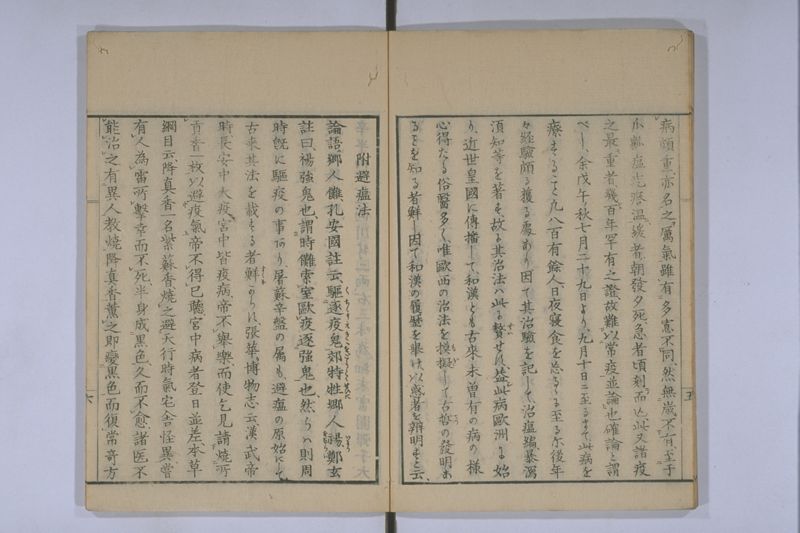
翻刻
【右】
_レ病頗重、亦名_一之 ̄ヲ厲氣_レ雖_レ有_二多■不_一レ同、然無_二歳不_一レ有、至_二干
瓜瓤瘟疤■唐温 ̄ニ_一、緩者 ̄ハ朝發夕死、急者頃刻 ̄ニノ而兦、此又諸疫
之最 ̄モ重者、幾 ̄ント百年罕有之證、故難_下以_二常疫_一並論_上也確論と謂
べし、余戌午 ̄ノ秋七月二十九日より、九月十日に至るまて、此病を
療すること凢八百有餘人、日夜寝食を忘るゝに至る尓後年
々経験頗る獲る處あり、因て其治験を記して、治瘟編、暴食瀉
湏知等を著す、故に其治法は此に贅(ぜい)せす、益 ̄シ此病欧州に始
り、近世皇国に傳播して、和漢とも古來未曾有の病の様
心得たる俗醫多く、唯欧西の治法を模擬(もぎ)して、古/哲(てつ)の發明あ
ることを知る者鮮し因て和漢の履歴を挙け、以惑者を辨明すと伝、
【左】
附避瘟法
論語 ̄ニ郷人儺、孔安国註伝、駆_二逐疫鬼_一郊特牲(くちくすえきゝをゝこうとくせいに)郷人禓(いよう)【をはらい 左ルビ】、鄭玄
註曰、裼強鬼也、謂_三儺索_レ室欧_レ疫逐_二強鬼_一也、然らは則周
時既に駆疫の事あり、屠蘇辛盤の属も、避瘟の原始にして、
古来其法を載する者鮮(すくな)からず、張華 ̄か博物志伝、漢武帝
時、長安中大疫、宮中皆疫病、帝不_レ挙_レ楽、而使乞見請_下焼_二所
_レ貢香一枚_一以避_中疫氣_上帝不_レ得_レ巳聴、宮中病者登日並差、本草
網目伝、降真香一名紫蘇香、焼_レ之避_二天行時氣宅舎怪異嘗
有_レ人為_レ雷所_レ撃幸而不_レ死、半身成_二黒色_一、久而不_レ愈、諸医不
_レ能_レ治_レ之有_二異人_一教焼_一降真香_一薫_レ之即変_二黒色_一而復常竒方
現代語訳
【右】
病気となり頗る重篤で、これを「癘気」とも名づける。多種多様で同一ではないが、毎年必ず発生する。瓜瓤瘟や疱瘡温病に至っては、緩やかなものでも朝発病すれば夕方に死に、急激なものは瞬く間に死ぬ。これはまた諸々の疫病の中で最も重篤なもので、ほぼ百年に一度の稀有な症状である。故に通常の疫病と並べて論じることは困難である」というのは確かな論である。
私は戌午の秋、七月二十九日から九月十日に至るまで、この病気を治療すること凡そ八百余人に及び、昼夜寝食を忘れるに至った。その後、年々の経験で頗る得るところがあり、そのため治験を記録して『治瘟編』『暴瀉須知』等を著した。故にその治法についてはここでは冗長になるので述べない。
そもそもこの病気は欧州に始まり、近世わが皇国に伝播したもので、和漢ともに古来未曾有の病気だと心得ている俗医が多く、ただ欧西の治法を模倣するだけで、古の哲人の発明があることを知る者は少ない。そのため和漢の履歴を挙げて、迷う者を弁明すると言う。
【左】
附 避瘟法
『論語』に「郷人儺」とあり、孔安国の注に「疫鬼を駆逐する」とある。『郊特牲』に「郷人禓」とあり、鄭玄の注に「強鬼を祓うなり。儺して室を索し疫を駆い強鬼を逐うを謂う」とある。そうであるならば周の時代に既に疫病を駆逐する行事があった。屠蘇や辛盤の類も避瘟の起源であって、古来その方法を載せる者は少なくない。
張華の『博物志』に言う、「漢武帝の時、長安中に大疫があり、宮中皆疫病となった。帝は楽を催さず、乞見に命じて貢物の香一枚を焼いて疫気を避けることを請わせた。帝はやむを得ずこれを聞き入れたところ、宮中の病者は即日皆回復した」と。
『本草綱目』に言う、「降真香は一名紫蘇香、これを焼けば天行時気や宅舎の怪異を避ける。かつて雷に撃たれた人がいて、幸い死なずに済んだが、半身が黒色となり、長らく治らなかった。諸医もこれを治すことができなかったが、異人がいて降真香を焼いて薫じることを教えたところ、即座に黒色が変じて常に復した。奇方である」と。
英語訳
【Right】
it becomes disease, quite severe, and is also named 'pestilent qi.' Though there are many varieties that differ from one another, there is no year without occurrence. As for gourd-flesh epidemic and pox-warm diseases, even the mild cases progress from morning onset to evening death, while the acute cases kill within moments. These are the most severe among all epidemics, symptoms rarely seen in nearly a hundred years. Therefore it is difficult to discuss them alongside ordinary epidemics" - this should be considered a sound argument.
In the autumn of Wuwu year, from the 29th day of the 7th month to the 10th day of the 9th month, I treated this disease in approximately 800-plus people, to the extent of forgetting sleep and meals day and night. In subsequent years, through accumulated experience I gained considerable insights, and therefore recorded these treatment experiences and authored works such as "Treatise on Epidemic Treatment" and "Essential Knowledge of Violent Diarrhea." Hence I will not elaborate on those treatment methods here as it would be redundant.
Originally this disease began in Europe and in recent times spread to our imperial nation. Many folk doctors in both Japanese and Chinese traditions consider it an unprecedented disease, merely imitating Western treatment methods while few know of the discoveries made by ancient sages. Therefore I present the historical records of Japanese and Chinese medicine to clarify matters for those who are confused.
【Left】
Appendix: Methods for Avoiding Epidemics
In the Analects it states "village exorcism," with Kong Anguo's annotation "to drive out epidemic demons." In "Suburban Special Sacrifice" it states "village purification," with Zheng Xuan's annotation "to expel strong demons, meaning to conduct exorcism, search rooms, drive out epidemics and chase away strong demons." If this is so, then already in the Zhou period there were rituals to drive out epidemics. Tusu wine and spiced plates were also the origins of epidemic avoidance, and since ancient times those who recorded such methods have been numerous.
Zhang Hua's "Records of Diverse Matters" states: "During Emperor Wu of Han's time, there was a great epidemic in Chang'an, and everyone in the palace fell ill with epidemic disease. The emperor did not hold entertainments, but ordered Qijian to request burning one piece of tribute incense to avoid the epidemic qi. The emperor had no choice but to consent, whereupon all the sick in the palace recovered that very day."
The "Compendium of Materia Medica" states: "Jiangzhen incense, also called purple perilla incense - burning it avoids seasonal epidemics and household anomalies. Once there was a person struck by lightning who fortunately did not die, but half his body turned black and would not heal for a long time. All physicians could not cure it, but a strange person taught him to burn jiangzhen incense and fumigate with it, whereupon the black color immediately changed and returned to normal. A miraculous prescription."