翻刻
【上巻廿四丁裏】
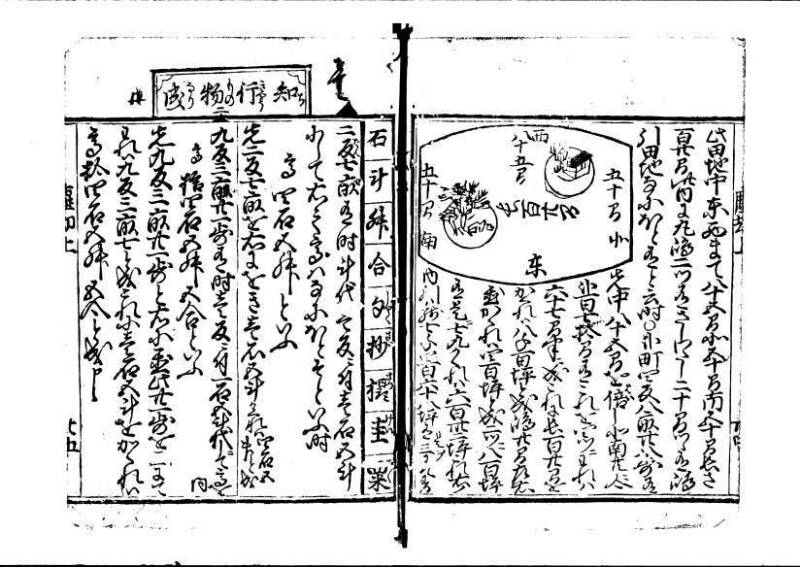
[図始_円形の島二つを内包する太鼓形の田地]
[右辺] 五十間 北
[左辺] 五十間 南
[中央横向き] 長百廿間
[上弧中央下] 西 八十五間
[下弧中央上] 東
[図終]
此田地中東西まて八十五間北五十間南五十間長さ
百廿間 此内に丸嶋二つ有 さしわたし二十間つつ有 嶋
引田地なにほと有と云時
⚪︎弍町四反八畝廿八歩有
先中八十五間を倍(はい)し北南共に合
弍百七拾間有 これを四つにわれは
六十七間半に成 これに長百廿間を
かくれは八千百坪と成 嶋廿間左右
置 かくれは四百坪と成 二つに八百坪
有 是に七九かくれは六百丗二坪 これ右の
内引残七千四百六十八坪有 是を三にてわる
【上巻廿五丁表】
知(ち)行(きやう)物(もの)成(なり)
(この条の各節冒頭の▲の上の「壱二三」などは後書きか)
石 斗 舛 合 勺(しゃく) 抄(さい) 撮(さつ) 圭(けい) 粟(そく)
壱▲二反(たん)七畝(せ)有時斗代壱反に付壱石五斗にして右の高はなにほとそといふ時
高四石五舛といふ
先二反七畝を右にをき壱石五斗かくれは四石五舛と成
二▲九反三畝廿一歩有時壱反に付一石五斗代にして高を問
高拾四石五舛五合といふ
先九反三畝廿一歩と右に置 此廿一歩を二[三の中線消失]にてわれは九反三畝七と成 これに壱石五斗をかくれは高拾四石五舛五合と成申候
現代語訳
【上巻二十四丁裏】
[図:太鼓形(弓形)の田地の中に、丸い島が二つある。右辺「五十間・北」、左辺「五十間・南」、中央横向き「長百二十間」、上弧中央下「西・八十五間」、下弧中央上「東」と記す]
この田地の中、東西まで八十五間、北五十間、南五十間、長さ百二十間。この内に丸い島が二つあり、それぞれ差し渡し(直径)二十間ずつある。島を除いた田地はどれほどあるかというと、
⚪︎二町四反八畝二十八歩ある。
まず中央の八十五間を二倍し、北・南を合わせて二百七十間とする。これを四つに割れば六十七間半となる。これに長さ百二十間をかければ八千百坪となる。島の直径二十間を縦横に置いてかければ四百坪となる。二つ(の島)で八百坪となる。これに七九(0.79)をかければ六百三十二坪となる。これを右(の八千百坪)の内から引けば、残り七千四百六十八坪となる。これを三で割る。
---
【上巻二十五丁表】
知行物成(ちぎょうものなり)
石(こく) 斗(と) 升(しょう) 合(ごう) 勺(しゃく) 抄(さい) 撮(さつ) 圭(けい) 粟(そく)
一▲ 二反七畝あるとき、斗代(とだい)として一反につき一石五斗として、右の高(たか)はどれほどかというと、
高は四石五升という。
まず二反七畝を右に置き、一石五斗をかければ四石五升となる。
二▲ 九反三畝二十一歩あるとき、一反につき一石五斗代として、高を問う。
高は十四石五升五合という。
まず九反三畝二十一歩を右に置く。この二十一歩を三百で割れば九反三畝〇・〇七となる。これに一石五斗をかければ高は十四石五升五合となる。
英語訳
**Volume 1, Sheet 24 (Verso)**
[Figure: A drum-shaped (lens/arc-shaped) field containing two round islands. Labeled: right side "50 ken, North"; left side "50 ken, South"; center horizontal "length: 120 ken"; top arc center "West, 85 ken"; bottom arc center "East"]
This field measures 85 ken from east to west at the center, 50 ken to the north, 50 ken to the south, and 120 ken in length. Within it are two round islands, each with a diameter of 20 ken. The question asks how large the field is after subtracting the islands.
⚪︎ Area: 2 chō 4 tan 8 se 28 bu.
First, double the central measurement of 85 ken, and add the north and south measurements to get 270 ken total. Divide this by 4 to get 67.5 ken. Multiply by the length of 120 ken to get 8,100 tsubo. For each island, multiply 20 ken by 20 ken to get 400 tsubo. For two islands, this gives 800 tsubo. Multiply by 0.79 to get 632 tsubo. Subtract this from the 8,100 tsubo to leave 7,468 tsubo. Divide this by 3.
---
**Volume 1, Sheet 25 (Recto)**
**Chigyo Motonari** (Calculating rice yields from landholdings)
Units of volume: *koku*, *to*, *shō*, *gō*, *shaku*, *sai*, *satsu*, *kei*, *soku*
Problem 1▲: When there is 2 tan 7 se of land, and the yield rate (*todai*) is 1 koku 5 to per tan, what is the total yield (*taka*)?
The total yield is 4 koku 5 shō.
First, place 2 tan 7 se to the right and multiply by 1 koku 5 to, to get 4 koku 5 shō.
Problem 2▲: When there is 9 tan 3 se 21 bu of land, and the yield rate is 1 koku 5 to per tan, what is the total yield?
The total yield is 14 koku 5 shō 5 gō.
First, place 9 tan 3 se 21 bu to the right. Divide the 21 bu by 300 to convert it, giving 9 tan 3 se 0.07. Multiply this by 1 koku 5 to to obtain a total yield of 14 koku 5 shō 5 gō.