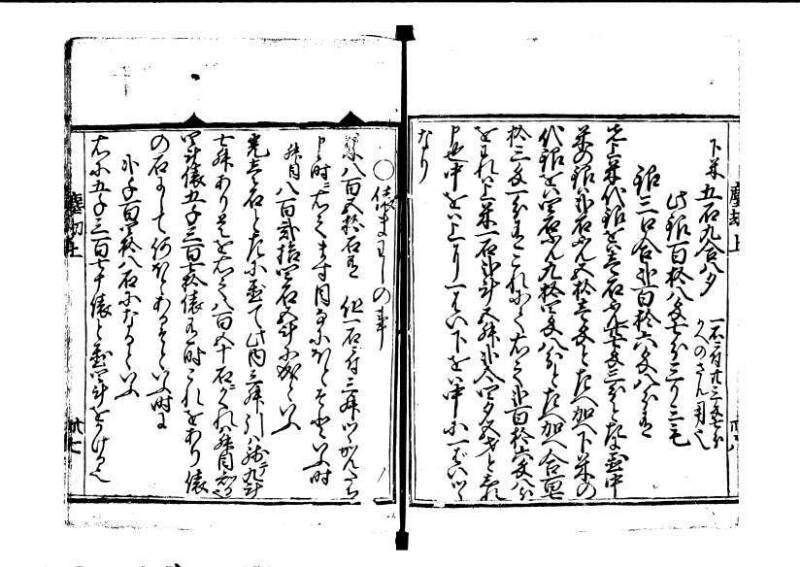
翻刻
【上巻卅六丁裏】
下米 五石九合八勺《割書:一石に付廿三匁七分|かへのさん用也》
此銀百拾八匁七分三り三毛
銀三口合弐百拾六匁八分有
先上米代銀をは壱石ふん廿七匁三分と左に置 中
米の銀は弐石ふん五拾壱匁と左へ加へ下米の
代銀をは四石ふん九拾四匁八分と左へ加へ合百七
拾三匁一分有 これにて右の弐百拾六匁八分
をわれは上米一石弐斗五舛弐合四勺五才としれ
申也 中をは上に一はい下をは中に一ばいつゝ
なり
【上巻卅七丁表】
○俵まわしの事
▲米八百五拾石有 但一石に付三舛つゝかんたち
申候時に右のます目なにほとそといふ時
舛目 八百弐拾四石五斗に成といふ
先壱石と左に置て此内三舛引は残て九斗
七舛あり 是を右の八百五十石にかくれは舛目しる也
▲四斗俵五千三百七拾俵有時これをあり俵
の石にして何ほとあるそといふ時に
弐千百四拾八石になるといふ
右に五千三百七十俵と置四斗をかける也
現代語訳
【上巻三十六丁裏】
下米 五石九合八勺 《割書:一石につき二十三匁七分換えの算用也》
この銀 百十八匁七分三厘三毛
銀三口合計 二百十六匁八分也
まず上米の代銀は一石分として二十七匁三分と左に置く。中米の銀は二石分として五十一匁を左に加え、下米の代銀は四石分として九十四匁八分を左に加えると、合計百七十三匁一分となる。これをもって右の二百十六匁八分を割れば、上米一石二斗五升二合四勺五才と知れ申す也。中(米)は上(米)の一倍、下(米)は中(米)の一倍ずつとなる。
---
【上巻三十七丁表】
○俵廻しの事
▲米八百五十石あり。ただし一石につき三升ずつ鑑立て(かんだて)申し候時に、右の升目はいくらかという時、
升目は八百二十四石五斗になるという。
まず一石と左に置いて、この内三升を引けば残りて九斗七升あり。これを右の八百五十石にかければ升目が知れる也。
▲四斗俵五千三百七十俵ある時、これをあり俵の石にして何ほどあるかという時に、
二千百四十八石になるという。
右に五千三百七十俵と置き、四斗をかける也。
英語訳
**Volume 1, Sheet 36 (Verso)**
**Inferior rice:** 5 *koku* 9 *gō* 8 *shaku* *(marginal note: calculated at the rate of 23 monme 7 bu per koku)*
— Silver required: 118 *monme* 7 *bu* 3 *rin* 3 *mō*
**Total silver for all three items: 216 *monme* 8 *bu*.**
First, place the cost of superior rice as 27 *monme* 3 *bu* (for 1 *koku*) on the left. Add to it the silver for medium rice as 51 *monme* (for 2 *koku*), and further add the silver for inferior rice as 94 *monme* 8 *bu* (for 4 *koku*), giving a total of 173 *monme* 1 *bu*. Dividing the 216 *monme* 8 *bu* by this figure reveals that the quantity of superior rice is **1 *koku* 2 *to* 5 *shō* 2 *gō* 4 *shaku* 5 *sai***. Medium rice is double that of superior rice, and inferior rice is double that of medium rice.
---
**Volume 1, Sheet 37 (Recto)**
○ **On the Matter of Bale Measurement (Tawara-mawashi)**
▲ There are 850 *koku* of rice. When 3 *shō* per *koku* is deducted as an inspection/measurement allowance (*kandachi*), one asks: what is the resulting measured quantity?
The answer is: **824 *koku* 5 *to***.
First, place 1 *koku* on the left; subtract 3 *shō* from it, leaving 9 *to* 7 *shō*. Multiply this by 850 *koku*, and the measured quantity is known.
▲ When there are 5,370 *yondō-tawara* (bales of 4 *to* each), and one asks how many *koku* this amounts to as filled bales,
The answer is: **2,148 *koku***.
Place 5,370 bales on the right, and multiply by 4 *to*.