翻刻
【上巻初丁裏】
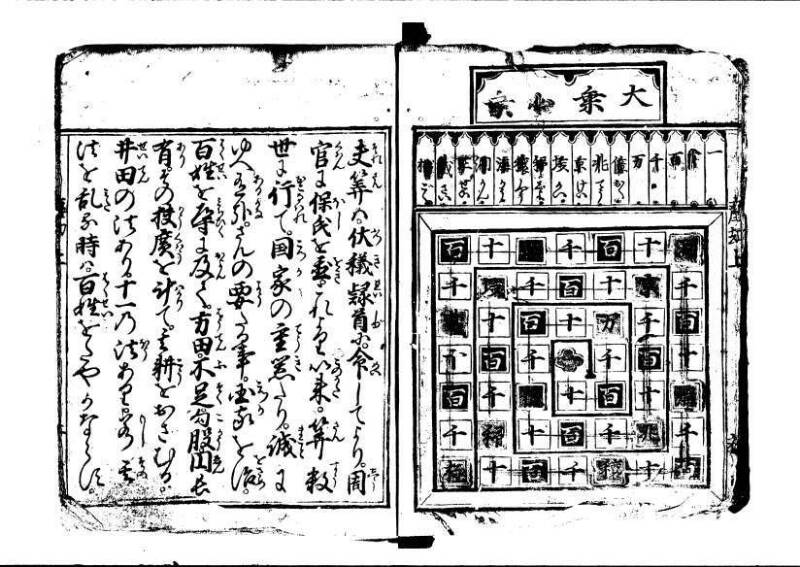
大乗小乗【上は横一列に小乗(十進法)の数詞名称,下は7行7列の正方形に大乗(万進法)の数詞名称---中心から左回りの螺旋状に進む---数詞(数字)は黒枠付き,「百」は全て白抜き,十百千以外の小乗の数詞([ ]で囲む)は黒塗りだが薄く透けて見える.黒塗りに見えるところは,小倉文庫本_イ16-32では赤に見え,同_イ16-36では無色に見える】
一
十 [澗] 千 百 十 [溝] 千 百
百
千 十 [京] 千 百 十 [京] 十
万
億おく 百 十 [万] 千 百 千 [穰]
兆てう
京けい 千 百 十 [一] 十 百 千
垓かい
𥝱しょ [正] 千 百 千 [億] 十 百
穰しやう
溝かう 十 [垓] 十 百 千 [𥝱] 十
澗かん
正せい 百 千 [載] 十 百 千 [極]
載さい
極ごく
【上巻二丁表】
/夫(それ)/筭(さん)は・/伏犠(ふつき)/隷首(れいしゆ)に・/命(めい)してより・/周(しう)
/官(くわん)に/保氏(ほし)を/置(をき)・これより/以来(このかた)・/筭(さん)/数(すう)
世に/行(をこなわれ)て・/国家(こつか)の/重器(てうき)たり・/誠(まこと)に
ゆへ/有哉(あるかな)・さんの/要(よう)たる事・/国家(こつか)を/治(をさめ)・
/百姓(はくせい)を/導(みちひく)に/及(およん)て・/方田(ほうてん)・/不足(ふそく)・/勾股(こかう)・/円(ゑん)長
/有(あり)・その/狭廣(かうくわう)を/計(はかり)て・其/耕(こう)をおさむる・
/井田(せいてん)の法あり・十一の/法(ほう)あり・/若(もし)/其(その)
法を/乱(みた)る時は・/百姓(はくせい)をたやかならす・
現代語訳
【上巻・初丁裏】
**大乗・小乗(数の名称表)**
〔小乗(十進法)の数詞名称――横一列〕
一・十・百・千・万・億・兆・京・垓・𥝱・穰・溝・澗・正・載・極
〔大乗(万進法)の数詞名称――七行七列の方陣、中心から左回りの螺旋状に配置〕
(方陣の配置は原書の図版を参照のこと)
---
【上巻・二丁表】
そもそも算術は、伏犠(ふっき)が隷首(れいしゅ)に命じてより、周官において保氏を置き、これより以来、算数は世に行われて、国家の重器となった。誠にゆえあることかな。算の要たること、国家を治め、百姓を導くに及んで、方田・不足・勾股・円長があり、その狭広を計って、その耕作を収める井田の法がある。十一の法がある。もしその法を乱る時は、百姓をたやすからず(穏やかならず)。
英語訳
[Upper Volume, First Folio, Verso]
**Large-Unit and Small-Unit Numerical Nomenclature (Chart)**
[Small-unit (*shōjō*) numerals — decimal system, in a horizontal row:]
*ichi* (1), *jū* (10), *hyaku* (100), *sen* (1,000), *man* (10,000), *oku* (10⁸), *chō* (10¹²), *kei* (10¹⁶), *gai* (10²⁰), *jo* (10²⁴), *jō* (10²⁸), *kō* (10³²), *kan* (10³⁶), *sei* (10⁴⁰), *sai* (10⁴⁴), *goku* (10⁴⁸)
[Large-unit (*daijō*) numerals — myriad-based system (*man-shin*), arranged in a 7×7 square matrix, spiraling counterclockwise from the center:]
(See the original diagram in the source document for the layout of the matrix.)
---
[Upper Volume, Second Folio, Recto]
Now then, arithmetic dates from the time when Fuxi [the mythological sovereign] commanded Lìshǒu [the legendary inventor of numbers], and thereafter, with the appointment of the *Hoshi* [Guardian Instructor] in the *Zhōuguān* [Rites of Zhou], arithmetic and mathematics have been practiced in the world and have become an instrument of great importance to the state. Truly, there is good reason for this. The essentials of arithmetic extend to governing the state and guiding the common people: there are [methods for] *hōden* (rectangular field [measurement]), *fusoku* (the method of excess and deficit), *kōkō* (right-triangle [calculation]), and *enchō* (circles and lengths). There are methods for calculating their dimensions — narrow and wide — and for managing cultivation, including the *seiden* [well-field] system of land division. There is the law of one-in-eleven [a taxation principle]. If these laws are disrupted, the common people will not be at ease.