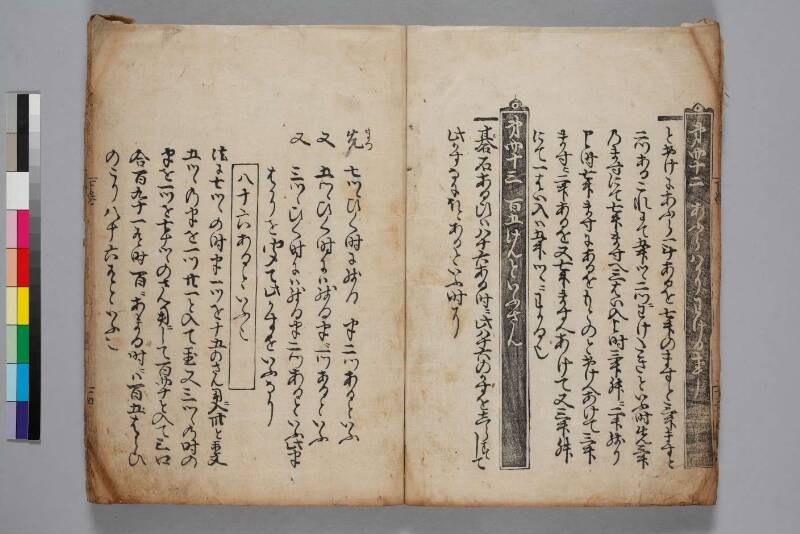
翻刻
【下巻十三丁裏】
《題:第四十二 あふらはかりわける事》
┃とおけにあふら一斗あるを七升のますと三升ますと
二つあるこれにて五升つつ二つにわけたきといふ時先三升
のますにて七升ますへ三はい入申候時三升舛に二升残り
申候時七升ますにあるをもとのとおけへあけて三升
ますに二升あるを又七升ますへあけて又三升舛
にて一はい入は五升つつにわかる也
《題:第四十三 百五けんといふさん》
┃碁(こ)石あるひは八十六ある時に此八十六のかすをしらすして
此かすなにほとあるといふ時に
【下巻十四丁表】
先(まつ) 七つつひく時に残る半二つあるといふ
又 五つつひく時には残る半に一つあるといふ
又 三つつ引く時には残る半二つあるといふ此半
はかりをやめて此かすをいふなり
[八十六あるといふ也]
法に七つつの時半一つを十五のさん用に入卅と事
五つつの半を一つ卅一と入て置又三つつの時の
半を一つを七十つつのさん用にして百四十と入て三口
合百九十一有百にあまる時には百五はらひ
のこり八十六有といふ也
現代語訳
【下巻十三丁裏】
《第四十二問 油を量り分ける事》
十桶に油が一斗あるのを、七升枡と三升枡の二つがある。これで五升ずつ二つに分けたいという時、まず三升枡で七升枡へ三杯入れる(合計九升)と、三升枡に二升残る。その時、七升枡にある油をもとの十桶へ空けて、三升枡に残っている二升を七升枡へ移す。さらに三升枡で一杯(三升)入れると、五升ずつに分けられる。
---
《第四十三問 百五減(ひゃくごげん)というさん》
碁石がある。例えば八十六個ある時、この八十六という数を知らずに、その数がいくつあるかを求める時、
【下巻十四丁表】
まず、七つずつ引いていくと、余りが二つあると言う。
また、五つずつ引いていくと、余りが一つあると言う。
また、三つずつ引いていくと、余りが二つあると言う。
この余りだけを聞いて、その数を求めるのである。
〔八十六あるという也〕
解法:七で割った余りを一つ(二)について十五をかけて三十とする。五で割った余り一つ(一)について二十一をかけて二十一とする。また三で割った余り一つ(二)について七十をかけて百四十とする。三口を合わせると百九十一となる。百を超える時は百五を引き、残りが答えとなる。残り八十六があると言う。
※計算の詳細:
- 七で割った余り2 × 15 = 30
- 五で割った余り1 × 21 = 21
- 三で割った余り2 × 70 = 140
- 合計:30 + 21 + 140 = 191
- 191 − 105 = 86
英語訳
【Fascicle 3 (下巻),丁13 Reverse】
**Problem 42: Dividing Oil by Measure**
There is one *to* (斗) of oil in a large tub (*tōke*). You have two measures: a seven-*shō* measure and a three-*shō* measure. When you wish to divide the oil into two equal portions of five *shō* each, proceed as follows:
First, use the three-*shō* measure to pour three full measures into the seven-*shō* measure (totaling nine *shō* transferred). At this point, two *shō* remain in the three-*shō* measure. Then, empty the contents of the seven-*shō* measure back into the original large tub, and pour the two *shō* remaining in the three-*shō* measure into the seven-*shō* measure. Next, add one more full three-*shō* measure into the seven-*shō* measure, and you will have divided the oil into two portions of five *shō* each.
---
**Problem 43: The Calculation Called "Hyakugo-ken" (百五減, the "105 Reduction")**
Suppose there are some go stones — say, eighty-six of them. Without knowing the number is eighty-six, when someone wishes to determine how many there are:
【Fascicle 3 (下巻), 丁14 Front】
First, they say that when subtracting (dividing) by sevens, the remainder is two.
Next, they say that when subtracting (dividing) by fives, the remainder is one.
Next, they say that when subtracting (dividing) by threes, the remainder is two.
From these remainders alone, one determines the total number.
〔The answer is eighty-six.〕
**Method:** For the remainder from dividing by seven, multiply it by 15 (the "seven-factor"): 2 × 15 = 30. For the remainder from dividing by five, multiply it by 21 (the "five-factor"): 1 × 21 = 21. For the remainder from dividing by three, multiply it by 70 (the "three-factor"): 2 × 70 = 140. Adding the three results together gives 191. When this exceeds 100, subtract 105, and the remainder is the answer: 191 − 105 = 86.