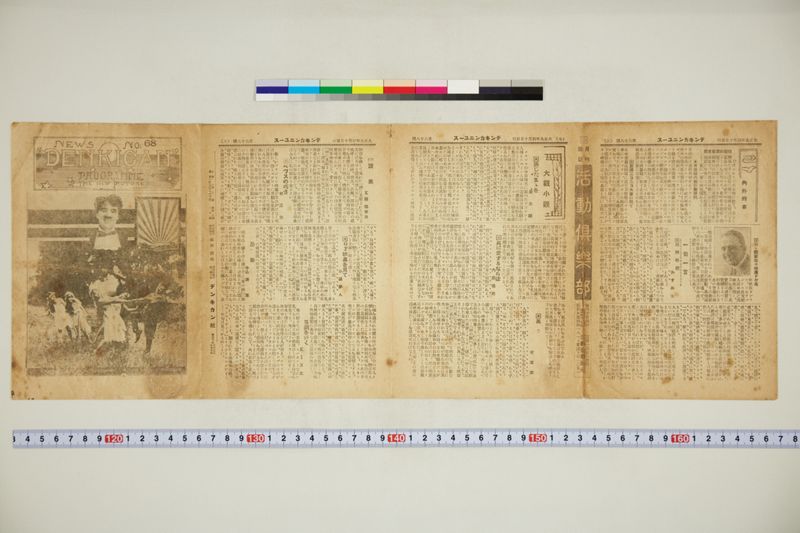
翻刻
【このコマの3頁(=(八))と4頁(=表紙)は、他のコマに有るため着手不要です】
【上部欄外】大正九年四月十日発行 デンキカンニユース 第六十八号 (六)
【本文】
内 外 時 事
問題の週替実現【@上部(横書き、文字順=右から左へ)】
Dはニューズ六七号に於て、永らく
懸案たりし週替に就て強硬且穏健なる
最後の交渉を求【?】め必ずや近く実践すべ
きことを言明せり。果然要求徹底!問
題可決!愈々来るべきDの巨弾春季特
別興行の終ると共に週間興行たる事に
決定す。我改造の第二歩に入りDの奮
闘正に今後に在り。乞ふ親愛なる諸賢
よ!更に一層の御後援あらんことを。
日活社の新映画契約
日活社は過般来朝せるフアースト ナシヨ
ナル社及ゴールドウイン社代表者を通じて
同社の新映画を契約し既にその数種を輸入
せり。両社はパラマウント、アートクラフ
ト社と共に米国第一流の映画製作社にして
フ社はグリフヰス映画ピツクフオード映画
タルマツヂ姉妹映画ステワート映画及チヤ
ツプリン映画等を又ゴ社はフアーラー映画
フレデリツク映画レツクス、ピ【?】ーチ映画ノ
ーマンド映画等の大作品を有す。而も最近
独逸映画の契約を了し、欧米の名画続々輸
入されつゝあり。来るべき六区の変動、否
東洋【?】の大映画戦に対する日活社及びDの奮
戦活躍は真に目覚ましきものあらむ。
巨弾ニコニコ大会に就て
従来否最近四回に亘りD独特のニコニコ大
会にチヤプリン、ドグラスの両映画を列挙
し来りたるも开は実際に於て永続し難き情
実あり。共に斯界の巨星にして経済とプロ
グラムに於に許さず。今回より相分立して
D独特の一大散弾砲たらしむ。而してドグ
ラス映画は近く他の名篇と共に上映すべし
【ここから中段】
おゝ親愛なり快漢ドグ氏
【十行分、写真下部】
昨秋我ドグラ
ス、フヱアバ
ンクス氏支配
人田中欽之氏
来東に際し、
Dを通じて氏
愛好の諸賢に
寄贈さるべく
約束されたる
氏の肖像は既
に数日前より送達されつゝあり。その数実
に一万余、快活に笑める君の面影、真情溢
るゝ如く且頗る優美也。D感激に堪へず。
その君の肖像を掲げ、爰に氏及び田中氏に
対し、諸賢と共に満腔の謝意を表す。
一 旬 一 言
出 陣 の 辞
か す み 生
【傍点ここから】『饒舌は銀、沈黙は金』とある。【傍点ここまで】
銀は到底金の比ではない。然し銀をもつて
金たらしむる為めには――否銀をもつて金
の地位を得せしめんには――【傍点ここから】まづ金の滅尽
を必要とする。所謂ダンヌチオ氏の完全な
る占有は滅尽に在る。とか云ふ哲学から割
出して考へて見れば饒舌も終には金たるこ
とが出来る。不可能のことではない。且饒
舌の等閑覗【ママ】すべからざる所以なのである。【傍点ここまで】
こんな理由から――或は屁理屈から――折
角沈黙を守つて居らうとした決心も、遂に
オヂヤンになつてしまつた。そして何か言
つて見ようと云ふ野心がむら〳〵起る。
【ここから下段】
【傍点ここから】見て感じて書く――たゞこれ丈では批評の
価値が充分生じない。不充分である。見て
感じ同時に批評的衝動が起つて、然る後に
書く――少くともこの四つのヱリメントが
必要である。【傍点ここまで】勿論批評的衝動が起つて書い
た批評が必ずしも好いと極つて居ないが、
苟くも多少なりとも権威ある批評を書かん
とせば、批評的衝動もないのに無理に書い
た批評は価値がない。スピンガアンと云ふ
人は『想像的精神と批評的精神とは根本に
於て一致す』と云って居る。
【傍点ここから】創作家も批評家もその表現能力のクライマ
ツクスに於ける精神的過程は根本に於て同
一である。即ち創作も批評も共に想像でき
ると説いて居る。【傍点ここまで】
人々は一般に批評を軽視しすぎて居りはし
ないだらうか。少くとも批評は真面目でな
さるべきである。下らない悪口や美文ヨタ
を飛ばして、極めて childish な喧嘩や口論
で埋めた不真面目な批評は何の権威もない【ママ】
殊に、苟くも活動写真が立派な芸術である
と認められて居る今日、映画に対する批評
は軽視すべきではない。
大変憎まれ口をきいたが、これもソリロキ
イだと思つてくれゝば別に腹も立つまい。
兎に角来週あたりから何か出鱈目に書くこ
とにする。『出鱈目』と言つてもトラシユマ
ホッスがうぢや〳〵して居る世の中、うつ
かりした事も言へまい。言々句々責任を以
つて言ふ『出鱈目』なんだから骨が折れる。
私は自分の振りまわした鞭で、自分を鞭打
たれてゐるのである。自分自身がまだ碌な
批評も出来ないくせに――と、私は烈しい
鞭の音を胸に聞く。お恥かしい次第だ。
【▼▼▼頁境界部▲▲▲】
《割書:月刊|雑誌》活動倶楽部【この直下に次の三行】
毎月十日発行――定価一部金六拾銭
《割書:東京市下谷区南|稲荷町卅一番地》――活動倶楽部社
振替東京四四一八一=電話下谷一二五一
【上部欄外】(七) 大正九年四月十日発行 デンキカンニユース 第六十八号
【本文】
大 観 小 観
感じたまゝを
章 太 郎
メキシコの中世時代に起つたアズテツク
人種とスペイン人種との宗教的争闘を劇の
主格【?】として、モンテズマの愛娘と其恋人た
る敵方の若武者とのデリケートな戀愛を描
出した原作者の力は偉大である。そして此
作品を斯くも艶麗に、優美に指導し遂せた
デミル氏の手腕もまた偉大であると思ふ。
【傍点ここから】何時の世にも私等は実例を見ることではあ
るが、公衆的或は個人的盛衰の裏面には、常
に女性の蠱惑的なパウワーを発見する。そ
して吾人は一種の戦慄みたいな感じを与へ
られる。私はこの奇跡的な劇筋を見て一層
それを感ぜざるを得ない。【傍点ここまで】
ペーガニズムの衆人をクリスチヤンに導か
うとしたコルテズは終にアズテツク人種を
全滅せしめた。然も悲惨な戦に依つて仕遂
せたのであつた。私等は斯る公衆的盛衰の
裏面に唯一個の女性を見出すのみである。
中世紀に於けるペーガニズムが人心の上に
与えた影響は、基督教のそれより以上に深
く大きなものであつたと思ふ。そしてその
反動はモンテズマの如き英傑にも、人身供
犠【?】などゝ云ふ凄惨な行為を敢てなさしめた
のであらう。
放逸遊惰にながれたアズテツク城内に起居
【ここから中段】
して多くの待女に取囲かれたテズカの性格
は、フアーラーに依つて表現されてゐた、
彼女の演出する処、何等の軽薄浮華なるは
なく、真摯的に且情緒充溢たるものであつ
た。美の神の神前に若者を救はんがために
跪いた彼女の態度、モンテズマが敵の捕物
になつたことを意識した時の彼女の表現、
谷川に過古の黄金時代を追想しつゝ沈痛な
恋を若者と語る時の彼女の表情等を見るに
実際フアーラーの芸風の偉大であり、且つ
荘厳であることを認識する―無論デミル氏
の指導や周囲の情景より享ける処も大では
あるが――。
其他の俳優も皆理解を持つて演出されてゐ
た。リード氏に就ても一言評したいが。そ
れは次の機会まで待つことにする。
真に愛するならば
内 田 徳 司
【傍点ここから】何んな物にも其もの自身の弱点がある、
週報そのものが其館の機関紙である以上そ
れは或程度まで其館の利益を保護せねばな
らぬ。それが即ち週報そのものゝ弱点であ
る。【傍点ここまで】而も投書家の中には其弱点に付入つて
徒らに賛美の文のみを寄して、自己の投書
欲を充そうとする者がある。彼等は映画の
批評とはお世辞なりと思ひ違いして居るか
然らずばお太鼓を叩いてまでも自分の名を
求めやうと言ふヒキヨウ者である――それ
が真の批評であり、それが愛する館のため
幸福であるならば兎も角――。
然し自分達は、Dを真に愛するならば所謂
『良薬口に苦し』の筆法であらねばならぬ。
だから、俺は出鱈目の賛美の文は書かない
のだ。俺はDが好きだ!だから良薬ならず
とも切めて苦い薬を進ぜるのだ。
Dはそれを快く受けて呉れる度量を有つて
【ここから下段】
ゐる。私は其れを喜ぶのである
Dを愛する人々よ!私等は真摯な批評もし
忠告もし賛美もし、そうしてDのニユース
から不真面目なお世辞やを撃退しませう!
Dの巨弾と相俟つて……、
美 !!【左九〇度】
可 津 次
【傍点ここから】人間が苦み、働き、そして生を全ふして
行くには、何者かそこに一つの目的があら
ねばならぬ。それは何?富!成功!あらず
即ち『美』そのものに帰着するのである。
人間は常にそう云ふ感じを有つ本能を有し
て居る。【傍点ここまで】であるから少しでも美に接しやう
接しやうと祈つて、それに触るべく望んで
ゐる。映画を見る上に於ても『美』なるべ
きものをと希望して止まない。
大芸術的映画!それの多くは皆『美』の化身
である。曰く『神の娘』『ウーマン』そして期
待を重ねた名優フアーラー嬢の『神に見離
された女』皆悉く美を以て充満されてゐる。
そうした映画それが我々の真に求むる映画
上の『美』なのである。
『神に見離された女』何たる雄大な、荘厳な
極美なるものではないか。宮殿の美麗さに
先づ胸を衝かれる。あの暁の色を充分に表
現し得た城中の大石段、王の愛娘テズカが
一人余生を送る大森林中の自然、自分は美
の国に遊んでゐる如く思はれた。殊に映画
の初め、フアーラー嬢のあの絶大なチヤー
ミングな瞳を、永く絞り残したことは美観
以外に印象を深からしめた。
此映画に依つて、私は求むる『美』その者に
浸り得たことを感謝せねばならぬ。
【このコマの3頁(=(八))と4頁(=表紙)は、他のコマに有るため着手不要です】
現代語訳
【上部欄外】大正9年4月10日発行 デンキカン・ニュース 第68号 (6)
【本文】
国内外時事
問題の週替え実現
Dはニュース67号において、長らく懸案であった週替えについて強硬かつ穏健な最後の交渉を求め、必ずや近く実践すべきことを言明した。果たして要求徹底!問題可決!いよいよ来るべきDの巨弾春季特別興行の終了と共に週間興行となることに決定した。我々の改造の第二歩に入り、Dの奮闘はまさに今後にある。親愛なる諸賢よ!さらに一層のご後援をお願いしたい。
日活社の新映画契約
日活社は先般来日したファースト・ナショナル社およびゴールドウィン社代表者を通じて同社の新映画を契約し、すでにその数種を輸入した。両社はパラマウント、アートクラフト社と共にアメリカ第一流の映画製作社であり、ファースト・ナショナル社はグリフィス映画、ピックフォード映画、タルマッジ姉妹映画、スチュワート映画およびチャップリン映画等を、またゴールドウィン社はファーラー映画、フレデリック映画、レックス・ビーチ映画、ノーマンド映画等の大作品を有している。しかも最近ドイツ映画の契約を完了し、欧米の名画が続々と輸入されつつある。来るべき六区の変動、いや東洋の大映画戦に対する日活社およびDの奮戦活躍は真に目覚ましいものがあるだろう。
巨弾ニコニコ大会について
従来、いや最近4回にわたりD独特のニコニコ大会にチャップリン、ダグラスの両映画を並べてきたが、これは実際において永続し難い事情がある。共に業界の巨星であり、経済とプログラムにおいて許されない。今回より相分離してD独特の一大散弾砲とする。そしてダグラス映画は近く他の名作と共に上映すべし。
ああ親愛なる快男児ダグラス氏
昨秋我がダグラス・フェアバンクス氏の支配人田中欽之氏が来東した際、Dを通じて氏を愛好する諸賢に寄贈されるべく約束された氏の肖像は、すでに数日前より送達されつつある。その数実に1万余、快活に笑む君の面影は、真情溢れるように、かつ頗る優美である。D感激に堪えず。その君の肖像を掲げ、ここに氏および田中氏に対し、諸賢と共に満腔の謝意を表す。
一旬一言
出陣の辞
かすみ生
『雄弁は銀、沈黙は金』とある。
銀は到底金の比ではない。しかし銀をもって金とするためには―いや銀をもって金の地位を得させるには―まず金の滅尽を必要とする。いわゆるダンヌンツィオ氏の完全な占有は滅尽にある、とかいう哲学から割り出して考えてみれば、雄弁も終には金となることができる。不可能なことではない。かつ雄弁の等閑視すべからざる所以なのである。
こんな理由から―あるいは屁理屈から―せっかく沈黙を守っていようとした決心も、ついにダメになってしまった。そして何か言ってみようという野心がむらむらと起こる。
見て感じて書く―ただこれだけでは批評の価値が十分生じない。不十分である。見て感じ同時に批評的衝動が起こって、しかる後に書く―少なくともこの四つの要素が必要である。もちろん批評的衝動が起こって書いた批評が必ずしも良いと決まっているわけではないが、いやしくも多少なりとも権威ある批評を書こうとすれば、批評的衝動もないのに無理に書いた批評は価値がない。スピンガーンという人は『想像的精神と批評的精神とは根本において一致する』と言っている。
創作家も批評家もその表現能力のクライマックスにおける精神的過程は根本において同一である。すなわち創作も批評も共に想像でできると説いている。
人々は一般に批評を軽視しすぎているのではないだろうか。少なくとも批評は真面目になされるべきである。つまらない悪口や美文よたを飛ばして、極めて子供じみた喧嘩や口論で埋めた不真面目な批評は何の権威もない。
殊に、いやしくも活動写真が立派な芸術であると認められている今日、映画に対する批評は軽視すべきではない。
大変憎まれ口をきいたが、これもひとりごとだと思ってくれれば別に腹も立つまい。
とにかく来週あたりから何かでたらめに書くことにする。『でたらめ』と言っても、たわごとがうじゃうじゃしている世の中、うっかりしたことも言えまい。一言一句責任を以って言う『でたらめ』なんだから骨が折れる。
私は自分の振り回した鞭で、自分を鞭打たれているのである。自分自身がまだろくな批評もできないくせに―と、私は激しい鞭の音を胸に聞く。お恥ずかしい次第だ。
【ページ境界】
月刊雑誌『活動倶楽部』
毎月10日発行――定価一部金60銭
東京市下谷区南稲荷町31番地――活動倶楽部社
振替東京44181=電話下谷1251
【上部欄外】(7) 大正9年4月10日発行 デンキカン・ニュース 第68号
【本文】
大観小観
感じたままを
章太郎
メキシコの中世時代に起こったアステカ人種とスペイン人種との宗教的争闘を劇の主格として、モンテズマの愛娘とその恋人たる敵方の若武者とのデリケートな恋愛を描出した原作者の力は偉大である。そしてこの作品をかくも艶麗に、優美に指導し遂げたデミル氏の手腕もまた偉大であると思う。
いつの世にも私たちは実例を見ることではあるが、公衆的或いは個人的盛衰の裏面には、常に女性の蠱惑的な力を発見する。そして我々は一種の戦慄のような感じを与えられる。私はこの奇跡的な劇筋を見て一層それを感ぜざるを得ない。
異教主義の衆人をキリスト教徒に導こうとしたコルテスは、ついにアステカ人種を全滅させた。しかも悲惨な戦いによって成し遂げたのであった。私たちはこのような公衆的盛衰の裏面に、ただ一個の女性を見出すのみである。
中世紀における異教主義が人心の上に与えた影響は、キリスト教のそれより以上に深く大きなものであったと思う。そしてその反動はモンテズマのような英傑にも、人身御供などという凄惨な行為を敢えてなさしめたのであろう。
放逸遊惰に流れたアステカ城内に起居して多くの待女に取り囲まれたテスカの性格は、ファーラーによって表現されていた。彼女の演出するところ、何等の軽薄浮華なることはなく、真摯的にかつ情緒充溢たるものであった。美の神の神前に若者を救わんがために跪いた彼女の態度、モンテズマが敵の捕虜になったことを意識した時の彼女の表現、谷川に過去の黄金時代を追想しつつ沈痛な恋を若者と語る時の彼女の表情等を見るに、実際ファーラーの芸風の偉大であり、かつ荘厳であることを認識する―もちろんデミル氏の指導や周囲の情景より受けるところも大ではあるが―。
その他の俳優も皆理解を持って演出されていた。リード氏についても一言評したいが、それは次の機会まで待つことにする。
真に愛するならば
内田徳司
どんなものにもそのもの自身の弱点がある。週報そのものがその館の機関紙である以上、それはある程度まで劇場の利益を保護せねばならない。それがすなわち週報そのものの弱点である。しかも投書家の中にはその弱点に付け入って、いたずらに賛美の文のみを寄して、自己の投書欲を充たそうとする者がある。彼らは映画の批評とはお世辞なりと思い違いしているか、然らずばお太鼓を叩いてまでも自分の名を売ろうという卑怯者である―それが真の批評であり、それが愛する館のため幸福であるならばともかく―。
しかし自分たちは、Dを真に愛するならば、いわゆる『良薬口に苦し』の筆法でなければならない。
だから、俺はでたらめな賛美の文は書かないのだ。俺はDが好きだ!だから良薬でなくとも極めて苦い薬を進呈するのだ。
Dはそれを快く受けてくれる度量を有している。私はそれを喜ぶのである。
Dを愛する人々よ!私たちは真摯な批評もし忠告もし賛美もし、そうしてDのニュースから不真面目なお世辞を撃退しましょう!
Dの巨弾と相まって……。
美!!
可津次
人間が苦しみ、働き、そして生を全うして行くには、何者かそこに一つの目的がなければならない。それは何?富!成功!ではない。すなわち『美』そのものに帰着するのである。
人間は常にそういう感じを有つ本能を有している。であるから少しでも美に接しようと祈って、それに触れるべく望んでいる。映画を見る上においても『美』なるべきものをと希望して止まない。
大芸術的映画!それの多くは皆『美』の化身である。『神の娘』『ウーマン』そして期待を重ねた名優ファーラー嬢の『神に見離された女』皆ことごとく美を以って充満されている。
そうした映画、それが我々の真に求める映画上の『美』なのである。
『神に見離された女』何たる雄大な、荘厳な極美なるものではないか。宮殿の美麗さにまず胸を突かれる。あの暁の色を十分に表現し得た城中の大石段、王の愛娘テスカが一人余生を送る大森林中の自然、自分は美の国に遊んでいるかのように思われた。殊に映画の初め、ファーラー嬢のあの絶大なチャーミングな瞳を、永くアップで残したことは美観以外に印象を深からしめた。
この映画によって、私は求める『美』その者に浸り得たことを感謝せねばならない。
英語訳
【Header】
Published April 10, 1920, Taisho 9 Denkican News No. 68 (6)
【Main Text】
Domestic and Foreign Current Events
Realization of the Problem of Weekly Programming Changes
In News No. 67, D declared that regarding the weekly programming changes that had long been a pending issue, they would seek firm yet moderate final negotiations and would certainly put this into practice soon. Indeed, the demand was thoroughly met! The issue was approved! Finally, it has been decided that weekly programming will begin upon the completion of D's upcoming major spring special program. We enter the second step of our reform, and D's struggle truly lies ahead. Dear gentlemen! We ask for even greater support.
Nikkatsu Company's New Film Contracts
Nikkatsu Company has contracted new films from First National and Goldwyn companies through their representatives who recently came to Japan, and has already imported several of these. Both companies, along with Paramount and Artcraft, are America's first-class film production companies. First National has Griffith films, Pickford films, Talmadge sisters films, Stewart films, and Chaplin films, while Goldwyn has Farrar films, Frederick films, Rex Beach films, Normand films and other major works. Moreover, they recently completed contracts for German films, and European and American masterpieces are being imported one after another. The fierce struggle and activity of Nikkatsu and D in the coming changes in the six districts—no, in the great film war of the East—will truly be remarkable.
About the Major Smiling Convention
Previously—no, in the recent four sessions—D's unique Smiling Convention has featured both Chaplin and Douglas films, but this has circumstances that make it difficult to continue in practice. Both are giants of the industry and are not permitted in terms of economics and programming. From this time, they will be separated to become D's unique major shotgun blast. Douglas films will be screened soon with other masterpieces.
Oh, Our Beloved Cheerful Fellow Douglas!
The portrait of Douglas Fairbanks that was promised to be donated to the gentlemen who admire him through D, when his manager Mr. Tanaka Kinji came to Tokyo last autumn, has been delivered since several days ago. The number is actually over 10,000. The cheerfully smiling image of you overflows with true feeling and is quite graceful. D cannot contain its emotion. We display your portrait here and express our heartfelt gratitude to you and Mr. Tanaka along with all gentlemen.
One Word Every Ten Days
Declaration of Going to Battle
Kasumi-sei
"Speech is silver, silence is golden."
Silver is no match for gold. However, to make silver into gold—no, to make silver attain gold's position—first requires the destruction of gold. From the philosophy that says D'Annunzio's complete possession lies in destruction, if we think it through, speech too can eventually become gold. It's not impossible. And this is why speech should not be neglected.
For such reasons—or perhaps sophistry—the determination to maintain silence has finally been ruined. And the ambition to say something keeps rising up.
To see, feel, and write—this alone is insufficient to create valuable criticism. It's inadequate. To see, feel, simultaneously have critical impulse arise, and then write—at least these four elements are necessary. Of course, criticism written with critical impulse is not necessarily good, but if one attempts to write criticism with some authority, criticism forced without critical impulse has no value. A man named Spingarn says "The imaginative spirit and the critical spirit fundamentally coincide."
Both creators and critics have fundamentally identical mental processes at the climax of their expressive abilities. That is, both creation and criticism can be accomplished through imagination.
Don't people generally undervalue criticism too much? At the very least, criticism should be done seriously. Frivolous criticism filled with worthless abuse and flowery nonsense, extremely childish quarrels and arguments has no authority.
Especially since moving pictures are now recognized as legitimate art, criticism of films should not be taken lightly.
I've spoken quite harshly, but if you think of this as a soliloquy, it shouldn't make you particularly angry.
Anyway, I'll start writing something carelessly from next week. Even though I say "carelessly," in a world full of nonsense, one can't say thoughtless things. Since it's "careless" talk spoken with responsibility for every word and phrase, it's troublesome.
I am being whipped by the whip I myself wielded. Even though I myself cannot yet write proper criticism—I hear the fierce sound of the whip in my chest. How shameful.
【Page Break】
Monthly Magazine "Katsudo Club"
Published monthly on the 10th—Price: 60 sen per copy
31 Minami-Inarimachi, Shitaya-ku, Tokyo—Katsudo Club Company
Postal Transfer Tokyo 44181 = Telephone Shitaya 1251
【Header】
(7) Published April 10, 1920, Taisho 9 Denkican News No. 68
【Main Text】
Grand and Small Observations
Just as I Felt
Shotaro
The power of the original author who depicted the religious conflict between the Aztec and Spanish races that occurred in medieval Mexico as the main framework of the drama, and portrayed the delicate romance between Montezuma's beloved daughter and her lover, a young warrior from the enemy side, is great. And I think DeMille's skill in directing this work so gorgeously and gracefully to completion is also great.
In every age we see examples, but behind public or personal rise and fall, we always discover the bewitching power of women. And we are given a kind of trembling feeling. Seeing this miraculous dramatic plot, I cannot help but feel this even more.
Cortés, who tried to lead the pagan masses to Christianity, finally annihilated the Aztec race. Moreover, he accomplished this through tragic war. We find only a single woman behind such public rise and fall.
I think the influence that paganism had on people's hearts in the medieval period was deeper and greater than that of Christianity. And this reaction probably caused even a hero like Montezuma to dare perform such ghastly acts as human sacrifice.
The character of Tesca, living in the dissolute and idle Aztec palace surrounded by many attendants, was expressed by Farrar. In her performance, there was nothing frivolous or showy, but it was sincere and overflowing with emotion. Seeing her attitude as she knelt before the god of beauty to save the young man, her expression when she realized that Montezuma had been captured by the enemy, her facial expressions when she spoke painful love with the young man while reminiscing about the golden age of the past by the valley stream—I recognize that Farrar's artistic style is truly great and majestic—though of course much is also received from DeMille's direction and the surrounding scenes.
The other actors also all performed with understanding. I would like to comment on Mr. Reid as well, but I'll wait until the next opportunity.
If You Truly Love
Uchida Tokuji
Everything has its own weaknesses. Since the weekly report itself is the theater's house organ, it must protect the theater's interests to some degree. That is precisely the weekly report's own weakness. Yet among letter writers, there are those who take advantage of this weakness and merely send flattering articles to satisfy their desire to contribute. They either misunderstand that film criticism means flattery, or they are cowards who would beat drums just to make their names known—if only that were true criticism and brought happiness to the theater they love.
However, if we truly love D, we must use the so-called "good medicine tastes bitter" approach.
Therefore, I don't write nonsensical praise. I love D! So I offer extremely bitter medicine, if not good medicine.
D has the magnanimity to accept this gladly. I rejoice in that.
People who love D! Let us make sincere criticisms, give advice, and offer praise, and drive away insincere flattery from D's News!
Together with D's major productions...
Beauty!!
Katsuji
For humans to suffer, work, and fulfill life, there must be some purpose there. What is it? Wealth! Success! No. It ultimately comes down to "Beauty" itself.
Humans always have the instinct to have such feelings. Therefore, they pray to encounter beauty even a little, hoping to touch it. Even when watching films, they never stop hoping for things that should be "Beautiful."
Great artistic films! Many of them are all incarnations of "Beauty." "The Daughter of the Gods," "A Woman," and the highly anticipated "The Woman God Forgot" by the famous actress Miss Farrar—all are completely filled with beauty.
Such films—that is the "Beauty" in cinema that we truly seek.
"The Woman God Forgot"—what a magnificent, majestic, supremely beautiful thing it is! First, one's heart is struck by the beauty of the palace. The great stone steps in the castle that fully expressed the color of dawn, the nature of the great forest where the king's beloved daughter Tesca spends her remaining life alone—I felt as if I were wandering in a country of beauty. Especially at the beginning of the film, keeping Miss Farrar's absolutely charming eyes in close-up for a long time deepened the impression beyond mere beauty.
Through this film, I must be grateful that I was able to immerse myself in the very "Beauty" I seek.