翻刻
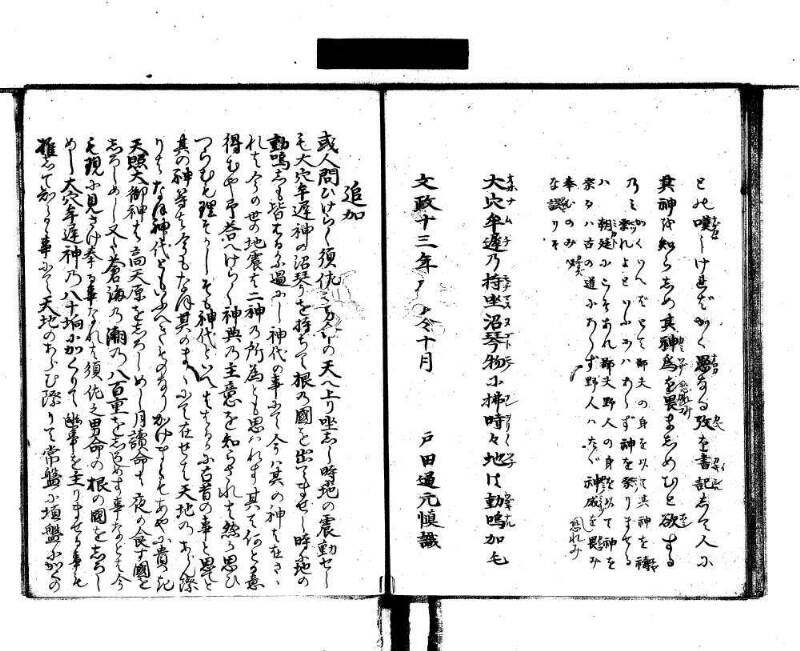
【右丁】 【この書者は振り仮名と送り仮名を重複して記すことがあります。】
との嘆(ナゲカハ)しければかく愚(オロカ)なる 攷(カヾヘ)【「カンガヘ」の「ン」の表記が脱落したもの。「ん」の省略はよく見られる。】を書(カイ)【 見せ消ち カキ 】記(シル)して人に
其神を知らしめ其 神為(カミワザ)を恐れみ【「恐れみ」は挿入 語】畏(カシコ)ましめむと欲(ホシ)【ママ】する
のみ【ここから三行に渡る長い割書計六行】
かくいへばとて鄙夫の身を以て其神を祷(ネギ )【禱】
祭(マツ)れよといふにはあらず神を祭(マツ)りませる
は 【闕字】朝廷(ミカト)にこそあれ鄙夫野人の身を以て神を
祭るは古の道にあらず野人はたゞ神威(カミノミイヅ)を恐れみ【「恐れみ」は挿入語】畏(カシコ)み
奉心のみ必(カナラズ)
な誤(アヤマ)りそ
【「な・・・そ」は優しい禁止表現。
大穴牟遅(オホナムチ)乃 持坐沼琴(モチマスヌゴト)物(モノ)に払(フレ)時々(ヲリ〳〵)地(ツチ)は動(ウゴキ)鳴(ナル)かも
文政十三年□□【「初冬」or「孟冬」ヵ】十月 戸田通元愼識
【左丁】
追加
或人問ひけらく須佐之男命の天へ上り坐しし時に地の震動せし
も大穴牟遅神の沼琴を持ちて根の国を出てませし時に地の
動鳴しも皆はるかに過にし神代の事にて今は其の神は在さヽ
れは今の世の地震は二神の所為とも思はれす其は何とか意
得むや予答へけらく神典の主意を知らされは然う思ひ
つらむも理そかし【ことわりぞかし】そも神代といへははるかに古昔の事と思てと
其の神等は今もなほ其のまゝにて在せは天地のあらん際
りはなほ神代ともいふへきものなり かけまくもあやに貴き
天照大御神は高天原をしろしめし月読命は夜の食す国を
しろしめし又た【この「た」は不要。語尾のダブり】蒼海の潮の八百重をしろしめす事なとは今
も現に見さけ奉る事なれば須佐之男命の根の国をしろし
めし大穴牟遅神の八十垧にかくりて幽事を主りませる事も
推して知らるゝ事にて天地のあらむ際りて常盤に垣盤にかくの
現代語訳
【右丁】
ことが嘆かわしいので、このような愚かな考察を書き記して、人にその神を知らせ、その神の御業を恐れ畏まらせようと思うのである。
このように言うからといって、田舎者の身でその神を祈り祭れというのではない。神を祭るのは朝廷においてこそふさわしい。田舎者や庶民の身で神を祭るのは古の道ではない。庶民はただ神威を恐れ畏み奉る心だけで十分である。決して誤ってはならない。
大穴牟遅が持っている沼琴が物に触れるとき、時々地は動き鳴るのである。
文政十三年(一八三〇年)十月 戸田通元謹んで記す
【左丁】
追加
ある人が問うことには、「須佐之男命が天に上られた時に地が震動したのも、大穴牟遅神が沼琴を持って根の国を出られた時に地が動き鳴ったのも、皆はるか昔の神代の出来事で、今はその神はいらっしゃらないので、今の世の地震は二神の仕業とも思われない。それはどのように理解すべきか」と。
私は答えて言うには、「神典の主旨を知らなければ、そう思うのも道理である。そもそも神代というのは、はるか昔のことと思っているが、その神々は今もなおそのままでいらっしゃるので、天地のある限りは、なお神代とも言うべきものである。恐れ多くも貴い天照大御神は高天原を治められ、月読命は夜の国を治められ、また大海原の潮の幾重もの波を治められることなどは、今も現に拝見申し上げることであるから、須佐之男命が根の国を治められ、大穴牟遅神が多くの土地に隠れて霊的なことを司られることも、推して知られることで、天地のある限り常に永久に、このような
英語訳
[Right page]
This is so lamentable that I write down these foolish considerations to make people know these deities and to make them fear and revere the work of these gods.
Just because I say this does not mean that country folk should pray to and worship these gods with their humble status. Worshipping gods is appropriate for the imperial court. For country folk and commoners to worship gods with their status is not the ancient way. Commoners need only have hearts that fear and revere the divine authority. One must never err in this.
When Onamuji's marsh koto touches something, the earth moves and resounds from time to time.
Tenth month of Bunsei 13 (1830), respectfully recorded by Toda Michimoto
[Left page]
Addition
Someone asked: "The earth's trembling when Susanoo-no-Mikoto ascended to heaven, and the earth's moving and resounding when Onamuji-no-Kami left Ne-no-kuni carrying the marsh koto - these are all events from the distant age of the gods, and since those gods are no longer present, the earthquakes of today cannot be considered the work of these two deities. How should this be understood?"
I answered: "If one does not know the main meaning of the divine classics, it is reasonable to think so. The age of the gods is thought to be ancient times, but since those deities still exist as they were, as long as heaven and earth exist, it should still be called the age of the gods. The awesome and noble Amaterasu Omikami rules Takamagahara, Tsukuyomi-no-Mikoto rules the land of night, and governs the countless layers of ocean tides - these we can actually witness today. Therefore, we can infer that Susanoo-no-Mikoto rules Ne-no-kuni and Onamuji-no-Kami is hidden in many lands governing spiritual matters, and as long as heaven and earth exist, eternally and perpetually, such..."