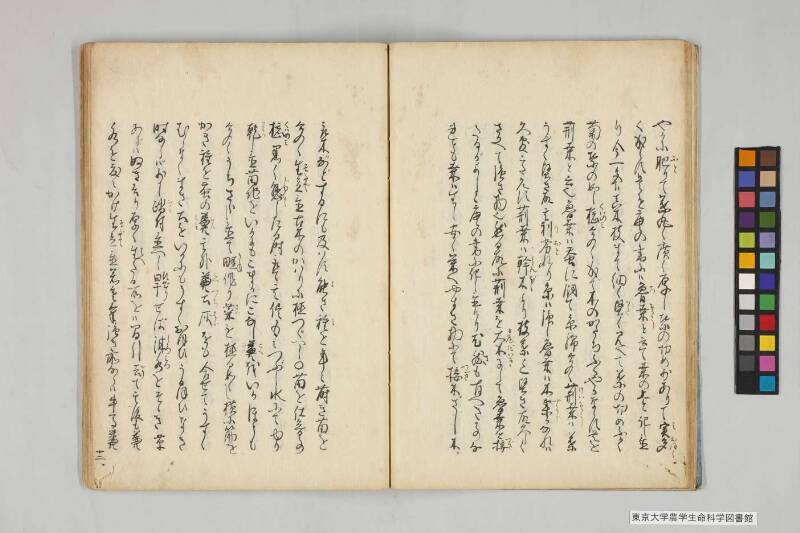
翻刻
やか尓/肥(ふと)りて葉丸く廣く厚し葉の切め少ありて/実多(みおほく)
く成ら須是を唐の書尓は/魯桑(ろそう)と云て桑の上と記し置
り今一色は真木枝まて細く/堅(かた)く見へて葉の切めふかく
菊の葉の如し/椹(くはのみ)多く成て木のかたちふくやかなら須是を
荊桑と云也魯桑は蚕に飼て糸綿多く/荊桑(けいそう)は葉
うすく堅き故其/利劣(りおと)れり糸は強し魯桑は木/柔(やわら)かなれは
久敷こたえ須荊桑は/幹木(しんぼく)より枝葉迄堅き故久しく
さかへて強き物也然る故尓荊桑を/大木(屋だいき)尓して魯桑を/接(つぎ)
たるがよしと唐の書尓記し置けり尤/然(さ)も有へき事な
連とも桑は生し安く菜へやすき物尓て/接(つぎ)木。さし木。
取木。などするにも及は須/能(よ)き/種(み)を年々蒔き苗を
多く/生立(そたで)置古木のかはり尓植つぐへし〇苗を仕立る事
/椹(くはのみ)黒く/熟(じゆく)したる時取て其侭もみつぶし水尓てゆり
/乾(かわか)し置苗地をいか尓もこまかにこなし/糞(こへ)越いかほとも
多くうちさらし置て/畦(う年)作り/菜(さい)を植る如くし横尓筋を
かき種を蚕の/糞(ふん)其外/糞土灰(こへつちはい)をも合せてうすく
むらなくまき土をいか尓もうすくおほひうるほひなき
時ならば少し/踏(ふみ)付置へし/旱(ひでり)せば/湛水(しろみつ)をそゝき草
あらはぬき去り厚く/生(はへ)たる所をは間引/去(す)て其後も糞
水を度々かけ/生立(そだて)置若寒気強き所ならは牛馬糞
左ページ四行目左ルビー 「糞 ふん」
同 六行目左ルビー 「糞 くそ」
現代語訳
やかに太って葉が丸く広く厚い。葉の切れ込みが少なくて実が多くつかない。これを唐の書には魯桑と言って桑の上等品と記している。もう一色は幹から枝まで細く堅く見えて葉の切れ込みが深く菊の葉のようである。椹(桑の実)が多くつき木の形が豊かでない。これを荊桑と言う。魯桑は蚕に与えて糸が多く取れ、荊桑は葉が薄く堅いため、その利益は劣るが糸は強い。魯桑は木が柔らかなので久しく保たない。荊桑は幹から枝葉まで堅いため久しく栄えて強いものである。それゆえ荊桑を大木にして魯桑を接ぎ木するのがよいと唐の書に記してある。もっともそうであろうことだが、桑は育ちやすく栽培しやすいもので、接ぎ木・挿し木・取り木などするにも及ばない。良い種を年々蒔き苗を多く育てておき、古木の代わりに植え継ぐべきである。
○苗を仕立てること
椹(桑の実)が黒く熟した時に取ってそのまま揉み潰し、水で洗い乾かしておく。苗地をできるだけ細かく耕し、肥料をいくらでも多く撒いてならしておいて畦を作り、菜を植えるようにして横に筋をかく。種を蚕の糞その他肥料・土・灰をも合わせて薄く斑なく蒔き、土をできるだけ薄く覆う。潤いがない時ならば少し踏み付けておくべきである。旱魃すれば水をそそぎ、草が生えれば抜き去り、厚く生えた所は間引き去って、その後も肥料を溶いた水を度々かけ育てておく。もし寒気の強い所ならば牛馬糞を
英語訳
grows luxuriantly and becomes thick, with leaves that are round, wide, and thick. The leaf serrations are few and it bears little fruit. Chinese books call this "rosō" (Lu mulberry) and record it as the superior type of mulberry. The other type appears slender and hard from trunk to branches, with deep leaf serrations like chrysanthemum leaves. It bears many mulberries (mulberry fruits) but the tree form is not abundant. This is called "keisō" (Jing mulberry). Lu mulberry produces much silk when fed to silkworms, while Jing mulberry has thin, hard leaves so its yield is inferior, but the silk is strong. Lu mulberry has soft wood so it does not last long. Jing mulberry is hard from trunk to branches and leaves, so it thrives long and is strong. Therefore, Chinese books record that it is good to use Jing mulberry as the large tree stock and graft Lu mulberry onto it. This would certainly make sense, but mulberry grows easily and is easy to cultivate, so there is no need for grafting, cutting, or layering. One should sow good seeds every year, raise many seedlings, and plant them as replacements for old trees.
○Raising seedlings
When mulberries (mulberry fruits) ripen black, pick them and crush them as is, wash with water and dry. Cultivate the seedbed as finely as possible, spread as much fertilizer as possible and level it, make ridges, and draw furrows across as when planting vegetables. Sow the seeds mixed with silkworm droppings and other fertilizer, soil, and ash, spreading thinly and evenly, then cover with soil as thinly as possible. If there is no moisture, one should tread it down a little. If there is drought, pour water; if weeds appear, pull them out; thin out densely grown areas, and afterwards frequently apply liquid fertilizer to raise them. If it is a place with severe cold weather, use cattle and horse manure