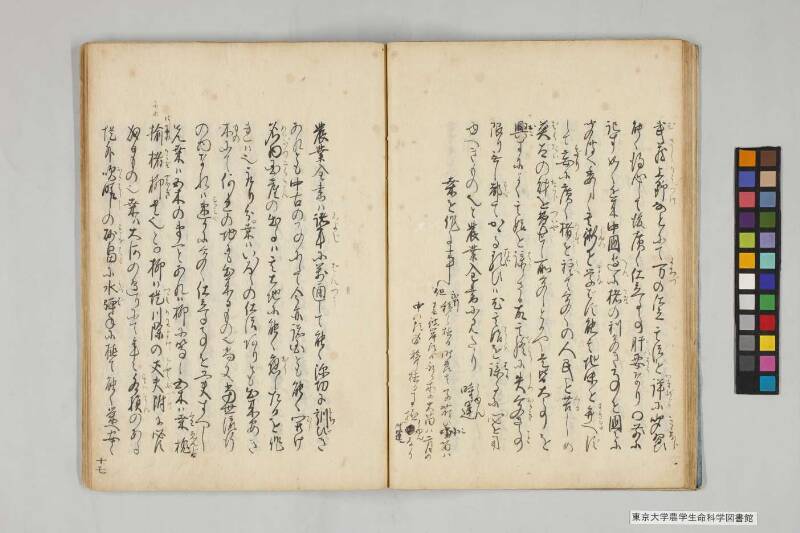
翻刻
/武蔵(むさし)/上野(かうづけ)なと尓て/万(よろづ)の仕立其法を/詳(つまびらか)尓/聞習(きゝなら)ひ
能く得心して後廣く仕立る事の/肝要(かんよう)なり〇前尓
記す如く近来中國/邊(へん)尓/楮(かぞ)の利多き事を國々尓
聞傳へ委しく其/術(じゆつ)を/学(まな)ばず能其地味を/弁(わきま)へず
して/妄(みだり)尓廣く/楮(かぞ)を/種(うへ)て多くの人民を/苦(くる)しめ
/莫太(ばくだい)の/財(たから)を/費(ついや)せし所多しとかや是皆大事を
/興(おこ)す尓よく其始を/謀(はか)らさる故其/終(をわり)尓/失多(しつおゝき)き/事(こと)
限り無し/都(春べ)てかゝる/類(たぐ)ひは尤其/始(はじめ)を/謀(はか)る尓心を用
ゆへきもの也と農業全書尓見たり /時運(しゆん)
桑を作る事但《割書:武州移し植る時節は子蒔の/小(こ)苗は|春彼岸頃ゟ取り木の大苗は二月の》
《割書:中の頃ゟ移し植る事極/時運(しゆん)なり|》
農業全書は/諸事(志よじ)尓/萬通(ばんつう)して能く深切尓/訓(みち)びき
あれとも中古の事尓して今亦諸国とも能く/開(ひら)け
/名物國産(めいぶつこくさん)の出るは其土地尓能く/應(おう)したるを作
連は也取り分。桑はいろ〳〵の仕法阿りとも出来安き
/木(もの)尓て何連の地尓も出来るもの也尚又当世流行
の物なれは/速(春みや)か尓多く仕立る事を工夫すへし
先桑五木の第一とあれは柳尓等し五木は/桑(くわ)/槐(ゑんじゆ)
/楡(尓れ)/楮(かうぞ)/柳(やなぎ)是也と。柳は/堤(つゝみ)/川除(かわよけ)の/丈夫附(じやうぶづけ)尓必須
成るもの也桑は大河の邊り尓て年々/水損(春いそん)のある
堤外/吹晴(ふきはらし)しの/砂畠(春なはた)尓/水弾(みづば)年尓植て能く栄へ安く
現代語訳
武蔵・上野などで万事の仕立て、その方法を詳しく聞き習い、よく得心してから広く仕立てることが肝要である。○前に記したように、近頃中国地方で楮の利益が多いことを諸国で聞き伝え、詳しくその技術を学ばず、よくその土質を弁えずして、みだりに広く楮を植えて多くの人民を苦しめ、莫大な財産を費やした所が多いとか。これは皆大事を起こすのによくその始めを謀らないが故に、その終わりに失敗が多いこと限りなし。すべてこのような類いは最もその始めを謀るのに心を用いるべきものであると農業全書に見えている。
桑を作ること(但し武州で移し植える時節は、実生の小苗は春彼岸頃より、取り木の大苗は二月の中頃より移し植えることが極めて時節に適っている)
農業全書は諸事に万通して、よく深切に導きがあるけれども、中世のことであって、今また諸国ともよく開け、名物・国産の出るのはその土地によく応じたものを作るからである。取り分け桑はいろいろの仕法があるとも、できやすい木であって、どのような地にもできるものである。なおまた当世流行のものであるから、速やかに多く仕立てることを工夫すべきである。まず桑は五木の第一とあれば、柳に等しい。五木は桑・槐・楡・楮・柳である。柳は堤・川除けの丈夫付けに必須となるものである。桑は大河の辺りで年々水損のある堤外の吹きさらしの砂畠に、水際に植えてよく栄え安く
英語訳
In Musashi, Kozuke and other provinces, one should carefully learn the methods of cultivation in all matters, thoroughly understand them, and then it is essential to cultivate extensively. ○As previously recorded, recently in the Chugoku region, hearing reports throughout the provinces about the great profits from paper mulberry, without properly learning the techniques in detail and without properly understanding the soil quality, many places carelessly planted paper mulberry extensively, causing suffering to many people and wasting enormous wealth. This is because when undertaking great enterprises, one fails to properly plan the beginning, resulting in countless failures at the end. Generally, for all such endeavors, one should particularly focus on planning the beginning well, as seen in the Agricultural Compendium.
On cultivating mulberry (However, for transplanting seasons in Musashi Province: small seedlings from seed should be transplanted from around the spring equinox, and large seedlings from layering should be transplanted from mid-February, which is extremely seasonally appropriate)
The Agricultural Compendium provides comprehensive guidance on all matters with deep care, but it deals with medieval times. Now that all provinces are well developed, famous products and local specialties emerge because they cultivate what is well-suited to their land. Particularly, although mulberry has various cultivation methods, it is an easy tree to grow that can thrive in any kind of land. Moreover, since it is currently popular, one should devise ways to cultivate it quickly and extensively. First, mulberry is listed as the foremost of the five trees, equal to willow. The five trees are mulberry, Japanese pagoda tree, elm, paper mulberry, and willow. Willow is essential for reinforcing embankments and river protection works. Mulberry, planted along large rivers where there is annual flood damage, on exposed sandy fields outside the embankments, near the water's edge, thrives easily and