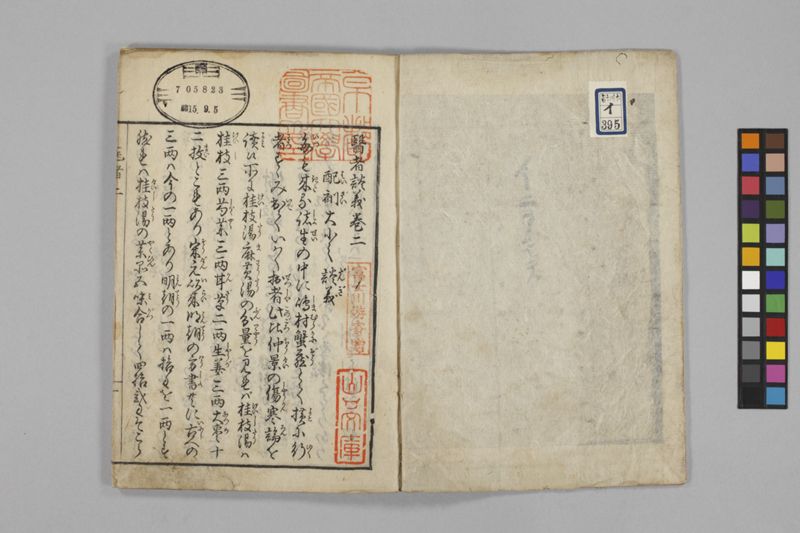
翻刻
【整理ラベル・富士川本/イ/395】
医者談義巻二
配剤(はいざい) 大小之 談義(だんぎ)
毎(いつ)も来(きた)る諸生(しよせい)の中に嶋村蟹蔵(しまむらかにぞう)とて横(よこ)に行(ゆく)
者(わろ)すゝみ出(いで)ていはく拙者(せつしや)此頃(このごろ)仲景(ちうけい)の傷寒論(しやうかんろん)を
読(よみ)候所に桂枝湯(けいしたう)麻黄湯(まわうたう)の分量(ぶんりやう)を見れば桂枝湯(けいしたう)は
桂枝(けいし)三両 芍薬(しやくやく)三両 甘草(かんざう)二両 生姜(しやうが)三両 大棗(なつめ)十
二 枚(まい)とこれあり宋元(そうげん)以来(いらい)明朝(みんてう)の方書(はうしよ)共に古(いにし)への
三両は今の一両とあり明朝(みんてう)の一両は十匁を一両とす
然れは桂枝湯(けいしたう)の薬品(やくひん)五 味(み)合(がつ)して四十二匁そこら
【朱印・京都帝国大学図書之印】
【朱印・富士川游寄贈】
【朱印・山口文庫】
【黒印・705823 昭和15.9.5】
現代語訳
【整理ラベル・富士川本/イ/395】
医者談義巻二
配剤(処方)の大小についての談義
いつものように来ている諸生の中で、島村蟹蔵という横柄な者が進み出て言うには、「私は最近、仲景の『傷寒論』を読んでいるところですが、桂枝湯や麻黄湯の分量を見ると、桂枝湯は桂枝三両、芍薬三両、甘草二両、生姜三両、大棗十二枚とあります。宋・元時代以来、明朝の医学書においても、昔の三両は今の一両だとあります。明朝の一両は十匁を一両とします。そうすると桂枝湯の薬品五味を合わせて四十二匁ほどになります。」
【朱印・京都帝国大学図書之印】
【朱印・富士川游寄贈】
【朱印・山口文庫】
【黒印・705823 昭和15.9.5】
英語訳
[Classification label: Fujikawa Collection / I / 395]
Doctors' Discourse, Volume 2
Discussion on the Large and Small [Dosages] of Pharmaceutical Prescriptions
Among the students who come regularly, there is one called Shimamura Kanizō who is rather arrogant. He steps forward and says: "I have recently been reading Zhongjing's 'Treatise on Cold Damage Disorders' (Shanghan lun), and when I look at the dosages for Guizhi Tang (Cinnamon Twig Decoction) and Mahuang Tang (Ephedra Decoction), I find that Guizhi Tang contains: cinnamon twig 3 liang, peony root 3 liang, licorice root 2 liang, fresh ginger 3 liang, and Chinese jujube 12 pieces. Since the Song and Yuan dynasties, including the medical texts of the Ming dynasty, it is stated that the ancient 3 liang equals today's 1 liang. In the Ming dynasty, 1 liang equals 10 monme. Therefore, the five medicinal ingredients of Guizhi Tang together amount to about 42 monme."
[Red seal: Kyoto Imperial University Library seal]
[Red seal: Donated by Fujikawa Yū]
[Red seal: Yamaguchi Collection]
[Black seal: 705823 September 5, Showa 15 (1940)]