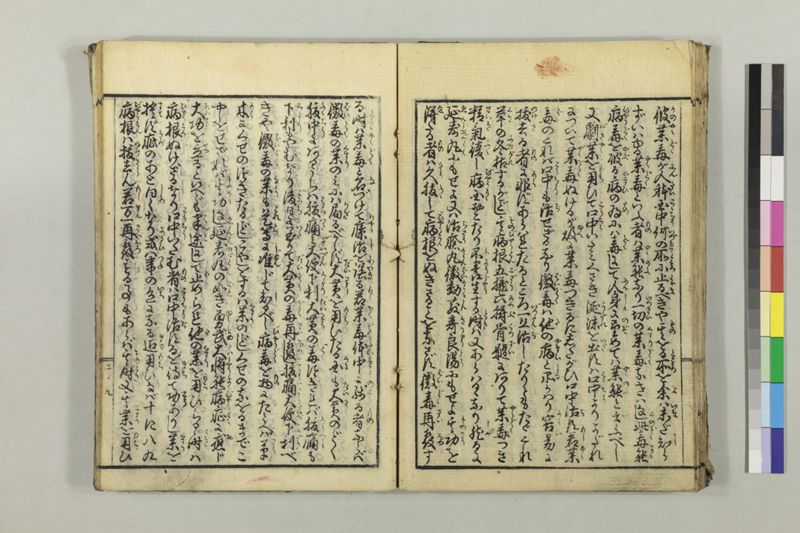
翻刻
【右丁】
彼(かの)薬毒(やくどく)が人体(にんたい)国中(こくちう)何(いづれ)の所(ところ)に止(とゞま)るべきや其(その)をる所(ところ)を余(よ)は未(いま)だ知(し)ら
ずいはゆる薬毒(やくどく)といふ者(もの)は薬能(やくのふ)なり一切(いつさい)の薬(くすり)毒(どく)なきはなし此毒(このどく)能(よく)
病毒(びやうどく)を破(やぶ)る病(やまひ)の為(ため)には毒(どく)にして人身(にんしん)に望(のぞ)めては 薬能(やくのふ)と云(い)ふべし
又/劇薬(げきやく)を用(もち)ひて口中(こうちう)いたみくさき涎沫(よだれ)を出(いだ)すは口中(こうちう)よりよだれ
について薬毒(やくどく)ぬけるが故(ゆえ)に薬毒つきるにしたがひ口中/治(ぢ)す若(もし)薬(やく)
毒(どく)のこれば口中(こうちう)も治(ぢ)せざるなり黴毒(ばいどく)は他(た)の病(やまひ)と品(しな)かはり容易(ようい)に
抜去(ぬけさ)る者(もの)に非(あら)ずあらはれたるところ一旦(いつたん)治(ぢ)したりともたゞこれ
草(くさ)の冬枯(ふゆがれ)するがごとし其(その)病根(びやうこん)五臓六腑(ござうろつぷ)骨髄(こつずい)にありて薬毒(やくどく)つき
精氣(せいき)復(ふく)し病国(びやうこく)おこたり不養生(ふようじやう)する時(とき)は又あらはるゝなり然(しか)るに
延寿丸(ゑんじゆぐわん)にもせよ又は治瘡丸(ぢさうぐわん)黴効散(ばいかうさん)奇良湯(きりやうとう)にもせよ其(その)功(かう)を
得(ゑ)たる者(もの)は久服(きうふく)して病根(びやうこん)をぬきさることをなさず黴毒(ばいどく)再発(さいほつ)す
【左丁】
る時(とき)は薬毒(やくどく)と名(な)づけて療治(りやうじ)を誤(あやま)る若(もし)薬毒(やくどく)体中(たいちう)に残(のこ)る者(もの)ならば
黴毒(ばいどく)の薬(くすり)のみには局(かぎ)るべからず大黄(だいわう)を用(もち)ひたる国(くに)も大黄(だいわう)のどく
腹中(ふくちう)にあるうちは腹(はら)痛(いた)み大便(だいべん)下利(くだり)大黄(だいわう)の毒(どく)つきれば腹痛(ふくつう)も
下利(くだり)もやむなり後日(ごにち)に至(いた)りて大黄(だいわう)の毒(どく)再発(さいほつ)し腹(はら)痛(いたみ)大便(だいべん)下利(くだり)べ
きや黴毒(ばいどく)の薬(くすり)も是等(これら)に准(じゆん)じて知(し)るべし病毒(びやうどく)を物(もの)にたとへば草(さう)
木(もく)にくせのつきたるごとしこやしをするは薬(くすり)のごとしくせのなをるまでこ
やしをせざれば其功(そのかう)なし延寿丸(ゑんじゆぐわん)の如(ごと)き勇武(ゆうぶの)大将(たいしやう)能(よく)病症(びやうせう)に応(おう)じ
大功(たいこう)を立(たつ)るといへども半途(はんと)にして止(や)められ他(た)の薬(くすり)を用(もち)ひらるゝ時(とき)は
病根(びやうこん)ぬけざるなり口中(こうちう)いたむ者(もの)は口中(こうちう)治(ぢ)するを待(まち)て功(こう)ありし薬(くすり)を
捨(すて)ず疵(きづ)のあと白(しろ)くなり或(あるひ)は常(つね)の色(いろ)になる迄(まで)用(もち)ひなば十に八九
病根(びやうこん)は抜去(ぬけさら)ん若(もし)万(まん)一 再発(さいほつ)する事もあらば其時(そのとき)又其 薬(くすり)を用(もち)ひ
現代語訳
【右丁】
その薬毒が人体国中のどこに留まるというのか。その留まる所を私はまだ知らない。いわゆる薬毒というものは薬能である。一切の薬で毒のないものはない。この毒がよく病毒を破る。病気にとっては毒であるが、人身に望んでは薬能と言うべきである。
また劇薬を用いて口中が痛み、臭い涎沫を出すのは、口中より涎について薬毒が抜けるが故に、薬毒が尽きるに従い口中が治る。もし薬毒が残れば口中も治らない。梅毒は他の病気と種類が変わり、容易に抜け去るものではない。現れたところが一旦治ったとしても、ただこれは草の冬枯れするようなものである。その病根は五臓六腑・骨髄にあって、薬毒が尽き、精気が復し、病国が怠り、不養生する時はまた現れる。
しかるに延寿丸にしても、または治瘡丸・梅効散・奇良湯にしても、その功を得た者が久服して病根を抜き去ることをしなければ、梅毒が再発する。
【左丁】
その時に薬毒と名づけて療治を誤る。もし薬毒が体中に残る者ならば、梅毒の薬のみには限るべきではない。大黄を用いた国も、大黄の毒が腹中にあるうちは腹が痛み大便が下利し、大黄の毒が尽きれば腹痛も下利もやむ。後日に至って大黄の毒が再発し、腹が痛み大便が下利するだろうか。梅毒の薬もこれ等に準じて知るべきである。
病毒を物に例えれば、草木に癖がついたようなものである。肥やしをするのは薬のようなもので、癖が治るまで肥やしをしなければその功はない。延寿丸のような勇武の大将がよく病症に応じ大功を立てるといえども、半途にして止められ、他の薬を用いられる時は病根が抜けない。
口中が痛む者は、口中が治るのを待って功ありし薬を捨てず、傷の跡が白くなり、或いは常の色になるまで用いなば、十のうち八九は病根は抜け去るであろう。もし万一再発することもあらば、その時またその薬を用い...
英語訳
[Right Page]
Where exactly in the human body does this so-called "drug toxicity" remain? I do not yet know where it lodges. What is called "drug toxicity" is actually the medicinal potency. There is no medicine without any toxicity. This toxicity effectively breaks down disease toxicity. What is toxic to the disease should be called medicinal potency when it benefits the human body.
Also, when using strong medicines causes mouth pain and produces foul-smelling saliva, this is because the drug toxicity is expelled through the saliva from the mouth. As the drug toxicity is exhausted, the mouth heals accordingly. If drug toxicity remains, the mouth will not heal either. Syphilis is different in nature from other diseases and is not something that can be easily eliminated. Even if the visible symptoms are temporarily cured, this is merely like grass withering in winter. The disease root remains in the five organs, six viscera, and bone marrow. When the drug toxicity is exhausted, vital energy recovers, the diseased body becomes negligent, and poor health management occurs, the disease will manifest again.
Therefore, whether using Enjūgan, Jisōgan, Baikōsan, or Kiryōtō, if those who have obtained their benefits do not continue long-term treatment to extract the disease root, syphilis will recur.
[Left Page]
At that time, they mistakenly name it "drug toxicity" and err in treatment. If drug toxicity truly remained in the body, it should not be limited to syphilis medicines alone. Even in cases where rhubarb (daio) is used, while rhubarb's toxicity remains in the abdomen, there is abdominal pain and diarrhea, but when rhubarb's toxicity is exhausted, both abdominal pain and diarrhea cease. Would rhubarb's toxicity recur later, causing abdominal pain and diarrhea again? Syphilis medicines should be understood by analogy to these cases.
To compare disease toxicity to something tangible, it is like a bad habit that has taken hold in plants and trees. Applying fertilizer is like medicine—without continuing to fertilize until the bad habit is cured, there will be no effect. Even though brave generals like Enjūgan can respond well to disease symptoms and achieve great success, if they are stopped midway and other medicines are used instead, the disease root will not be extracted.
For those with mouth pain, if they do not discard the effective medicine after waiting for the mouth to heal, and use it until the scars turn white or return to their normal color, eight or nine out of ten cases will have their disease roots completely extracted. If by any chance there should be a recurrence, then at that time use that medicine again...