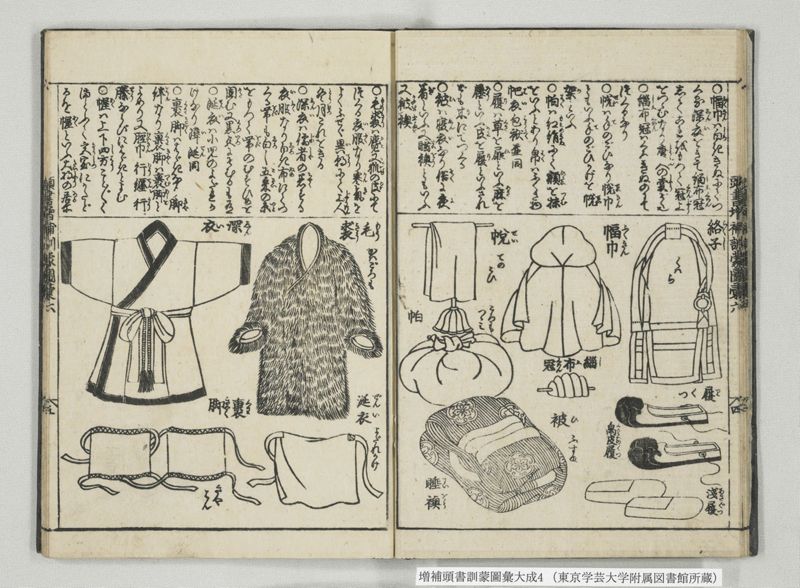
翻刻
【右丁上段】
○幅巾(ふくきん)は白(しろ)ききぬにてつ
くる深衣(しんい)をきて緇布冠(しふくはん)
してこれをもつて冠上(くはんじやう)
をつゝむなり唐人(とうじん)の裳(しやう)ぞく也
○緇布冠(しふくはん)はくろきぬのにて
つくるなり
○帨(せい)は手(て)のごひなり帨巾(せいきん)
ともいふ手(て)のごひかげを帨(せい)
架(か)といふ
○帕(はく)は紅絹(もみのきぬ)にて額(ひたい)を抹(つゝむ)
をいふとあり帛(はく)はふくさ物
帊衣(はい)包袱(はうふく)並同
○履(り)は草(くさ)を屝(ひ)といふ麻(あさ)を
屨(ろう)といふ皮(かわ)を履(り)といふされ
ども木(き)にてつくる
○被(ひ)は寝衣(しんい)なり俗(そく)に夜(よ)
着(ぎ)といふ又/睡襖(すいをう)ともいふ
又/被(かふむる)_レ襖(ふすまを)
【左丁上段】
○毛裘(もうきう)は麑(かこ)又/狐(きつね)の皮(かは)にて
つくる衣服(いふく)なり寒気(かんき)を
よくふせぐ異朝(いてう)にて上人(じやうにん)
冬月(とうけつ)これをきる
○深衣(しんい)は儒者(じゆしや)の着(ちやく)する
衣服(いふく)なり白(しろ)き布(ぬの)にてつ
くる帯(をび)も白(しろ)し五采(こさい)の糸(いと)
をもつて帯(をび)のむすひめを
固(かた)む又/黒色(くろいろ)にそむるも有
○涎衣(せんい)は小児のよだれか
けなり幃涎(いせん)同
○裹脚(くわきやく)ははゞきなり脚(きや)
絆(はん)なり裹脚(くわきやく)は裹(つゝむ)_レ脚(あしを)と
よめり又/脛巾(けいきん)行纏(かうてん)、行(かう)
縢(とう)ならびにはゞきとよむ
○幄(あく)は上下/四方(しはう)こと〴〵く
まとふて宮室(きうしつ)にかたど
るを幄(あく)といふ大将(たいしやう)の居(ゐる)所
【右丁下段挿絵】
絡子( らくし)《割書:くは| ら》 履(り)《割書:く|つ》 《振り仮名:■皮履|くりかわのくつ》【注】 浅履(あさぐつ)
幅巾(ふくきん) 《割書:緇(し)|布(ふ)|冠(くはん)》
帨(せい)《割書:ての| こひ》 帕《割書:ころも| つゝみ》 被(ひ)《割書:ふすま》 睡襖(すいをう)
【左丁下段挿絵】
《割書:毛(もう)|裘(きう)》《割書:かはごろも》 涎衣(ぜんい)《割書:よだれかけ》
《割書:深(しん)|衣(い)》 《割書:裹(くわ)|脚(きやく)》《割書:きや| はん》
【注 ■は「烏」の誤記ヵ】
現代語訳
【右丁上段】
○幅巾は白い絹で作る。深衣を着て緇布冠をかぶり、これで冠の上を包むのである。中国人の装束である。
○緇布冠は黒い絹で作るものである。
○帨は手ぬぐいである。帨巾ともいう。手ぬぐいを掛ける物を帨架という。
○帕は紅絹で額を包むことをいうとある。帛は袱紗物で、帊衣・包袱と同じである。
○履は、草で作るものを屝といい、麻で作るものを屨といい、皮で作るものを履というが、木で作るものもある。
○被は寝間着である。俗に夜着という。また睡襖ともいう。また襖を被るという意味である。
【左丁上段】
○毛裘は鹿または狐の皮で作る衣服である。寒気をよく防ぐ。中国では上流階級の人が冬にこれを着る。
○深衣は儒者が着用する衣服である。白い布で作り、帯も白い。五色の糸で帯の結び目を固める。また黒色に染めるものもある。
○涎衣は小児のよだれかけである。幃涎と同じである。
○裹脚は脚絆のことである。裹脚は脚を包むと読む。また脛巾・行纏・行縢と並んで脚絆と読む。
○幄は上下四方をすべて囲んで宮室に似せて作るものを幄という。大将の居所である。
【右丁下段挿絵】
絡子《掛絡》 履《靴》 烏皮履《烏革の靴》 浅履
幅巾 緇布冠
帨《手ぬぐい》 帕《衣包み》 被《夜具》 睡襖
【左丁下段挿絵】
毛裘《皮衣》 涎衣《よだれかけ》
深衣 裹脚《脚絆》
英語訳
【Right Page Upper Section】
○"Fukukin" is made of white silk. One wears deep robes and a black cloth cap, using this to wrap the top of the cap. This is Chinese attire.
○"Shifukukan" (black cloth cap) is made of black silk.
○"Sei" is a hand towel. It is also called "seikin." The rack for hanging hand towels is called "seika."
○"Haku" refers to wrapping the forehead with red silk. "Haku" is a wrapper cloth, same as "hai" and "hōfuku."
○"Ri" (footwear): those made of grass are called "hi," those made of hemp are called "rō," and those made of leather are called "ri," but some are also made of wood.
○"Hi" is sleepwear. Commonly called "yogi" (night wear). Also called "suiō." It means "covering oneself with a futon."
【Left Page Upper Section】
○"Mōkyū" is clothing made from deer or fox fur. It effectively protects against cold. In China, upper-class people wear this in winter.
○"Shin'i" is clothing worn by Confucian scholars. Made of white cloth, the belt is also white. The knot of the belt is secured with five-colored thread. Some are also dyed black.
○"Sen'i" is a bib for small children. Same as "isen."
○"Kakyaku" are leg wrappings. "Kakyaku" is read as "wrapping the legs." Along with "keikin," "kōten," and "kōtō," they are all read as leg wrappings.
○"Aku" refers to enclosing all four directions above and below, made to resemble a palace room. It is a general's quarters.
【Right Page Lower Section Illustration】
Rakushi《hanging cord》 Ri《shoes》 Crow leather shoes《black leather shoes》 Shallow shoes
Fukukin Black cloth cap
Sei《hand towel》 Haku《cloth wrapper》 Hi《bedding》 Suiō
【Left Page Lower Section Illustration】
Mōkyū《fur clothing》 Sen'i《bib》
Shin'i Kakyaku《leg wrappings》