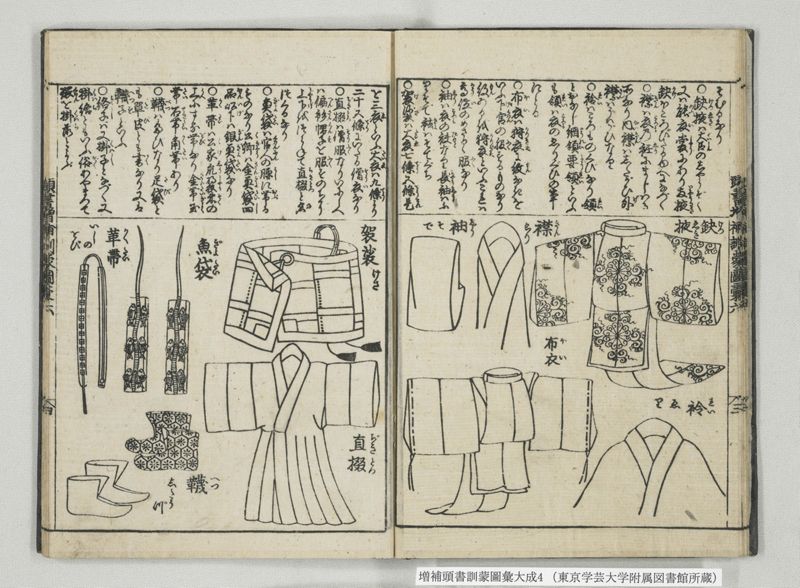
翻刻
【右丁上段】
そむるなり
○缺掖(けつゑき)は大臣(たいしん)のしやうぞく
又は能衣裳(のふいしやう)にあり両掖(りやうわき)
缺(かけ)ほころびたるゆへになづく
○襟(きん)は衣(ころも)の衽(ゑり)にまじはる
所なり内襟(ないきん)はしたがひ外(げ)
襟(きん)はうはがひなり
○袊(れい)はころものくびなり領(れい)
とおなじ綱領(かうれい)要領(ようれい)といふ
も領(れい)は衣(ころも)のゑりぐひの事
にとる
○布衣(ほい)は狩衣(かりきぬ)に紋(もん)なきを
いふ下官(げくはん)の服(ふく)するものなり
紋(もん)あるを狩衣(かりぎぬ)といふこれは
高位(かうい)のめさるゝ服(ふく)なり
○袖(しう)は衣(ころも)の袂(たもと)なり長袖(ちやうしう)はふ
りそで袪(きよ)はそでぐち
○袈裟(けさ)は大衣(たいゑ)七/條(でう)五/條(てう)是(これ)
【左丁上段】
を三/衣(ゑ)といふ大衣(たいゑ)は九/條(てう)より
二十五/條(でう)にいたる僧衣(そうい)なり
○直掇(ぢきとつ)は僧服(そうふく)なりいにしへ
は偏衫(へんさん)《振り仮名:𢂽子|くんす》を服(ふく)すのちに
上下(じやうげ)をつらねて直掇(ちきとつ)と名(な)
つくるなり
○魚袋(ぎよたい)は官人(くはんにん)の腰(こし)に帯(おぶ)る
ものなり公卿(くぎやう)は金魚袋(きんぎよたい)四(し)
品(ほん)以下(いげ)は銀魚袋(ぎんぎよたい)なり
○革帯(かくたい)は公家衆(くげしう)装束(しやうそく)の
上(うへ)にする帯(をび)なり金帯(きんたい)玉(ぎよく)
帯(たい)石帯(せきたい)角帯(かくたい)あり
○韈(べつ)はたびなり足袋(たび)と
も単皮(たび)とも書(かく)なり又は
韈子(へつす)といふ
○絡子(らくし)は又/掛子(くはし)となづく又
掛絡(くはら)ともいふ俗(ぞく)あやまつて
環(くはん)を掛落(くはら)とよぶ
【右丁下段挿絵】
《割書:缺(けつ)|掖(ゑき)》 袊(れい)《割書:ゑ|り》
襟(きん)《割書:ゑ|り》 布衣(ほい)
袖(しう)《割書:そ|で》
【左丁下段挿絵】
袈裟《割書:けさ》 直掇(ぢきとつ)
魚袋(ぎよたい) 韈(へつ)《割書:したう| づ》
革帯(かくたい)《割書:いしの| をび》
現代語訳
【右丁上段】
(赤く)染めるのである。
○缺掖は大臣の装束
または能の衣装にある。両脇が
欠けほころびているのでそう名付ける。
○襟は衣の衿に交わる
所である。内襟は下側、外
襟は上側である。
○袊は衣の首部分である。領
と同じで、綱領・要領という
のも領は衣の襟首のこと
を指している。
○布衣は狩衣に紋がないもの
をいう。下級官吏が着用するものである。
紋があるものを狩衣といい、これは
高位の者が着る服である。
○袖は衣の袂である。長袖は振
り袖、袪は袖口である。
○袈裟は大衣、七条、五条、これ
【左丁上段】
を三衣という。大衣は九条から
二十五条に至る僧衣である。
○直掇は僧服である。昔
は偏衫を着ていたが、後に
上下を連ねて直掇と名
付けるのである。
○魚袋は官人が腰に帯びる
ものである。公卿は金魚袋、四
品以下は銀魚袋である。
○革帯は公家衆の装束の
上にする帯である。金帯、玉
帯、石帯、角帯がある。
○韈は足袋である。足袋と
も単皮とも書く。また
韈子という。
○絡子はまた掛子と名付ける。また
掛絡ともいう。俗に誤って
環を掛落と呼ぶ。
【右丁下段挿絵】
缺掖 袊《襟》
襟《襟》 布衣
袖《袖》
【左丁下段挿絵】
袈裟《袈裟》 直掇
魚袋 韈《足袋》
革帯《石の帯》
英語訳
【Right Page Upper Section】
(red) dyed.
○"Ketsueki" are found in ministers' attire
or Noh costumes. They are named so because both sides
are cut and frayed.
○"Kin" (collar) is where the garment meets
the neckline. The inner collar is the lower side, the outer
collar is the upper side.
○"Rei" is the neck part of clothing. It is the same as "ryō,"
and when we say "kōryō" (outline) or "yōryō" (gist), "ryō"
refers to the collar area
of clothing.
○"Hoi" refers to hunting garments without family crests.
They are worn by lower officials.
Those with crests are called "kariginu," which are
garments worn by those of high rank.
○"Shū" (sleeve) is the sleeve of clothing. Long sleeves are hanging
sleeves, and "kyo" is the sleeve opening.
○"Kesa" are the large robe, seven-panel, and five-panel robes, these
【Left Page Upper Section】
are called the three robes. The large robe ranges from nine panels
to twenty-five panels and is monastic clothing.
○"Chikitotsu" is monk's clothing. In ancient times
they wore "hensan," but later
they connected upper and lower garments and named it "chikitotsu."
○"Gyotai" (fish bag) is what officials
wear at their waist. Court nobles wear golden fish bags, those of fourth
rank and below wear silver fish bags.
○"Kakutai" (leather belt) is a belt worn over
the attire of court nobles. There are gold belts, jade
belts, stone belts, and horn belts.
○"Betsu" are tabi (split-toe socks). They are also written as
"tabi" or "tanpi." They are also
called "betsusu."
○"Rakushi" are also named "kakeshi." They are also
called "kakuraku." Common people mistakenly
call rings "kakuraku."
【Right Page Lower Section Illustration】
Ketsueki Rei《collar》
Kin《collar》 Hoi
Shū《sleeve》
【Left Page Lower Section Illustration】
Kesa《kesa》 Chikitotsu
Gyotai Betsu《tabi》
Kakutai《stone belt》