翻刻
【右丁上段】
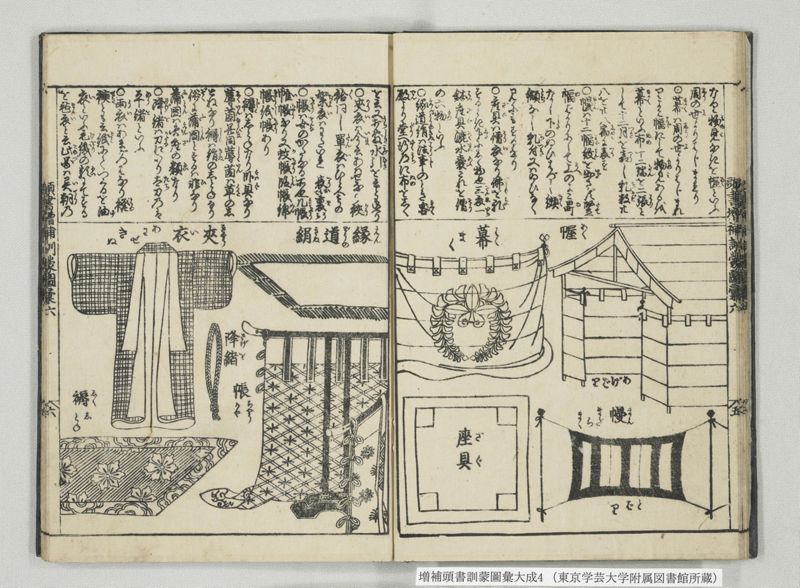
なり物見(ものみ)なきを幄(あく)といふ
周(しう)の世(よ)よりはじまれり
○幕(まく)は周(しう)の世(よ)よりはじまれ
りよこ幅(はゞ)にして物見(ものみ)あるを
幕(まく)といふ布(ぬの)十二/端(たん)を二/張(はり)と
して十二/月(つき)を表(へう)し乳数(ちかず)廿
八を廿八/宿(しゆく)に表(へう)す
○幔(まん)は十二/幅(はゞ)紋(もん)を出(いだ)さず竪(たて)
幅(の)ばかりにして上(うへ)のよこ𬏈(の)
なし下(した)のぬひはづし纐(きく)
纈(とぢ)なし乳付(ちつき)又はぬひなく
見にもするなり
○座具(ざぐ)は僧衣(そうい)なり仏(ほとけ)を礼(らい)
するとき下(した)にしく物也/三衣(さんゑ)一(いち)
鉢(はつ)座具(ざぐ)漉水嚢(ろくすいのふ)これを僧(そう)
の六/物(もつ)といふ
○縁道絹(えんどうのきぬ)は法事(はうじ)のとき客(きやく)
殿(でん)より堂(だう)へ行(ゆく)道(みち)に布(ぬの)をしく
【左丁上段】
を云又/打敷(うちしき)水引(みづひき)を云ともいへり
○夾衣(かうい)は今(いま)云あはせなり裌(かう)
袷(〳〵)同し単衣(たんい)はひとへもの
絮衣(ぢよい)はわたいれ 表(へう)《割書:お|も|て》裏(り)《割書:う|ら》
○帳(ちやう)は女(をんな)のかたなる所也/几帳(きちやう)
帷帳(いちやう)なり又/蚊帳(かちやう)段(どん)帳/綿(めん)
帳(ちやう)紙帳(しちやう)あり
○褥(じく)はしとねなり臥具(ぐはぐ)なり
蓐茵(しくいん)并(ならびに)同/蓐茵(しくいん)は草(くさ)のし
とねなり褥(しく)は絹(きぬ)のしとねなり
俗(ぞく)に蒲団(ふとん)とするは非(ひ)なり
蒲団(ふとん)は円座(えんざ)の類(るい)なり
○降緒(さげを)は刀(かたな)にあり太刀(たち)のは
平緒(ひらを)といふ
○雨衣(うい)はあまがつはなり襏(はつ)
襫(せき)とも云/紙(かみ)にてつくるを油(ゆ)
衣(い)といふ毛織(けをり)の類(るい)にてする
を毡衣(せんい)とい云/此図(このづ)は異朝(いてう)の
【右丁下段挿絵】
幄(あく) 《割書:あ|げ|ば|り》 幔(まん)《割書:まだ| ら|まく》 《割書:と|ば|り》
幕(はく)《割書:ま| く》 座具(ざぐ)
【左丁下段挿絵】
《割書:縁(えん)|道(どうの)|絹(きぬ)》
《割書:夾(きやう)|衣(い)》《割書:あ|わ| せ|き| ぬ》 降緒(さげを) 帳《割書:ちやう|かや》
褥(しく)《割書:し|とね》
現代語訳
【右丁上段】
である。物見(見張り台)がないものを幄という。周の時代から始まった。
○幕は周の時代から始まった。横幅にして物見があるものを幕という。布十二端を二張として十二か月を表し、乳の数二十八を二十八宿に表している。
○幔は十二幅で紋を出さず、縦幅ばかりにして上の横縫いなし、下の縫いはずし、絞り染めなし、乳付けまたは縫いなく、見るだけのものである。
○座具は僧衣である。仏を礼拝するとき下に敷く物である。三衣・一鉢・座具・漉水嚢、これを僧の六物という。
○縁道絹は法事のとき客殿より堂へ行く道に布を敷く
【左丁上段】
ことをいう。また打敷・水引をいうともいわれている。
○夾衣は今いう袷(あわせ)である。裌・袷同じ。単衣はひとえもの、絮衣は綿入れ。表・裏。
○帳は女性のいる所である。几帳・帷帳である。また蚊帳・段帳・綿帳・紙帳がある。
○褥は敷物である。臥具である。蓐茵と同じ。蓐茵は草の敷物である。褥は絹の敷物である。俗に蒲団とするのは間違いである。蒲団は円座の類である。
○降緒は刀にある。太刀のものは平緒という。
○雨衣は雨合羽である。襏襫ともいう。紙で作るものを油衣という。毛織りの類で作るものを毡衣という。この図は中国の
【右丁下段挿絵】
幄《揚げ張り》 幔《まだら幕》《帳》
幕《幕》 座具
【左丁下段挿絵】
縁道絹
夾衣《袷衣》 降緒 帳《帳・蚊帳》
褥《敷物》
英語訳
【Right Page Upper Section】
It is. Those without watchtowers are called "aku." This began from the Zhou dynasty.
○"Maku" (curtains) began from the Zhou dynasty. Those made horizontally with watchtowers are called "maku." Twelve tan of cloth make two zhang, representing twelve months, and the number of loops, twenty-eight, represents the twenty-eight constellations.
○"Man" has twelve widths without patterns, made only with vertical width, no horizontal stitching above, loose stitching below, no tie-dye, with or without loop attachments or stitching, made just for viewing.
○"Zagu" is monk's clothing. It is something spread below when worshipping Buddha. The three robes, one bowl, sitting mat, and water strainer bag are called the six possessions of a monk.
○"Endō no kinu" refers to spreading cloth on the path from the guest hall to the main hall during Buddhist ceremonies.
【Left Page Upper Section】
It also refers to altar cloths and ceremonial cords.
○"Kōi" is what we now call "awase" (lined kimono). "Kō" and "袷" are the same. "Tan'i" is single-layer clothing, "jyoi" is padded clothing. Front and back.
○"Chō" is where women reside. It refers to "kichō" and "ichō." There are also mosquito nets, tiered curtains, cotton curtains, and paper curtains.
○"Jiku" is bedding. It is sleeping gear. Same as "shikuin." "Shikuin" is grass bedding. "Jiku" is silk bedding. It is incorrect to commonly call it "futon." "Futon" is a type of round cushion.
○"Sageo" is found on swords. Those for "tachi" (long swords) are called "hirao."
○"Ui" is rain gear. Also called "hatsu" and "seki." Those made of paper are called "yui." Those made of woolen materials are called "sen'i." This illustration shows Chinese
【Right Page Lower Section Illustration】
Aku《tent》 Man《spotted curtain》《curtain》
Maku《curtain》 Zagu
【Left Page Lower Section Illustration】
Endō no kinu
Kōi《lined garment》 Sageo Chō《curtain・mosquito net》
Jiku《bedding》