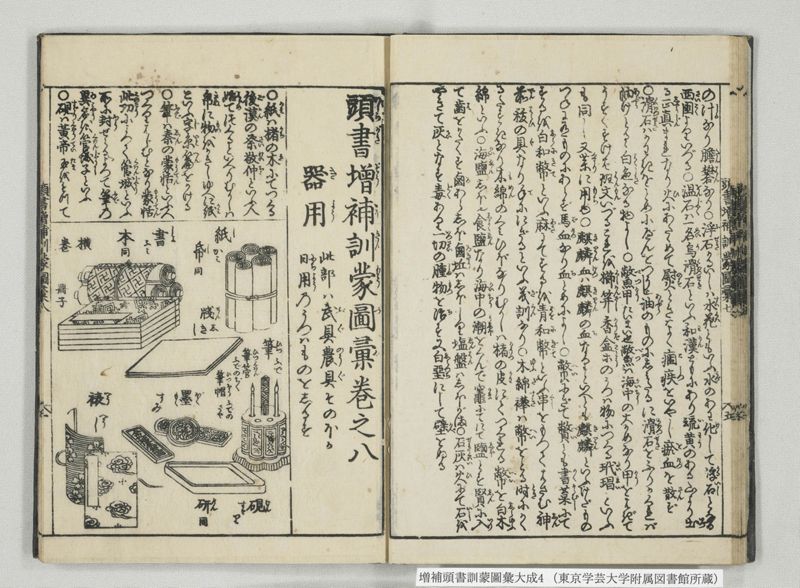
翻刻
【右丁】
の汁(しる)なり膽礬(たんはん)なり○浮石(ふせき)かるいしは水花(すいくは)ともいふ水(みづ)のあわ化(け)して浮石(かるいし)となる
西国(さいこく)よりいづる○温石(をんじやく)は一/名(めい)烏滑石(うくはつせき)といふ和漢(わかん)ともにあり硫黄(いわう)のある山より出(いづ)
る正真(しやうじん)まれなり火(ひ)にあたゝめて熨(のす)ときはよく痼疾(こしつ)をいやし瘀血(をけつ)を散(さん)ず
○滑石(くはつせき)はかわきをとめ小べんをつうじ油(あぶら)のものにしみたるに滑石(くはつせき)をふりかくれば
油(あぶら)けとるゝ白色(はくしき)なる物よし○鱉甲(べつかう)たいまい也/鱉(べつ)は海中(かいちう)の大かめなり甲(かう)をはぎて
うすくすけば斑文(はんもん)いづるこれを櫛(くし)笄(かんざし)香盒(かうばこ)等(とう)のうつは物につくる玳瑁(たいまい)といふ
も同し又/薬(くすり)に用(もち)ゆ○麒麟血(きりんけつ)は麒麟(きりん)の血(ち)なりといへとも麒麟(きりん)といふけだもの
つねに有ものにあらず馬血(ばけつ)なり血(ち)とめによし○幣(へい)はにぎて𧸁(へい)とも書(かく)葈(からむし)にて
するを白和幣(しらにきて)といふ麻(あさ)にてするを青名幣(あをにぎて)といふ串(くし)をもつてはさむ神(しん)
前(ぜん)秡(はらひ)の具(ぐ)なり手(て)ににぎるといふ義訓(ぎくん)なり○木綿襷(ゆふだすき)は幣(へい)をとる時(とき)にかく
るたすきなり木綿(もめん)のくみひぼなりむかしは楮(かうつ)の皮(かわ)にてつくれる幣(へい)を白木(しらゆふ)
綿といふ○海塩(かいゑん)しほ也/食塩(しよくゑん)なり海中(かいちう)の潮(うしほ)をくんで竃(かま)にてにて塩(しほ)とす賢(しん)【腎ヵ】に入(いり)
て歯(は)をかたくす鹵(ろ)あらしほ鹵坵(ろきう)はしほしり塩盤(ゑんはん)はしほがま○石灰(せきくはい)は火(ひ)にて石(いし)を
やきて灰(はい)となす毒(どく)あり一切(いつさい)の腫物(しゆもつ)を治(ち)す又/白堊(しらつち)にして壁(かべ)をぬる
【左丁】
《題:頭書増補訓蒙図彙(かしらがきぞうほきんもうづゐ)巻之八》
器用(きよう) 《割書:此部は武具(ぶぐ)農具(のうぐ)そのほか|日用(にちよう)のうつはものをしるす》
【左丁上段】
○紙(かみ)は楮(かち)の木(き)にてつくる
後漢(ごかん)の祭敬仲(さいけいちう)【注】といふ人
始(はじめ)てつくるといへりむかしは
帛(きぬ)に物(もの)をかきしゆへに紙(かみ)
といふ字(じ)糸篇(いとへん)をかける
○筆(ふで)は秦(しん)の蒙恬(もうてん)といふ人
つくりはじむとなり蒙恬(もうてん)
此功(このこう)によつて管城(くはんじやう)といふ
所に封(ほう)せらるよつて筆(ふで)の
異名(ゐみやう)を管城子(くはんじやうし)といふ
○硯(すゞり)は黄帝(くはうてい)玉(たま)をもつて
【左丁下段挿絵】
紙(し)《割書:かみ》 帋(し)《割書:同》 牋(せん)《割書:し|き|し》
筆(ひつ)《割書:ふで》 筆管(ひつくはん)《割書:ふでのぢく》 筆帽(ひつほう)《割書:ふでの|さや》
墨(ぼく)《割書:もく》 すみ 硯(けん)《割書:すゞり》 研(けん)《割書:同》
書(しよ)《割書:ふみ》 本《割書:同》 横巻 冊子 裱(へう)《割書:へう|し》
【注 「祭」は「蔡」の誤】
現代語訳
【右丁】
の汁である。胆礬のことである。○浮石(軽石)は水花ともいい、水の泡が化して浮石となる。西国から産出する。○温石は別名烏滑石という。和漢ともにあり、硫黄のある山から出る。本物は稀である。火で温めて熨斗として使うときはよく頑固な病気を治し、瘀血を散らす。
○滑石は乾燥を止め小便を通じさせる。油っぽいものに染みついたものに滑石を振りかければ油気を取る。白色のものがよい。○鼈甲(タイマイ)は海中の大きな亀である。甲羅を剥いで薄くすけば斑文が現れる。これを櫛、簪、香盒などの器物に作る。玳瑁というのも同じ。また薬に用いる。○麒麟血は麒麟の血といわれるが、麒麟という獣は常にいるものではない。馬血のことで、止血によい。○幣は「にぎて」とも書く。苧麻で作るものを白和幣といい、麻で作るものを青名幣という。串を持って挟む神前祓いの具である。手に握るという意味の義訓である。○木綿襷は幣を取るときにかける襷である。木綿の組紐で、昔は楮の皮で作った幣を白木綿という。○海塩(塩)は食塩である。海中の潮を汲んで竈で煮て塩とする。腎に入って歯を硬くする。鹵は荒塩、鹵坵は塩尻、塩盤は塩釜である。○石灰は火で石を焼いて灰とする。毒があり、一切の腫れ物を治す。また白土として壁を塗る。
【左丁】
《題:頭書増補訓蒙図彙 巻之八》
器用 《この部は武具、農具、その他日用の器物を記す》
【左丁上段】
○紙は楮の木で作る。後漢の蔡倫という人が初めて作ったという。昔は絹に物を書いていたので、紙という字に糸偏を付ける。
○筆は秦の蒙恬という人が作り始めたという。蒙恬はこの功によって管城という所に封ぜられたので、筆の異名を管城子という。
○硯は黄帝が玉を用いて作ったという。
【左丁下段挿絵】
紙《紙》 帋《同じ》 牋《紙、薄い紙》
筆《筆》 筆管《筆の軸》 筆帽《筆の鞘》
墨《墨》 すみ 硯《硯》 研《同じ》
書《文書》 本《同じ》 横巻 冊子 裱《表紙》
英語訳
【Right Page】
of juice. This is chalcanthite (tanban). ○Pumice (floating stone) is also called water flower. Water foam transforms into pumice. It comes from the western provinces. ○Heated stone, also called black talc, exists in both Japan and China, coming from mountains with sulfur. Genuine ones are rare. When heated by fire and used for ironing, it effectively cures chronic diseases and disperses stagnant blood.
○Talc stops dryness and promotes urination. When sprinkled on oil-stained items, talc removes the oil. White-colored ones are best. ○Tortoiseshell (bekko) refers to large sea turtles. When the shell is peeled and made thin, mottled patterns emerge. This is made into combs, hairpins, incense boxes and other vessels. Tortoiseshell (taimai) is the same. It is also used medicinally. ○Qilin blood is said to be the blood of qilin, but qilin beasts do not commonly exist. It is horse blood and is good for stopping bleeding. ○Sacred streamers (hei) can also be written as "nigte." Those made from ramie are called white waved streamers, those made from hemp are called blue streamers. They are ritual purification tools held with skewers before deities. The meaning derives from "grasping in hand." ○Cotton sashes are sashes worn when taking streamers. They are cotton braided cords. In ancient times, streamers made from paper mulberry bark were called white cotton. ○Sea salt is edible salt. Seawater is drawn and boiled in furnaces to make salt. It enters the kidneys and hardens teeth. Ro is coarse salt, rokyu is salt residue, and enban is salt kiln. ○Lime is made by burning stones with fire to create ash. It is toxic and treats all kinds of swellings. It is also used as white earth for plastering walls.
【Left Page】
《Title: Expanded Annotated Illustrated Encyclopedia for Children's Education, Volume 8》
Implements 《This section records weapons, farming tools, and other daily utensils》
【Left Page Upper Section】
○Paper is made from paper mulberry wood. A person called Cai Lun of the Later Han dynasty is said to have first created it. Since things were written on silk in ancient times, the character for paper includes the silk radical.
○The writing brush was first created by a person called Meng Tian of Qin. Because Meng Tian was enfeoffed at a place called Guancheng for this achievement, the alternative name for brush is Guanchengzi.
○The inkstone was made by the Yellow Emperor using jade.
【Left Page Lower Illustration】
Paper《paper》 Paper《same》 Writing paper《paper, thin paper》
Brush《brush》 Brush handle《brush shaft》 Brush cap《brush sheath》
Ink《ink》 ink Inkstone《inkstone》 Grinding stone《same》
Writing《document》 Book《same》 Horizontal scroll Booklet Mounting《cover》