翻刻
【右丁上段】
○仮面(かめん)は今(いま)いふ舞(まひ)の面(おもて)なり
代面(たいめん)とも戯面(きめん)ともいふ能(のふ)又は
楽(がく)に着(き)るなり
○雲版(うんはん)はちやうはんなり飯斎(はんさい)
の時(とき)大衆(たいしゆ)をあつむるときう
つものなり
○嗩吶(さのう)は大平簫(たいへいしやう)といふふえ
なり嗩哪(さの)鎖㖠(さの)ならびに同
○喇叭(らは)◦銅角(とうかく)ともに唐人(とうじん)
ぶゑなり又/唐音(とうゐん)にてちやる
めろといふ
○風鐸(ふうたく)は宝鐸(ほうちやく)なり又は檐(ゑん)
鐸(たん)ともいふ堂(だう)の檐(のき)にあり
○棊(ご)は帝堯(ていぎやう)つくり始(はじめ)給ひて
子(こ)の丹朱(たんしや)にをしへ給ふ所なり
黒白(こくびやく)の石(いし)は昼夜(ちうや)にかたどり
【左丁上段】
三百六十は日(ひ)の数(かす)を表(ひやう)する
なり碁(ご)いしを碁子(きし)といふ
碁笥(ごけ)を碁奩(きれん)といふ
○枰(へい)は碁盤(ごばん)なり又/棊局(ききよく)
ともいふ棊盤(ごばん)の目(め)を路(ろ)と云
棊石(こいし)を子(し)といふ棊笥(ごげ)を
奩(れん)といふ
○六/采(さい)は双六(すごろく)なり黒白(こくびやく)の石(いし)
は昼夜(ちうや)なり十二の目は十二月
なり盤(ばん)を局(きよく)といふ
○簺(さい)は日月の二つに表(ひやう)す四
角(かく)は四/方(はう)にかたどる骰子(たうし)は
筒(つゝ)なり投子(とうし)同
○象棊(しやうぎ)は周公旦(しうこうたん)作(つくり)出して成王(せいわう)に
教(をし)へ給ふとなり大中小の将棊(しやうぎ)有
又/摩訶陀(まかだ)象戯(しやうぎ)といふもあり
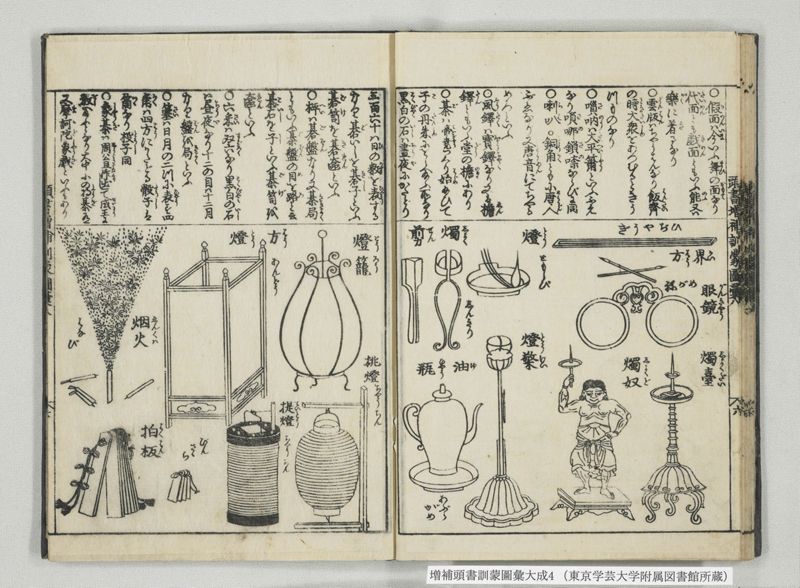
【右丁下段挿絵】
界方(かいはう)《割書:ひぢやうぎ》 眼鏡(がんきやう)《割書:めがね》 燭台(しよくだい) 燭奴(しよくど)
灯(とう)《割書:ともしび》 燭剪(しよくせん)《割書:しんきり》 灯檠(とうけい) 油瓶(ゆひやう)《割書:あぶらがめ》
【左丁下段挿絵】
灯籠(とうろう) 方灯(はうとう)《割書:あんどう》 挑灯《割書:ちやうちん》 提灯(ていとう)《割書:ちやうちん》
煙火(ゑんくは)《割書:はなび》 拍板(はくはん)《割書:びんさゝら》
現代語訳
【右丁上段】
○仮面は今でいう舞踊の面である。代面とも戯面ともいう。能や雅楽で着用する。
○雲版は鐘板である。食事の時間に大衆を集める時に打つものである。
○嗩吶は大平簫という笛である。嗩哪、鎖㖠とも同じ。
○喇叭・銅角はともに中国の笛である。また中国語でチャルメラという。
○風鐸は宝鐸である。また檐鐸ともいう。お堂の軒にある。
○囲碁は帝堯が作り始めて、子の丹朱に教えたものである。黒白の石は昼夜を模したもので、
【左丁上段】
三百六十は一年の日数を表している。碁石を碁子といい、碁笥を碁奩という。
○枰は碁盤である。また棊局ともいう。碁盤の目を路といい、碁石を子といい、碁笥を奩という。
○六采は双六である。黒白の石は昼夜で、十二の目は十二か月である。盤を局という。
○簺は日月の二つを表し、四角は四方を模したものである。骰子は筒である。投子と同じ。
○将棋は周公旦が作り出して成王に教えたという。大中小の将棋があり、また摩訶陀象戯というものもある。
【右丁下段挿絵】
界方《肘木》 眼鏡《眼鏡》 燭台 燭奴
灯《灯火》 燭剪《芯切り》 灯檠 油瓶《油瓶》
【左丁下段挿絵】
灯籠 方灯《行灯》 挑灯《提灯》 提灯《提灯》
煙火《花火》 拍板《編木》
英語訳
【Right Page Upper Section】
○Kamen (masks) are what we now call dance masks. They are also called taimen or kimen. They are worn in Noh theater and gagaku court music.
○Unban are bell plates. They are struck to gather the assembly at meal times.
○Sanō are flutes called taiheishō. Sano and sano are the same.
○Rappa and dōkaku are both Chinese flutes. In Chinese, they are also called charumera.
○Fūtaku are hōtaku. They are also called entaku and hang from the eaves of temples.
○Go (the board game) was first created by Emperor Yao and taught to his son Danzhu. The black and white stones represent day and night,
【Left Page Upper Section】
and the 360 points represent the number of days in a year. Go stones are called goshi, and the go containers are called goren.
○Hei are go boards. They are also called kikyoku. The intersections on the go board are called ro, the go stones are called shi, and the containers are called ren.
○Rokusai is sugoroku. The black and white stones represent day and night, and the twelve points represent the twelve months. The board is called kyoku.
○Sai represent the sun and moon, and the four corners represent the four directions. Tōshi are cylinders, the same as tōshi.
○Shōgi was created by Duke of Zhou and taught to King Cheng. There are large, medium, and small shōgi, and there is also something called makada shōgi.
【Right Page Lower Illustration】
Kaihō《architectural brackets》 Gankyō《eyeglasses》 Candle stands Candle holders
Lamps《lights》 Candle scissors《wick trimmers》 Lamp stands Oil bottles《oil jars》
【Left Page Lower Illustration】
Lanterns Square lanterns《standing lanterns》 Paper lanterns《lanterns》 Hand lanterns《lanterns》
Fireworks《fireworks》 Clappers《wooden clappers》