翻刻
【右丁上段】
輪廓(りんくはく)はみゝのわ垂珠(すいしゆ)はみゝの
たびら耳門(にもん)はみゝのあな完(くはん)
骨(こつ)はみゝのほね耵聹(ていねい)はみゝ
くそ聤耳(ていに)はみゝだり聾(ろう)は
みゝしひ
○鼻(はな)は肺(はい)のつかさとる所
なり頞(あつ)ははなばしら鼻梁(びりやう)
同 準(じゆん)はなさき皶鼻(さひ)はざ
くろばな洟(てい)すゝばな衂(ちく)は
はなぢなり
○眉(まゆ)年(とし)たけたるを眉寿(びじゆ)
といふ睫(まつげ)
○歯(は)は骨(ほね)のあまり腎(じん)のつか
どる所なり牙(きば)板歯(むかば)齨(うす)
歯(ば)齲歯(むしくひば)齦(はぐき)齗(同)《振り仮名:歯𡏋|はがすみ》【注】
○舌(した)は釈名(しやくみやう)に舌(ぜつ)は巻(けん)なり
【左丁上段】
食物(しよくもつ)を巻(まき)制(せい)して落(おち)ざら
しむ涎(ぜん)はよだれ唾(だ)はつば
き心(しん)の臓(さう)これをつかさどる
○髪(ばつ)は頭髪(つばつ)なり胎髪(たいばつ)
はうぶかみ髻(けい)はもとゞりなり
鬟(くはん)はみづら
○鬚(しう)は釈名(しやくみやう)に秀(しう)なり
物(もの)成(なつ)て秀(ひいで)人(ひと)成(なつ)て鬚(ひげ)生(しやう)
す髯(ぜん)はほうひげ
○髭(し)字彙(じい)に髭(し)は口上(こうじやう)
の毛(け)を髭(し)といふ下にある
を鬚(しう)といふ頬(ほう)にあるを髯(せん)
といふなり
○鬢(びん)は額(ひたいの)旁(かたはら)の髪(かみ)也 鬂(びん)髩(びん)
同 䭮(ふつ)はひたいがみ蝉髩(せんびん)はつと
○筋(すぢ)は絡脈(らくみやく)なり肝(かん)の臓(ざう)
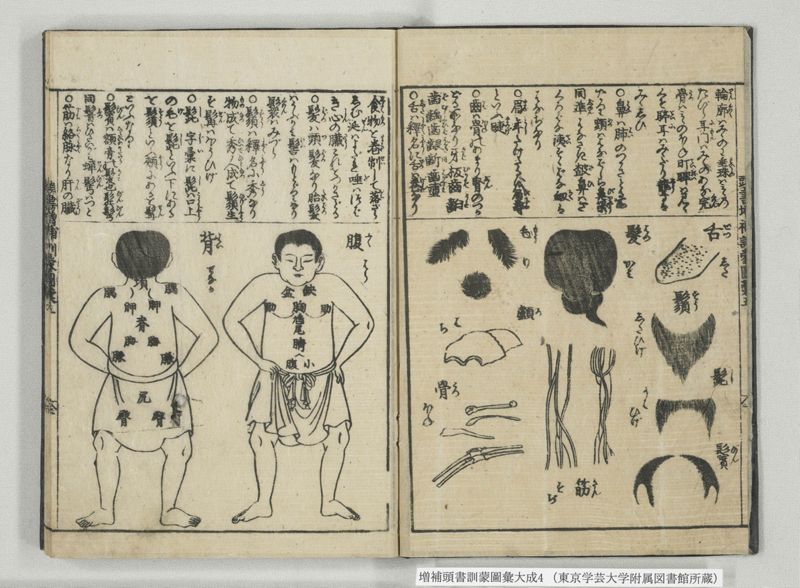
【右丁下段挿絵】
舌(ぜつ)《割書:した》 鬚(しう) 髭(し) 鬢(びん)
《割書:したひげ| 》 《割書:うは| ひげ》
髪(はつ)《割書: |かみ》 筋(きん)《割書:す| ぢ》
毛(もう)《割書: |け》 顱(ろ)《割書:は| ち》 骨(こつ)《割書: |ほね》
【左丁下段挿絵】
腹(ふく)《割書:はら》
肋
《割書:缺|盆》 胸 鳩尾 臍 《割書:小|腹》
肋
背(はい)《割書:せなか》
腢 膁 臀
胛 脢
項 脊 尻
胛 脢
腢 膁 臀
【注 「𡏋」は寛文版は「垽」】
現代語訳
【右丁上段】
輪廓(りんかく)は耳の輪、垂珠(すいしゅ)は耳の
たぶ、耳門(じもん)は耳の穴、完骨(かんこつ)
は耳の骨、耵聹(ていねい)は耳
垢、聤耳(ていじ)は耳だれ、聾(ろう)は
耳が聞こえないこと
○鼻(はな)は肺が司る所
である。頞(あつ)は鼻柱、鼻梁(びりょう)
も同じ。準(じゅん)は鼻先、皶鼻(さび)はざ
くろ鼻、洟(てい)は鼻水、衂(ちく)は
鼻血である
○眉(まゆ)年を取ったのを眉寿(びじゅ)
という。睫(まつげ)
○歯(は)は骨の余り、腎が司
る所である。牙(きば)、板歯(前歯)、臼
歯(うすば)、齲歯(虫歯)、齦(はぐき)、齗(同じく歯茎)
○舌(した)は『釈名』に舌は巻くことなり
【左丁上段】
食物を巻き取って落ちない
ようにする。涎(ぜん)はよだれ、唾(だ)はつば
き、心臓がこれを司る
○髪(はつ)は頭髪である。胎髪(たいはつ)
は産毛、髻(けい)は髷(まげ)である
鬟(かん)はみずら
○鬚(しゅう)は『釈名』に秀(しゅう)なり
物が成って秀で、人が成って鬚(ひげ)が生
える。髯(ぜん)は頬ひげ
○髭(し)『字彙』に髭(し)は口の上
の毛を髭(し)という。下にある
を鬚(しゅう)という。頬にあるを髯(ぜん)
というのである
○鬢(びん)は額の横の髪である。鬂(びん)髩(びん)
も同じ。䭮(ふつ)は額髪、蝉髩(せんびん)はつと
○筋(すじ)は絡脈である。肝臓が
【右丁下段挿絵】
舌 鬚(下ひげ) 髭(上ひげ) 鬢
髪 筋
毛 頭蓋骨 骨
【左丁下段挿絵】
腹
肋骨
缺盆 胸 鳩尾 臍 小腹
肋骨
背中
腢 膁 臀部
肩甲骨 脢
項 脊椎 尻
肩甲骨 脢
腢 膁 臀部
英語訳
【Right Page Upper Section】
The rim (rinkaku) is the outer edge of the ear, the earlobe (suishu) is the ear
lobe, the ear gate (jimon) is the ear canal, the complete bone (kankotsu)
is the ear bone, cerumen (teinei) is ear
wax, ear discharge (teiji) is ear drainage, deafness (rō) is
inability to hear
○The nose is what the lungs
govern. Atsu is the nasal bridge, nasal beam (biryō)
is the same. Jun is the nose tip, sabi-nose is pome-
granate nose, tei is nasal mucus, chiku is
nosebleed
○Eyebrows (mayu): advanced age is called eyebrow longevity (biju).
Eyelashes (matsuge)
○Teeth are the surplus of bones, what the kidneys
govern. Fangs (kiba), front teeth (maeba), molar
teeth (usuba), decayed teeth (mushiba), gums (haguki), gums (same)
○Tongue: according to "Shakumyō," the tongue means to roll
【Left Page Upper Section】
It rolls up food so it doesn't
fall. Saliva (zen) is drool, saliva (da) is spit-
tle, the heart governs this
○Hair (hatsu) is head hair. Fetal hair (taihatsu)
is fine baby hair, topknot (kei) is a hair knot
Kan is mizura (ancient hairstyle)
○Beard (shū): according to "Shakumyō" it means excellence (shū)
Things mature and excel, people mature and beards
grow. Zen is cheek whiskers
○Mustache (shi): "Jii" says mustache (shi) refers to
hair above the mouth as mustache (shi). What is below
is called beard (shū). What is on the cheeks is called whiskers (zen)
○Sideburns (bin) are hair at the sides of the forehead. Bin and bin
are the same. Futsu is forehead hair, sembin is tsuto
○Sinews (suji) are connecting vessels. The liver
【Right Page Lower Section Illustration】
Tongue Beard (lower whiskers) Mustache (upper whiskers) Sideburns
Hair Sinews
Body hair Skull Bone
【Left Page Lower Section Illustration】
Abdomen
Ribs
Clavicle area Chest Solar plexus Navel Lower abdomen
Ribs
Back
Upper back Lower back Buttocks
Shoulder blade Middle back
Nape Spine Buttocks
Shoulder blade Middle back
Upper back Lower back Buttocks