翻刻
【右丁】
色(いろ)あをし七 葉あり魂(こん)のかくるゝ所なり○膽(たん)は肝(かん)の臓(さう)の腑(ふ)なり肝(かん)の下に有
膽(たん)のぼるときは人いかりを生(しやう)ず○小腸(しやうちやう)は心(しん)の臓(さう)の腑(ふ)なり色(いろ)あかし小便(しやうべん)
これよりつたへて膀胱(ばうくはう)にいづるなり○大腸(だいちやう)は肺(はひ)のさうの腑(ふ)なり腰(こし)にあり
十六 廻(くわい)あり色(いろ)しろしはらわたといふはこれなり○胃(ゐ)は脾(ひ)のざうの腑(ふ)なり食(しよく)
物を脾(ひ)よりつたへて大腸(だいちやう)にをくるくそぶくろなり○包絡(はうらく)は心包絡(しんはうらく)なり命門(めいもん)
の下 右腎(うじん)の上にあり心包絡(しんはうらく)といふその腑(ふ)を三 焦(せう)といふ○膀胱(はうくはう)は腎(じん)の臓(ざう)の腑(ふ)
なり小便(しやうべん)ぶくろなり水分(すいぶん)の穴にて水穀(すいこく)分利(ぶんり)して穀(こく)は大腸(たいちやう)へゆき水(みづ)は膀胱(ばうくはう)
へゆくなり
○臓腑(ざうふ)心(しん)肝(かん)腎(じん)肺(はい)脾(ひ)を五 臓(ざう)といふ小腸(しやうちやう)大腸(だいちやう)胃(ゐ)膀胱(ばうくはう)三 焦(せう)膽(たん)を六 腑(ふ)と
いふ○胞胎(はうたひ)はらごもりなり五 臓論(ざうろん)に曰一月は珠露(たまつゆ)のごとし二月は桃花(もゝのはな)のごと
し三月は男女(なんによ)わかる四月は形象(かたち)そなはる五月は筋(すぢ)骨(ほね)なる六月は毛(け)髪(かみ)生(しやう)ず
七月はその魂(こん)をあそはしむ兒よく左(ひだり)の手(て)をうごかす八月はその魄(はく)をあそばしむ
兒(に)よく右(みぎ)の手(て)をうごかす九月は三たび身(み)を転(てん)す十月は気(き)をうくる事 足(たる)
【左丁】
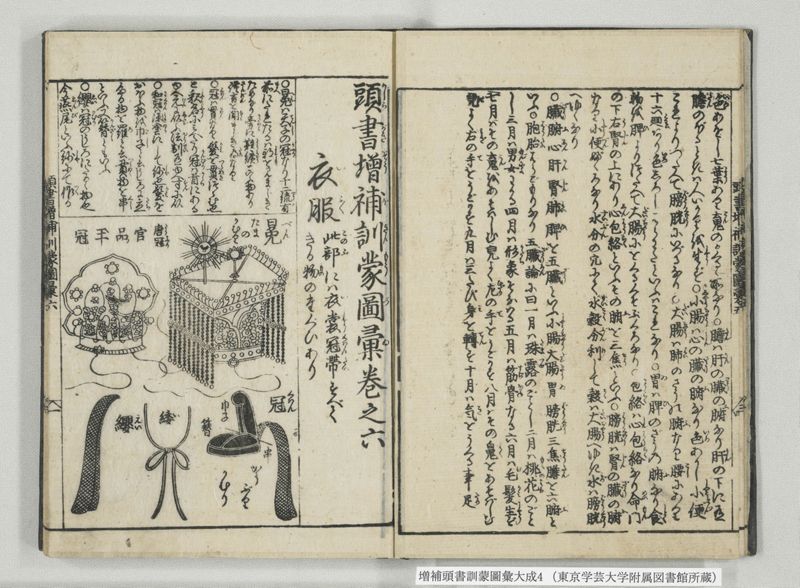
《題:頭書増補訓蒙図彙(かしらがきぞうほきんもうづゐ)巻之六》
衣服(いふく)《割書:此部(このぶ)には衣裳(いしやう)冠帯(くはんたい)すべて|きる物(もの)のたぐひあり》
【左丁上段】
○冕(へん)は天子(てんし)の冠(かふり)なり十二 𦀠(りう)有
前(まへ)にたれたるは邪(よこしま)を見まじき
ためなり旁(かたはら)に黈纊(とうくはう)といふ物あり
讒言(さんげん)を聞(きゝ)まじき為(ため)なり
○冠(くはん)は貫(くはん)なり髪(かみ)を貫(つらぬき)つゝむ也
と釈名(しやくみやう)にみへたり冠(かんむり)は首(かしら)にある
ゆへ元(けん)に从(したが)ふ法制(ほうせい)有ゆへ寸(すん)に从
○和冠(わくはん)は漆塗(うるしぬり)にして紗(しや)也 髪(かみ)を
おほふ物を巾子(こし)と云うしろに立(たち)
たる物を羅(ろ)と云 貫(つらぬく)物を串(くし)
といふ又 簪(かんざし)ともいふ
○纓(ゑい)は冠(かむり)のうしろにたるゝ物也
今 燕尾(ゑんび)といふ紗(しや)にて作(つく)る
【左丁下段挿絵】
冕(べん)
《割書:たま| の|かむり》
唐冠(たうかふり)
《割書:官|品 ̄ノ|玉-|冠》
冠(くはん)
串
かうぶり
巾子 かむり
簪
緌(い)
纓(えい)
現代語訳
【右丁】
色は青い。七葉がある。魂が隠れる所である。○胆は肝の臓に属する腑である。肝の下にある。
胆が上ると人は怒りを生じる。○小腸は心の臓に属する腑である。色は赤い。小便は
これより伝わって膀胱に出るのである。○大腸は肺の臓に属する腑である。腰にある。
十六回(の曲がり)がある。色は白い。はらわたというのはこれである。○胃は脾の臓に属する腑である。食べ
物を脾より伝えて大腸に送る。くそぶくろである。○包絡は心包絡である。命門
の下、右腎の上にある。心包絡という、その腑を三焦という。○膀胱は腎の臓に属する腑
である。小便袋である。水分の穴にて水穀を分利して、穀は大腸へ行き、水は膀胱
へ行くのである。
○臓腑 心・肝・腎・肺・脾を五臓という。小腸・大腸・胃・膀胱・三焦・胆を六腑と
いう。○胞胎はお腹の中の赤ちゃんである。五臓論に曰く、一月は珠露のごとし、二月は桃の花のごと
し、三月は男女が分かる、四月は形が備わる、五月は筋骨になる、六月は毛髪が生じる、
七月はその魂を備えさせる、子はよく左の手を動かす、八月はその魄を備えさせる、
子はよく右の手を動かす、九月は三たび身を転ずる、十月は気を受けることが足りる。
【左丁】
《題:頭書増補訓蒙図彙 巻之六》
衣服《この部には衣裳・冠帯すべて着る物の類がある》
【左丁上段】
○冕は天子の冠である。十二旒がある。
前に垂れているのは邪なものを見ないため
である。傍らに黈纊という物がある。
讒言を聞かないためである。
○冠は貫である。髪を貫き包むのだと
『釈名』に見える。冠は頭にある
ゆえ元に従う。法制があるゆえ寸に従う。
○和冠は漆塗りにして紗である。髪を
覆う物を巾子という。後ろに立っている
物を羅という。貫く物を串
という。また簪ともいう。
○纓は冠の後ろに垂れる物である。
今、燕尾という。紗にて作る。
【左丁下段挿絵】
冕
《玉の冠》
唐冠
《官品の玉冠》
冠
串
こうぶり
巾子 かむり
簪
緌
纓
英語訳
【Right Page】
The color is blue. It has seven lobes. It is where the soul hides. ○The gallbladder is a bowel belonging to the liver organ. It is under the liver.
When the gallbladder rises up, people generate anger. ○The small intestine is a bowel belonging to the heart organ. Its color is red. Urine
passes through this and emerges into the bladder. ○The large intestine is a bowel belonging to the lung organ. It is in the lower back.
It has sixteen turns. Its color is white. What is called "intestines" is this. ○The stomach is a bowel belonging to the spleen organ. It transmits food
from the spleen and sends it to the large intestine. It is the excrement bag. ○The pericardium is the heart pericardium. It is below the gate of life
and above the right kidney. What is called the heart pericardium - its bowel is called the triple heater. ○The bladder is a bowel belonging to the kidney organ.
It is the urine bag. At the water division point, it separates water and grain, so grain goes to the large intestine and water goes to the bladder.
○Organs and bowels: Heart, liver, kidneys, lungs, and spleen are called the five organs. Small intestine, large intestine, stomach, bladder, triple heater, and gallbladder are called the six bowels.
○The womb contains the unborn child. The Five Organ Theory says: In the first month it is like pearl dew, in the second month it is like peach blossoms,
in the third month male and female are distinguished, in the fourth month the form is complete, in the fifth month it becomes sinews and bones, in the sixth month hair grows,
in the seventh month it is endowed with soul - the child can move its left hand well, in the eighth month it is endowed with spirit -
the child can move its right hand well, in the ninth month it turns three times, in the tenth month it has received sufficient qi.
【Left Page】
《Title: Illustrated Dictionary for Beginners with Supplementary Headnotes, Volume 6》
Clothing and Garments《This section contains garments, caps and sashes - all types of things to wear》
【Left Page Upper Section】
○The ceremonial crown is the emperor's cap. It has twelve hanging strings.
What hangs in front is to prevent seeing
evil things. At the sides there is something called yellow silk floss.
This is to prevent hearing slanderous words.
○"Crown" means "to pierce through." It pierces through and wraps the hair, as
seen in "Explaining Names." Since the crown is on the head,
it follows the "yuan" (head). Since there are legal regulations, it follows the "cun" (inch).
○The Japanese crown is lacquered and made of gauze. What
covers the hair is called "koshi." What stands up
in the back is called "ra." What pierces through is called "kushi"
(comb). It is also called "kanzashi" (hairpin).
○The cord is what hangs from the back of the crown.
Now it is called "swallowtail." It is made of gauze.
【Left Page Lower Section Illustration】
Ceremonial crown
《jeweled crown》
Tang dynasty cap
《jeweled crown of official rank》
Crown
Pin
Cap
Hair cover Crown
Hairpin
Tassel
Cord