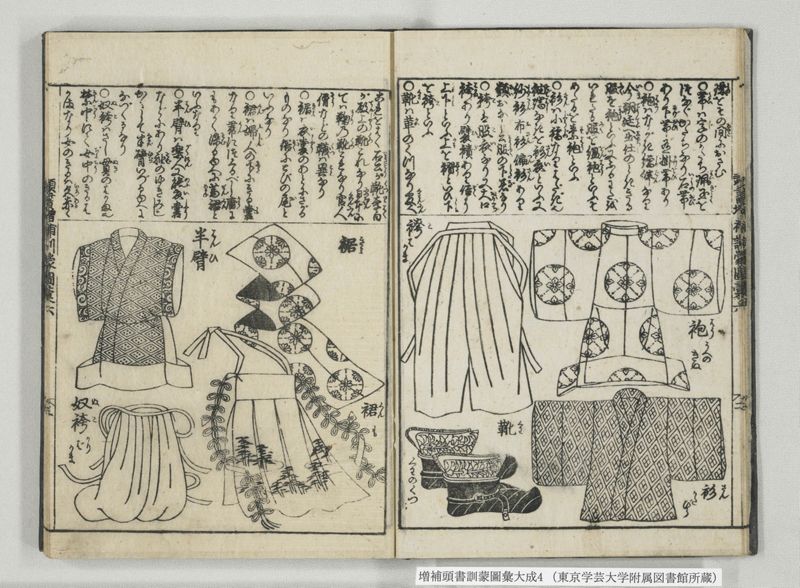
翻刻
【右丁上段】
珠(しゆ)をその間(あいた)におさむ
○帯(たい)は字(じ)のかたち珮玉(はいぎよく)を
つなぐかたちなり石帯(いしのおび)
あり下帯(さげおび)有 掛帯(かけをび)あり
○袍(はう)はながき繻絆(じゆばん)なり
今(いま)朝廷(てうてい)へ出仕(しゆつし)のとききる
服(ふく)を袍(はう)といふ又ふるわたを
いれたる服(ふく)を縕袍(をんはう)といふそ
めたるを素袍(すはう)といふ
○衫(さん)は小襦(しやうじゆ)なりはだぎ也
袖端(そではし)なきを衫衣(さんい)といふ又
紗衫(しやさん)布衫(ふさん)偏衫(へんさん)あり
類(るい)おなじ公服(こうふく)の下着(したぎ)なり
○袴(こ)は股衣(こい)なり又 大口(おほくち)
袴(はかま)あり襞襀(ひだ)あり俗(ぞく)に
上下(かみしも)といふ上(かみ)を褶(しう)といひ下(しも)
を袴(こ)といふ
○靴(くわ)は革(かは)のくつなり官人(くわんにん)
【左丁上段】
これをはく石公(せきこう)が靴(くつ)李白(りはく)
が殿上(てんじやう)の靴(くつ)これなり日本(につほん)に
ては鞠(まり)の靴(くつ)これなり官人(くはんにん)
僧(そう)などの韈(くつ)は異(こと)なり
○裾(きよ)は衣裳(いしやう)のあとにさがる
ものなり俗(ぞく)にとびの尾(お)と
いふなり
○裙(くん)は婦人(ふじん)の下(した)にきる裳(も)
なり帬(くん)につくるべし唐(から)に
もあかく染(そむ)るゆへに茜(せん)【左ルビ:あかね】裙(くん)と
いふなり
○半臂(はんひ)は楽人(がくにん)又 能衣裳(のふいしやう)
などにあり袖(そで)のゆきみじ
かくして半(なかば)臂(ひぢ)いづるゆへに
なづくるなり
○奴袴(ぬこ)はさし貫(ぬき)のはかま也
禁中(きんちう)にて女中(ぢよちう)のきるは
かまなり女のきるは色(いろ)赤(あか)く
【右丁下段挿絵】
袍(はう)《割書:うへの| きぬ》 衫(さん)《割書:かた| びら》
袴(こ)《割書:は| かま》 靴(くわ)《割書:く【かの誤ヵ】わのくつ》
【左丁下段挿絵】
裾(きよ) 裙(くん)《割書:も》
半臂(はんひ) 奴袴(ぬこ)《割書:かり| ば| かま》
現代語訳
【右丁上段】
珠をその間に納める。
○帯は文字の形が珮玉を
つなぐ形である。石帯
がある。下帯がある。掛帯がある。
○袍は長い襦袢である。
今、朝廷へ出仕する時に着る
服を袍という。また古い綿を
入れた服を縕袍といい、染めた
ものを素袍という。
○衫は小襦である。肌着である。
袖端がないものを衫衣という。また
紗衫、布衫、偏衫があり、
種類は同じで公服の下着である。
○袴は股衣である。また大口
袴がある。襞がある。俗に
上下という。上を褶といい、下
を袴という。
○靴は革の靴である。官人が
【左丁上段】
これを履く。石公の靴、李白が
殿上で履いた靴がこれである。日本で
は蹴鞠の靴がこれである。官人や
僧などの履物は異なる。
○裾は衣裳の後ろに下がる
ものである。俗にとびの尾と
いうものである。
○裙は婦人が下に着る裳
である。帬と書くべきである。中国で
も赤く染めるので茜裙と
いうのである。
○半臂は楽人または能の衣装
などにある。袖の行きが短
くして半分まで肘が出るので
そう名付けるのである。
○奴袴は差貫の袴である。
禁中で女中が着る
袴である。女性が着るものは色が赤く
【右丁下段挿絵】
袍《上の着物》 衫《肩衣》
袴《袴》 靴《革の靴》
【左丁下段挿絵】
裾 裙《裳》
半臂 奴袴《狩袴》
英語訳
【Right Page Upper Section】
Pearls are stored in the spaces between them.
○The "tai" (belt) has characters shaped like
connected jade ornaments. There are stone belts,
lower belts, and hanging belts.
○The "hou" is a long undergarment.
Now, the clothing worn when attending
court is called "hou." Also, clothing stuffed
with old cotton is called "on-hou," and dyed
ones are called "su-hou."
○The "san" is a small undergarment. It is underwear.
Those without sleeve ends are called "san-i." There are also
"sha-san," "fu-san," and "hen-san,"
which are of the same type and serve as undergarments for court dress.
○"Hakama" are leg coverings. There are also "ōguchi"
hakama. They have pleats. Commonly called
"kamishimo," the upper part is called "shū" and the lower
part is called "hakama."
○"Kutsu" are leather shoes. Officials
【Left Page Upper Section】
wear these. The shoes of Sekikō and the shoes
Li Bai wore in the palace hall are of this type. In Japan,
kemari (kickball) shoes are of this type. The footwear of officials and
monks differs.
○"Kyo" (hem) is what hangs down at the back
of clothing. It is commonly called
a kite's tail.
○"Kun" is the lower garment that
women wear. It should be written as "kun." In China
too, since they dye it red, it is called
"akane-kun" (madder skirt).
○"Han-hi" is found in musicians' clothing or Noh costumes.
The sleeves are made short
so that half the elbow shows, hence
the name.
○"Nuko" are hakama worn pulled up.
They are hakama worn by female attendants
in the imperial palace. Those worn by women are red in color.
【Right Page Lower Section Illustration】
Hou《upper garment》 San《shoulder wear》
Hakama《hakama》 Kutsu《leather shoes》
【Left Page Lower Section Illustration】
Kyo (hem) Kun《lower garment》
Han-hi Nuko《hunting hakama》