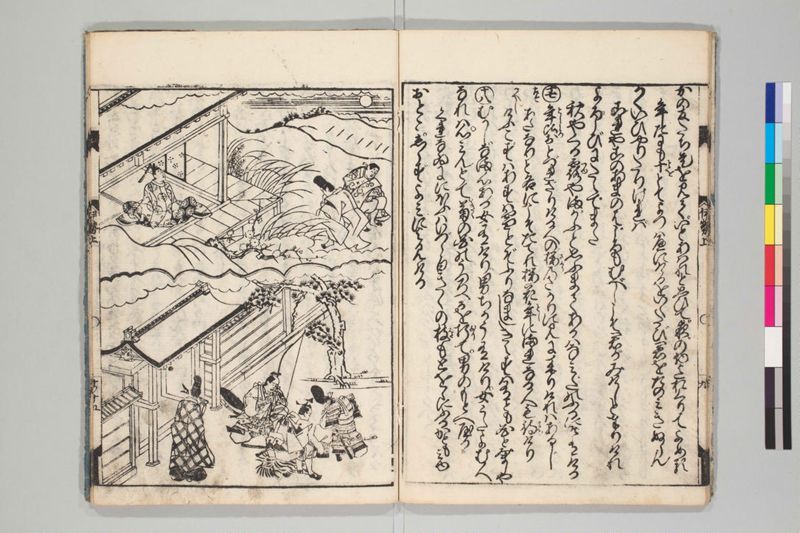
翻刻
【右丁】
かの友たち是を見て。いとあはれと思ひて。夜の物迄おくりてよめる
年たにも十(とを)とてよつはへにけるをいくたび君をたのみきぬらん
かくいひやりたりければ
これやこのあまのはごろもむべしこそ君がみけしと奉りけれ
よろこびにたえでまた
秋やくる露(つゆ)やまがふと思ふまであるはなみだのふるにそ有ける
「十七」年比(としころ)おとづれざりける人の桜(さくら)のさかりに見に来りけれは。あるじ
《送り仮名:古今》あたなりと名にこそたてれ桜花 年(とし)にまれなる人も待(まち)けり
《送り仮名:かへし》けふこずはあすは雪とぞふりなましきえすは有とも花とみましや
「十八」むかし。なま心ある女有けり。男ちかう有けり。女うたよむ人
なれは。心みんとて。菊(きく)の花のうつろへるを折(おり)て。男のもとへやる
くれなゐににほふはいづら白きくの枝(えた)もとをゝにふるかともみゆ
おとこ。しらずよみによみける
【左丁】
【挿絵】
現代語訳
【右丁】
(第十六段、続き)
その友人はこれを見て、たいそう哀れに思って、夜具までも送り届けて詠んだ歌、
*年さえも 十(とを)とて四つは 経にけるを いくたび君を たのみきぬらん*
(年月でさえ、十年・十年と数えて四十年が経ってしまったのに、その長い間、どれほど多くあなた(有常)を頼りにしてきたことだろうか)
このように(歌を)送ってきたので、(有常は)返歌として、
*これやこの 天の羽衣 むべしこそ 君が御衣(みけし)と 奉りけれ*
(これこそまさに天の羽衣というものよ――なるほど、あなたの(贈ってくださった)お召し物として謹んでお受け申し上げます)
(友人は)喜びに堪えられず、さらに(もう一首詠んだ)、
*秋や来る 露やまがふと 思ふまで あるは涙の ふるにぞありける*
(秋が来たのか、露と見紛うほどだと思うほどに、(降りかかっているのは)実は涙が降っているのであったよ)
【第十七段】
長年便りをよこさなかった人が、桜の盛りに(花見に)来たので、家の主人(あるじ)が詠んだ、
*あだなりと 名にこそたてれ 桜花 年にまれなる 人も待ちけり*
(浮気だと評判に立っているよ、桜の花は――(それでも)年にまれにしか来ないあなたのことも、(この桜は)待っていたのだよ)
(返し)
*今日来ずは 明日は雪とぞ ふりなまし 消えずはあれども 花と見ましや*
(もし今日来なかったら、明日は雪のように散ってしまったことだろう。たとえ(花が)散らずに残ってはいても、それを花と見ることができようか、いや、できなかっただろう)
【第十八段】
昔、なまめかしい心のある女がいた。(その)男が近くにいた。女は歌を詠む人であったので、(男を)試してみようとして、菊の花の色あせたものを折って、男のもとへ送った(歌)、
*紅に 匂ふはいづら 白菊の 枝もとをとに ふるかとも見ゆ*
(紅に色づいて美しく輝いているのはどこかしら――白菊の枝がしなやかにたわむほど(露が)ふりかかっているのかとも見える)
男は(ためらうことなく)すらすらと詠んだ。
【左丁】
【挿絵】
英語訳
【Right Page】
(Section 16, continued)
The friend, seeing this, was deeply moved, and sent even bed-clothes as a gift, composing:
*Toshi dani mo / tō tote yottsu wa / heni keru wo / ikutabi kimi wo / tanomi ki nu ran*
(Even the years — counting ten, then ten again — have passed to forty; how many times over those years must I have depended upon you?)
Having received this poem, (Aritsune replied):
*Kore ya kono / ama no hagoromo / mube shi koso / kimi ga mikeshi to / tatematsuri kere*
(Ah, this must be the Heavenly Feather Robe itself — how right it is that I should reverently receive this as your gracious garment.)
Unable to contain his joy, the friend composed yet another poem:
*Aki ya kuru / tsuyu ya magau to / omou made / aru wa namida no / furu ni zo ari keru*
(I wondered whether autumn had come, or whether this was dew, so much did it seem so — but what was falling was, in truth, my own tears.)
【Section 17】
A person who had not sent word for many years came to view the cherry blossoms at their peak. The host composed:
*Ada nari to / na ni koso tatere / sakura bana / toshi ni mare naru / hito mo machi keri*
(Fickle is the name the cherry blossoms have earned — yet even for you, who come but rarely in a year, they have waited.)
(Reply)
*Kyō kozuba / asu wa yuki to zo / furinamashi / kiezu wa aredo / hana to mimashi ya*
(Had you not come today, tomorrow they would have fallen like snow. Even had they remained without scattering, could one truly have called them blossoms worth seeing? No — one could not.)
【Section 18】
Long ago, there was a woman of knowing heart. A man lived nearby. Since the woman was one who composed poetry, wishing to put him to the test, she broke off a faded chrysanthemum blossom and sent it to the man with this poem:
*Kurenai ni / niou wa izura / shiragiku no / eda mo tawotao ni / furu ka to mo miyu*
(Where is that which glows so beautifully in crimson? — The white chrysanthemum's branches seem to bend beneath the weight of what falls upon them, as though showered with dew.)
The man composed a poem in reply with easy fluency.
【Left Page】
【Illustration】